Lab-grown diamonds are becoming increasingly popular among Japanese consumers for their diverse designs and competitive prices compared to natural diamonds, with Chinese-made gems being particularly favored in the Japanese market for their high quality.
The International Jewelry Tokyo 2025, held from Wednesday to Saturday, saw the participation of 11 lab-grown diamond companies from Japan and abroad, including four from China. The exhibition booths of Chinese companies attracted numerous jewelry merchants from around the world for inquiries and orders.
Some Japanese jewelry merchants have said that Chinese lab-grown diamonds are becoming increasingly favored by Japanese consumers due to their higher color grades and clarity.
"China excels in producing diamonds using high pressure and high temperature (HPHT) technology, with a high production volume and a significant price advantage. It also possesses advanced chemical vapor deposition (CVD) technology. There are numerous companies in the country capable of manufacturing high-quality lab-grown diamonds," said Takuya Ito, the head of a Japanese lab-grown diamond import company.
With quality approaching that of natural diamonds and the price advantage they offer, lab-grown diamonds have swiftly emerged as one of the primary raw materials for jewelry products, with a notable preference for those exceeding one carat and featuring unique shapes and vibrant colors.
In 2021, a department store in the Ginza district of downtown Tokyo launched a jewelry brand featuring lab-grown diamonds. According to sales personnel, customers have become more open to the concept, especially as they discover how lab-grown diamond jewelry showcases bolder cutting techniques and a more diverse range of designs compared to the relatively conservative styles of natural diamond jewelry.
"Three years ago, when the brand was first established, we often had to explain what lab-grown diamonds are to our customers. But recently, it seems that more and more people are familiar with lab-grown diamonds. I believe that natural diamonds and lab-grown diamonds are not in competition but represent different choices. In the future, the number of consumers willing to consider lab-grown diamonds when purchasing engagement rings may increase," said Ruriko Watanabe, the head of a Japanese lab-grown diamond jewelry brand.
"Lab-grown diamonds are cheaper than natural diamonds, and there is hardly any visible difference in appearance. Additionally, the designs and styles of lab-grown diamonds are quite diverse. I am willing to consider purchasing lab-grown diamond jewelry," said a consumer.
"Since lab-grown diamonds are more affordable, I would like to try large and extravagant lab-grown diamond jewelry," another customer said.
Some industry insiders in the Japanese jewelry sector noted that lab-grown diamonds had a late start in the Japanese jewelry industry, with the current market share standing at only around two percent.
As awareness and acceptance of lab-grown diamonds continue to grow among Japanese consumers, there is significant potential for the future development of lab-grown diamonds.

Lab-grown diamonds shine brighter in Japan's consumer market
Chinese Foreign Minister Wang Yi said on Tuesday that mediation efforts of the Pakistani side regarding the Middle East tensions are in the common interests of all parties.
Wang, also a member of the Political Bureau of the Communist Party of China Central Committee, made the remarks in his talks with Pakistani Deputy Prime Minister and Foreign Minister Mohammad Ishaq Dar in Beijing.
During their talks, the two sides exchanged views on current international issues and regional conflicts.
Wang welcomed the visit of the Pakistani side to Beijing for discussion on easing tensions in the Middle East, just after its holding of a quadrilateral foreign ministers' meeting in Islamabad.
He said China supports and looks forward to Pakistan playing a unique and important role in easing the situation and resuming peace talks. This process is no easy task, and Pakistan's mediation efforts are in line with the common interests of all parties, Wang added.
He noted China is willing to make joint efforts with Pakistan to end the hostilities as soon as possible, create opportunities for peace and open the window for peace talks.
On bilateral ties, Wang said this year marks the 75th anniversary of the establishment of diplomatic relations between China and Pakistan, calling on both sides to implement the important consensus reached by the leaders of the two countries and constantly advance the building of a China-Pakistan community with a shared future.
For his part, Dar said the Pakistan-China friendship is precious and deeply rooted in people's hearts, adding that Pakistan is willing to work with China to promote the continuous development of the all-weather strategic cooperative partnership between the two countries.
Dar thanked China for supporting Pakistan's mediation of the situation in Iran, adding that the current conflict has disrupted international energy supplies and caused heavy damage to developing countries.
Noting that solutions can only be found through negotiation, Dar said Pakistan is willing to strengthen communication and coordination with China to push all parties to start peace talks as soon as possible and restore regional peace.
The two sides also put forward a five-point initiative for restoring peace and stability in the Gulf and the Middle East region:
I. Immediate cessation of hostilities: China and Pakistan call for immediate cessation of hostilities and utmost efforts to prevent the conflict from spreading. Humanitarian assistance must be allowed to all war-affected areas.
II. Start of peace talks as soon as possible. Sovereignty, territorial integrity, national independence and security of Iran and the Gulf states should be safeguarded. Dialogue and diplomacy is the only viable option to resolve conflicts. China and Pakistan support the relevant parties in initiating talks, with all parties committing to peaceful resolution of disputes, and refraining from the use or the threat of use of force during peace talks.
III. Security of nonmilitary targets. The principle of protecting civilians in military conflict should be observed. China and Pakistan call on parties to the conflict to immediately stop attacks on civilians and nonmilitary targets, and fully adhere to International Humanitarian Law, and stop attacking important infrastructure, including energy, desalination and power facilities, and peaceful nuclear infrastructure, such as nuclear power plants.
IV. Security of shipping lanes. The Strait of Hormuz, together with its adjacent waters, is an important global shipping route for goods and energy. China and Pakistan call on the parties to protect the security of ships and crew members stranded in the Strait of Hormuz, allow the early and safe passage of civilian and commercial ships, and restore normal passage through the Strait as soon as possible.
V. Primacy of the United Nations Charter. China and Pakistan call for efforts to practice true multilateralism, to jointly strengthen the primacy of the United Nations, and to support the conclusion of an agreement for establishing a comprehensive peace framework and realizing lasting peace based on the purposes and principles of the UN Charter and international law.
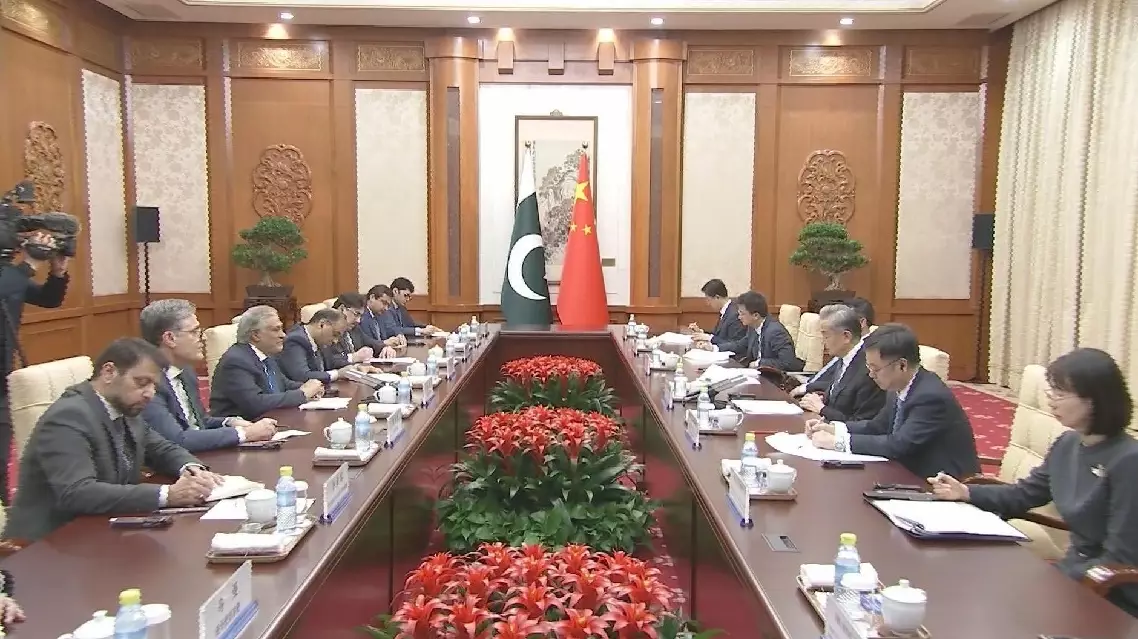
Pakistan's mediation efforts in common interests of all parties: Chinese FM
Pakistan's mediation efforts in common interests of all parties: Chinese FM