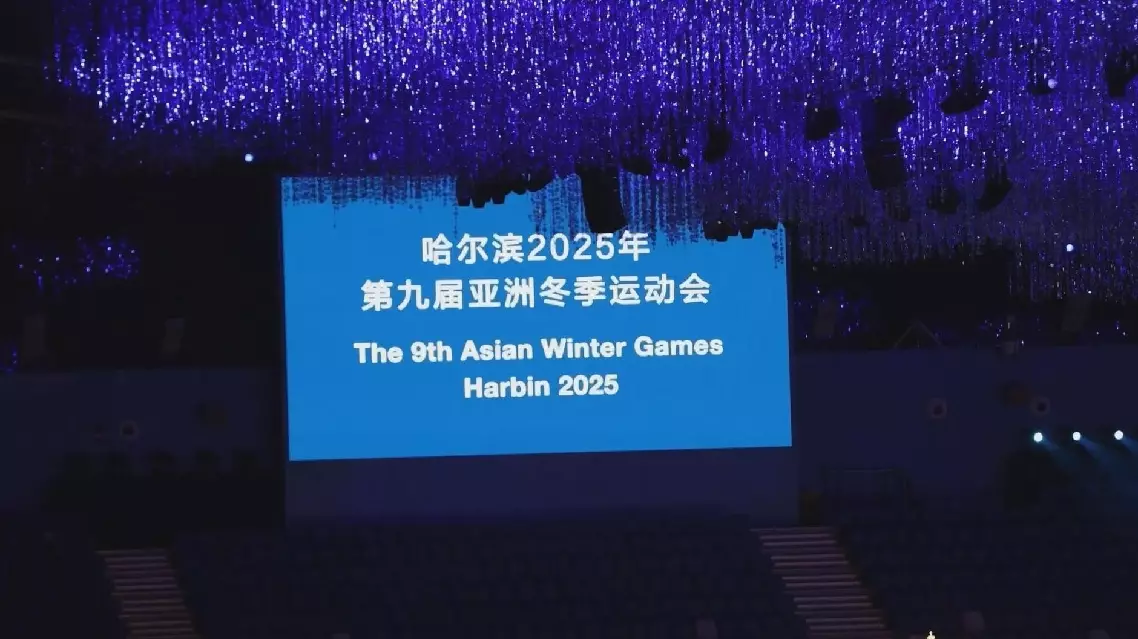
China's "ice city" Harbin is preparing to stun international audience with a technologically innovative and culturally rich opening ceremony of the upcoming 9th Asian Winter Games.
The annual continental sports event is slated to open on February 7 with a spectacular show at the Harbin International Conference, Exhibition and Sports Center.
The opening ceremony, centering around the official slogan of the Games, "Dream of Winter, Love among Asia," will highlight the concept of connecting Asian countries through ice and snow, creating new growth opportunities for winter economy, and promoting cultural exchanges between Asian countries.
With rehearsals for the opening and closing ceremonies underway, Sha Xiaolan, the chief director, told China Media Group (CMG) that the overall progress has been very smooth.
"Since we entered the venue in November, we have completed the building of the audio, light and electric equipment for the entire stage. After more than a month of work, our producing team and performers started on-site preparation. Generally, the rehearsals have gone smoothly, with modifications made for some parts. In the next step, we will hold more rehearsals to further polish the show, with the focus on further improving the interaction between multimedia images, performers and lightings," said Sha.
Sha and his creative team were responsible for the opening and closing ceremonies of major international sporting events, including the Beijing 2008 Olympics, the Beijing 2022 Winter Olympics, and the Hangzhou Asian Games in 2023.
The experienced producers promised audience an audio-visual feast featuring the use of technologies and the innovative presentation of Harbin's cultural heritages and customs.
"Technologies enable us to organize a 'streamlined, safe and splendid' event. Without lifts or wires, we make the indoor venue a multidimensional space through AR [augmented reality], multimedia and other technological means, aiming to allow the audience to feel the beauty of ice and snow, the beauty of arts closely," said Wu Yan, chief producer of the ceremonies.
"We want to turn the venue into a super meeting room, presenting unlimited creativity in a limited space. In fact, the whole show, as I understand, is to transfer the extreme cold of Harbin's ice and snow into the extreme beauty, the extreme excitement of sports, and finally into the extreme enthusiasm of Asia. With the combination of technology and art, we package the local cultural characteristics of Harbin, such as the intangible cultural heritages and folk customs, in an international and fashion style, to present a large-scale show integrating performance, culture and tourism," said Leng Song, chief copywriter of the ceremonies.
A total of 1,275 athletes from 34 countries and regions, including Cambodia and Saudi Arabia for their Asian Winter Games debut, have registered for Harbin 2025. It is likely to have the most participants ever in the history of the event.
Harbin, the capital city of northeast China's Heilongjiang Province, has a long-standing heritage in ice and snow sports due to its natural snowy conditions during the winter.
The city is going to host the Asian Winter Games for a second time. The first time was in 1996.
China's Harbin to stage high-tech, culture-rich opening ceremony of Asian Winter Games