Iranians have gathered at Tehran's Enghelab Square on Sunday in support of the government after the killing of Iranian Supreme Leader Ayatollah Ali Khamenei in U.S.-Israeli attacks on Saturday.
The Iranian government announced a 40-day mourning period after the report of the leader's death.
"It is our duty as a people to preserve calm and unity, and we must be strong — and we are. Our sorrow is for ourselves, because the Leader has achieved his wish: martyrdom on this path. The armed forces must respond to this act in the most forceful and powerful way possible and avenge this blood," said Minoo, a protester.
"We are in deep mourning, but this heavy grief does not mean we have become weak. Rather, it makes us, the people, more resilient in the face of Iran's enemies," said Fatemeh, another protester.
"The Supreme Leader was like a father to us, and it feels as though we have lost our own father. We call on the armed forces to give a decisive response to this aggression," said Pooya, a local resident.
On Saturday morning, Israel and the United States launched joint attacks on Tehran and several other Iranian cities. Iran responded with missile and drone strikes targeting Israel and U.S. bases across the region.
Several Iranian senior officials, including Chief of Staff of the Iranian Armed Forces Abdolrahim Mousavi, Defense Minister Aziz Nasirzadeh, Secretary of the Defense Council Ali Shamkhani, and Mohammad Pakpour, chief commander of the Islamic Revolutionary Guard Corps, were also killed in the strike.
The Iranian Red Crescent Society said that the strikes hit at least 24 of Iran's 31 provinces, with 201 deaths and 747 injuries reported so far.

Iranians mourn supreme leader's death, vow solidarity
Distinguished Singapore researcher Kishore Mahbubani called on the West to learn to work with China rather than to try to suppress China in a recent interview with CGTN, China’s global TV network.
Kishore Mahbubani, a fellow at the Asia Research Institute of the National University of Singapore, pointed out that some Western media outlets have long framed China's development primarily through the lens of "threat". He argued that what truly deserves vigilance is not China's development itself, but the cognitive bias in how Western societies assess their own judgments.
"Western media often suggests 'what a surprise that China is doing so well, its economy is growing. This is not real.' But what many in the Western media forget is that at the end of the day, China still represents the world's oldest continuous civilization. China has led the world in so many phases of human history. So, the return of China today as one of the most successful societies in the world is a perfectly natural development," he said.
China has prepared itself for major growth.
"Please don't expect the Chinese economy to collapse. Please don't expect the Chinese economy to peak. Instead, with all the investment that China has already made in its infrastructure, in its scientific innovation capabilities, and in its people, with all these investments, China has already prepared itself for another major growth spurt. And that's what the major Western media should look out for," he said.
The West should collaborate with China, as China's growth and its affordable products benefit the global economy, he added.
"Instead of focusing on China as a threat, the West should see that China's economic growth and development is in many ways advancing the human condition. By creating better products, cheaper products, more fulfilling products, China is actually doing the global economy a favor. And the West should learn to work with China rather than to try to suppress China," he said.
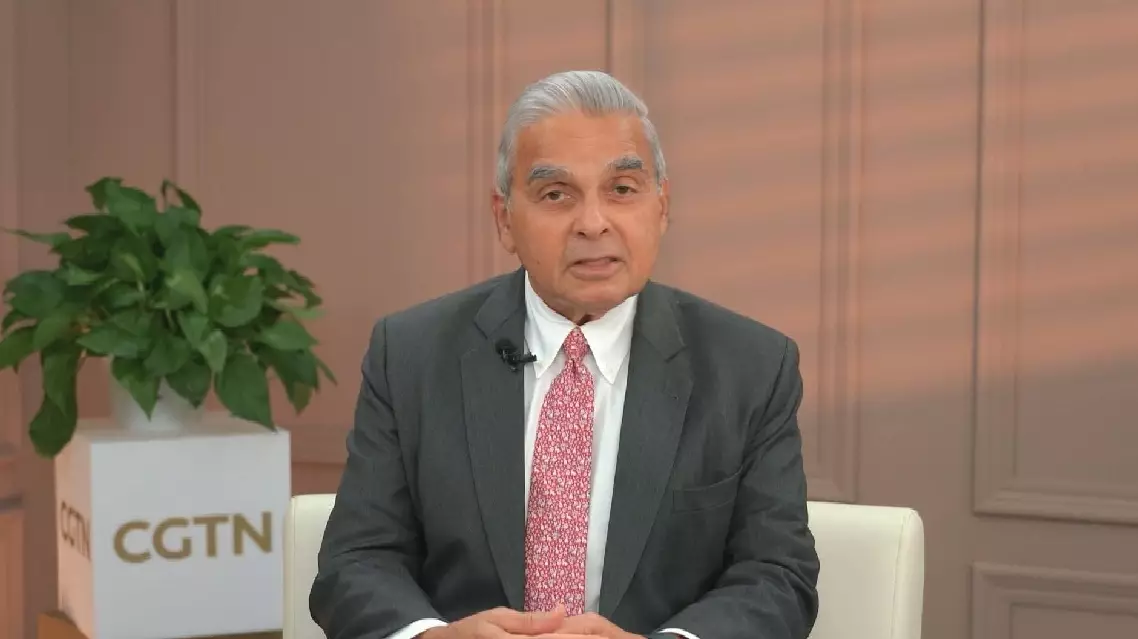
West should learn to work with China rather than to try to suppress China: Singaporean researcher