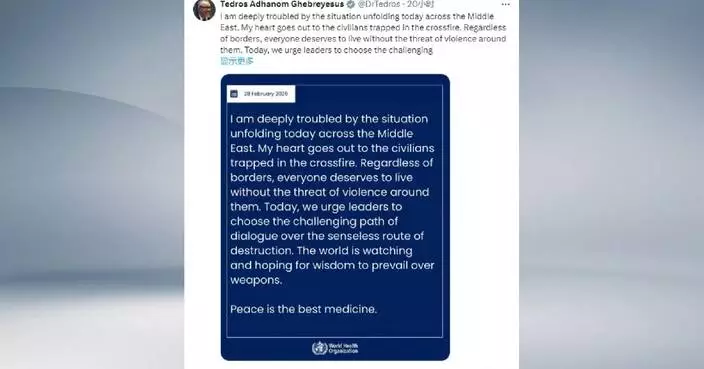
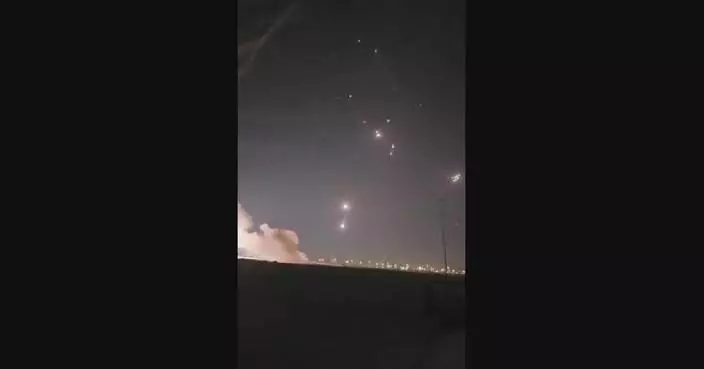
Israel is believed to have orchestrated the airstrikes that killed Iran's Supreme Leader Ayatollah Ali Khamenei via its long-term intelligence infiltration operations targeting Iran, Chinese military affairs commentator Wei Dongxu said, adding that Khamenei's death may intensify Iran's retaliation against Israel and U.S. targets across the Middle East.
Khamenei was killed in U.S.-Israeli attacks on Saturday, Iran's state media confirmed Sunday.
"Based on the public information we have previously obtained, Israel has conducted long-term intelligence infiltration operations targeting Iran. Through such an intelligence network, Israel continuously monitors the movements of Iran's senior officials and leaders to gather information and intelligence. Once the locations of Iran's supreme leader and senior Islamic Revolutionary Guard Corps commanders were confirmed, the joint U.S.-Israeli airstrike operation would commence. Based on information released by various parties, Israel appears to have obtained highly precise intelligence and immediately launched the airstrike," Wei said.
Israel intended to start the large-scale airstrike campaign with a "decapitation operation," according to the expert.
"Given the current situation, Iran has already launched extremely fierce counterattacks against Israeli facilities and U.S. military installations and combat forces in the Middle East. Once a successor emerges within Iran's supreme power structure, they will make public statements. It is believed that the scale of retaliation against Israel and U.S. military forces in the Middle East will expand, and the methods employed will also escalate. It cannot be ruled out that Iran's military forces, including the Islamic Revolutionary Guard Corps, may launch large-scale retaliatory operations against all targets associated with Israel and the United States across the entire Middle East," Wei said.
The United States and Israel on Saturday launched "major combat operations" against Iran, plunging the war-torn Middle East into a new round of violent conflicts.
At least 24 of Iran's 31 provinces were affected by U.S. and Israeli strikes, the Iranian Red Crescent Society reported, adding that at least 201 people were killed and 747 injured in the joint attacks on Iran.
The airstrikes struck a girls' school in southern Iran, and Iranian Foreign Ministry spokesman Esmaeil Baghaei said up to 160 people could have been killed there. Iran's president condemned the incident as "inhumane."

Khamenei's death to intensify Iran's retaliation: expert
Researchers at China's Chongqing University recently announced that a butterfly has successfully emerged from its pupa while orbiting Earth, yielding valuable data on biological survival in the harsh microgravity environment of space.
The butterfly chrysalis was sealed inside a small experimental space ecosystem payload developed by the university's research team and carried into space aboard the Kuaizhou-11 Y8 carrier rocket on Dec. 13, 2025.
Photos taken in space show the emerged butterfly moving inside the capsule, resting on leaves, and fluttering its wings, demonstrating notable adaptation to microgravity.
In order to witness the emergence of butterflies from their chrysalises in space, Professor Xie Gengxin of Chongqing University led a research team to conduct multiple rounds of screening and ultimately selected Swallowtail butterflies as the test subjects.
The selected butterfly species take approximately one to two weeks to transition from larvae to pupae and then to adult butterflies, which aligns with the duration of this on-orbit experiment. Additionally, the chrysalis's structure must withstand the various shocks encountered before and during launch.
"On the day of the launch, there will be intense vibrations. Therefore, when selecting the animals, we had to choose a species capable of enduring the two-week period of darkness and stillness before the launch while also being able to withstand the impact. In the end, we discovered that butterfly chrysalises were a relatively ideal target," said Qiu Dan, deputy chief engineer of the butterfly experiment payload.
The research team's payload, "Shennong Kaichu 2," serves as the "space home" for the butterfly chrysalises. It has a total mass of 8.3 kilograms and an internal usable space of 14.2 liters. In addition to the butterfly chrysalises, the research team also placed a chili plant, soil, water, and other materials inside the payload.
"With leaves on the chili plant, when sunlight shines in, it can carry out photosynthesis and produce oxygen for the little butterfly. We also introduced some microorganisms into the soil. On one hand, they help improve the soil; on the other hand, they can regulate oxygen and carbon dioxide levels while also purifying the air," said Xie, who is also the chief engineer of the butterfly experiment payload.
Data frameshifted back from the space show that technical indicators inside the sealed cabin of the "Shennong Kaiwu-2" payload, including pressure, temperature, and humidity, have remained stable and normal.
The successful hatching and flight of the butterfly in a microgravity environment not only verified the resilience of life on Earth but also provided important reference for life-support technologies in future long-term deep-space exploration.
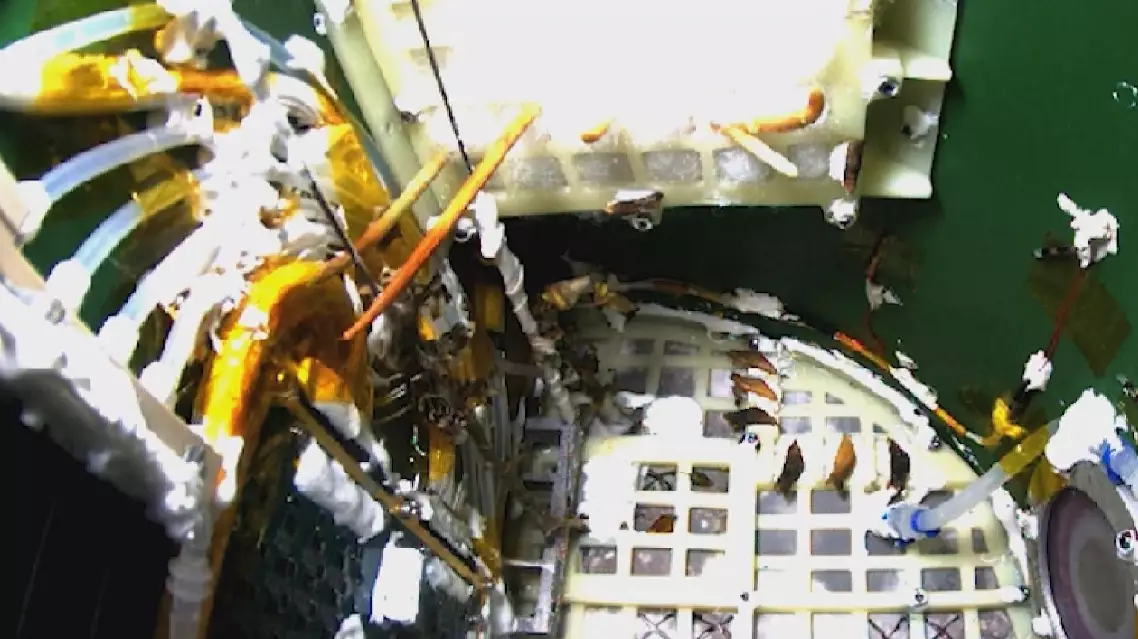
Chinese space experiment sees butterfly emerge from in orbit
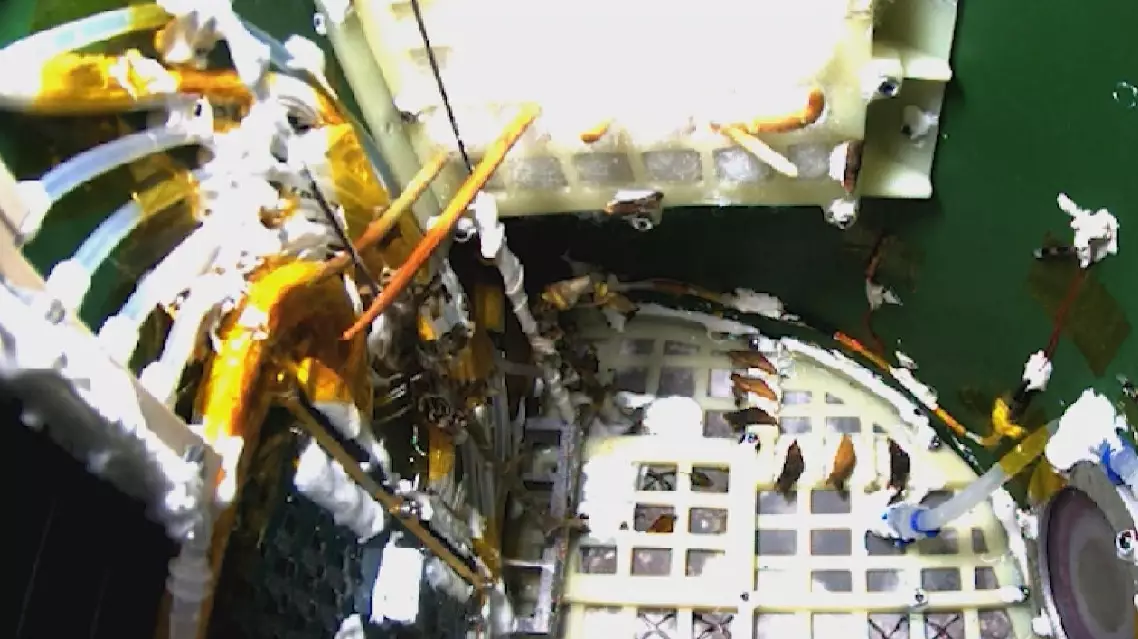
Chinese space experiment sees butterfly emerge from in orbit