The main agenda proposed for the upcoming fourth session of the 14th National Committee of the Chinese People's Political Consultative Conference (CPPCC), China's top political advisory body, was unveiled on Sunday.
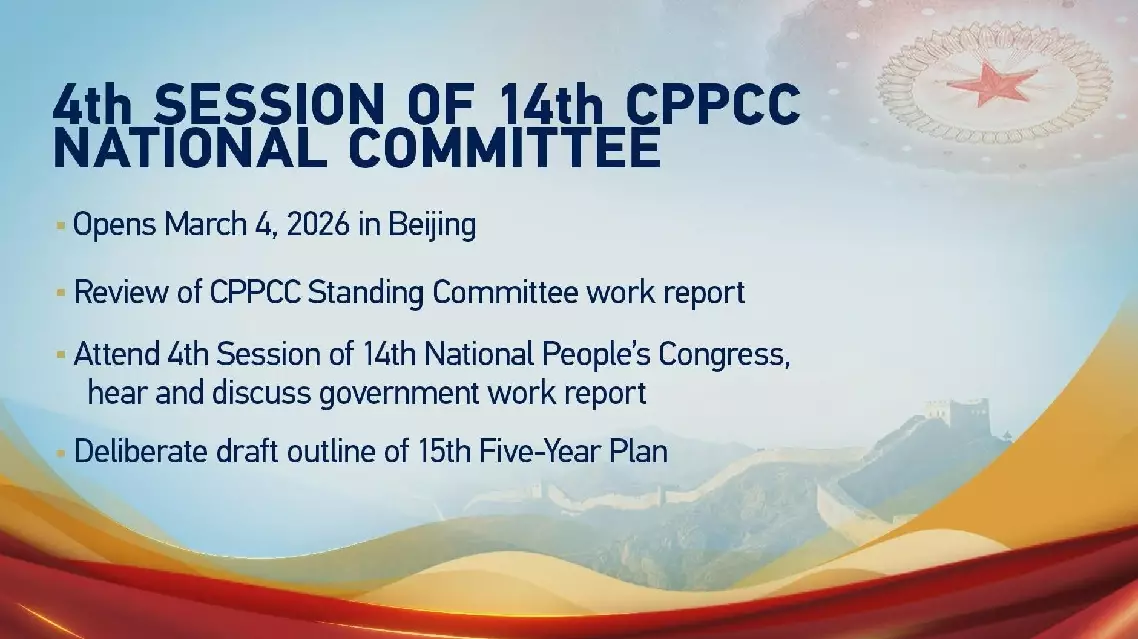
The fourth session of the 14th National Committee of the CPPCC will open on March 4 in Beijing, according to a decision made at a meeting of the Standing Committee of the CPPCC National Committee on Sunday.
The proposed agenda for the session includes hearing and deliberating on a work report of the Standing Committee of the CPPCC National Committee and a report on how the proposals from political advisors have been handled since the previous session of the CPPCC National Committee.
Members of the CPPCC National Committee will sit in on the fourth session of the 14th National People's Congress to hear and discuss documents including the government work report.
They will also discuss a draft outline of the 15th Five-Year Plan (2026-2030) for national economic and social development, according to the proposed agenda.
The upcoming CPPCC National Committee session is part of China's "two sessions" for 2026, along with the fourth session of the 14th National People's Congress, China's top legislature.
The "two sessions," which gather national lawmakers and political advisors from across China every year to discuss state affairs, are a major event in the country's political calendar and an important window for the rest of the world to observe and understand China's policy direction.
China's top political advisory body unveils agenda of annual session
The Houthis in Yemen are ready to coordinate countermeasures with Iran in response to a U.S. blockade on the Strait of Hormuz, a top adviser said on Tuesday, warning that the Bab al-Mandab Strait could also be blocked if red lines are crossed.
The United States imposed a blockade on the Strait of Hormuz to prevent ships from accessing Iranian ports, which took effect after the Iran-U.S. peace talks, held in Pakistan's capital Islamabad late last week, failed to yield a deal to end the war that the Unite States and Israel launched against Iran on Feb. 28. A two-week ceasefire is set to expire next week.
In an interview with China Global Television Network (CGTN) in Sanaa on Tuesday, Mohammed Taher Anam, an advisor to Yemen's Houthi Supreme Political Council, said these unilateral American actions must be rejected and confronted, so that the United States does not later impose blockades on other countries.
"We reject this blockade and call for confronting it through various means. We are also waiting for Iranian measures and are ready to take similar steps in our region," said Anam.
He said that the Bab al-Mandab Strait and nearby areas can be blocked at any time if red lines are crossed. They are coordinating with their Iranian allies and closely monitoring developments he said, and, at the right moment, they are ready to expand the confrontation against the U.S. and its allies.
The Bab el-Mandeb Strait, a strategic chokepoint linking the Suez Canal and the Red Sea with the Gulf of Aden, serves as a vital corridor for global trade, particularly oil and gas shipments between Europe and Asia.
"We remain ready to take any measures. We are coordinating with our allies in Iran and with friendly countries around the world if needed. One possible step is imposing a blockade against the American blockade. The Americans think they can impose a blockade on the Strait of Hormuz, but this is very difficult. We know Iranian missiles can reach up to 1,000 kilometers to target American ships, keeping them far from the Strait of Hormuz. If the U.S. continues on this path, we in Yemen can take similar steps to Iran, and the Americans will suffer greatly," said Mohammed.
The Houthi group, which has controlled Yemen's capital Sanaa and most northern provinces since late 2014, has voiced full solidarity with Iran since the U.S.-Israeli strikes against the Islamic Republic started.

Houthi official warns of possible key Red Sea strait closure as U.S. continues Hormuz blockade