Skip to Content Facebook Feature Image

Houthi official warns of possible key Red Sea strait closure as U.S. continues Hormuz blockade

China

China

China

Houthi official warns of possible key Red Sea strait closure as U.S. continues Hormuz blockade

2026-04-16 23:06 Last Updated At:04-17 01:27

The Houthis in Yemen are ready to coordinate countermeasures with Iran in response to a U.S. blockade on the Strait of Hormuz, a top adviser said on Tuesday, warning that the Bab al-Mandab Strait could also be blocked if red lines are crossed.

The United States imposed a blockade on the Strait of Hormuz to prevent ships from accessing Iranian ports, which took effect after the Iran-U.S. peace talks, held in Pakistan's capital Islamabad late last week, failed to yield a deal to end the war that the Unite States and Israel launched against Iran on Feb. 28. A two-week ceasefire is set to expire next week.

In an interview with China Global Television Network (CGTN) in Sanaa on Tuesday, Mohammed Taher Anam, an advisor to Yemen's Houthi Supreme Political Council, said these unilateral American actions must be rejected and confronted, so that the United States does not later impose blockades on other countries.

"We reject this blockade and call for confronting it through various means. We are also waiting for Iranian measures and are ready to take similar steps in our region," said Anam.

He said that the Bab al-Mandab Strait and nearby areas can be blocked at any time if red lines are crossed. They are coordinating with their Iranian allies and closely monitoring developments he said, and, at the right moment, they are ready to expand the confrontation against the U.S. and its allies.

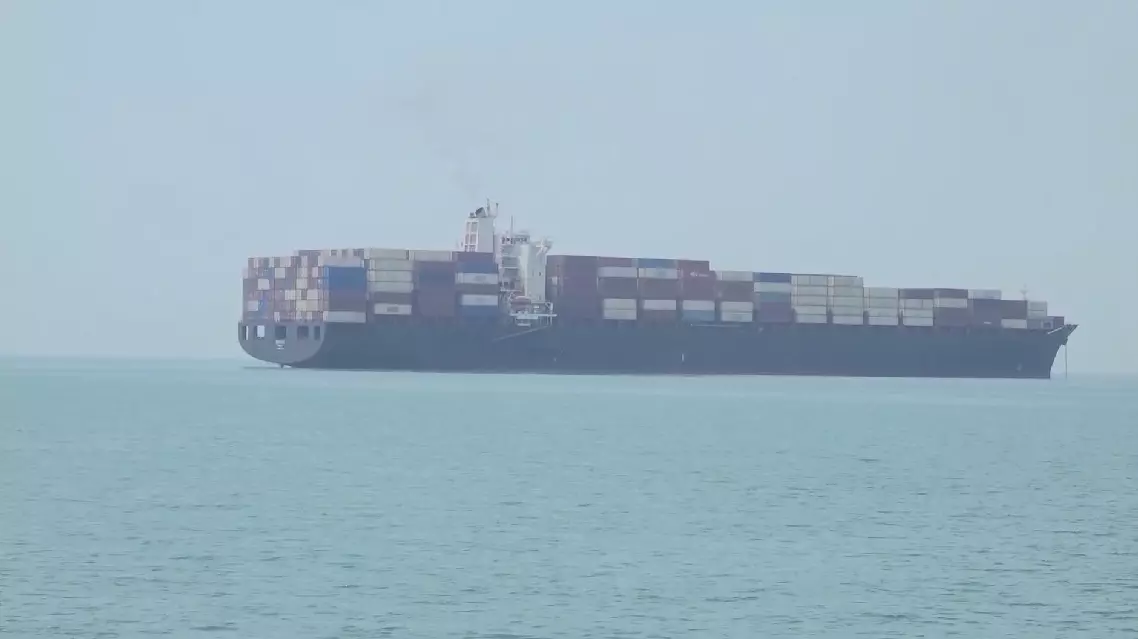
The Bab el-Mandeb Strait, a strategic chokepoint linking the Suez Canal and the Red Sea with the Gulf of Aden, serves as a vital corridor for global trade, particularly oil and gas shipments between Europe and Asia.

"We remain ready to take any measures. We are coordinating with our allies in Iran and with friendly countries around the world if needed. One possible step is imposing a blockade against the American blockade. The Americans think they can impose a blockade on the Strait of Hormuz, but this is very difficult. We know Iranian missiles can reach up to 1,000 kilometers to target American ships, keeping them far from the Strait of Hormuz. If the U.S. continues on this path, we in Yemen can take similar steps to Iran, and the Americans will suffer greatly," said Mohammed.

The Houthi group, which has controlled Yemen's capital Sanaa and most northern provinces since late 2014, has voiced full solidarity with Iran since the U.S.-Israeli strikes against the Islamic Republic started.

Houthi official warns of possible key Red Sea strait closure as U.S. continues Hormuz blockade

Houthi official warns of possible key Red Sea strait closure as U.S. continues Hormuz blockade

Israel aims to fuel division among Lebanese factions by holding direct talks with the Lebanese government, said a senior Hezbollah official in an interview with China Global Television Network (CGTN).

Bilal Lakkis, a member of Hezbollah's Central Committee, said Israel's military plans are failing in southern Lebanon, with no prominent military gains despite weeks of bombardment.

Israel has been bombarding most bridges over the Litani River, leaving only about two intact, in what appears to be an attempt to create an expanded buffer zone or to advance further north. Asked how Hezbollah views this strategy, Lakkis dismissed Israeli objectives as incoherent and militarily unachieved.

"Every day one of Israel's leaders says something different. Some say 'we need protection from the attacks', others say they want an occupation to settle the Israeli military. A third group says they want a buffer zone. A buffer zone needs a huge military victory, which has not been achieved. This proves that there is hesitance among them, there is no clarity. In any case, the region south of the river, some parts of it are just three kilometers between the river and the occupied Palestinian territories, so it doesn't achieve security," he said.

The United States hosted political talks for the first time in decades between the Lebanese government and Israel this week. Asked whether any agreement could be implemented without Hezbollah's consent and what Israel seeks from these negotiations, Lakkis was unequivocal in his rejection.

"The government is violating all laws. Some in Lebanon had hopes that the war on Iran would hit the brain, all the affiliates would perish. Instead they found success in holding negotiations in Pakistan. Every time Netanyahu fails militarily, he attempts to fuel the division within the Lebanese body," he said.

Asked about whether Hezbollah would avoid actions that might fuel such divisions, Lakkis emphasized the group's commitment to internal stability.

"The resistance in Lebanon doesn't want any internal instability. That is a long-standing historic stance. It's a red line for us to tamper with peace and stability. Moreover, the Arab and the Islamic support towards the resistance and Hezbollah specifically is at its best. To resist that is a way more valuable gain than to be dragged against an internal party. We are keen on national unity and Islamic unity," he said.

Hezbollah official says Israel aims to fuel division among Lebanese factions

Hezbollah official says Israel aims to fuel division among Lebanese factions

Recommended Articles