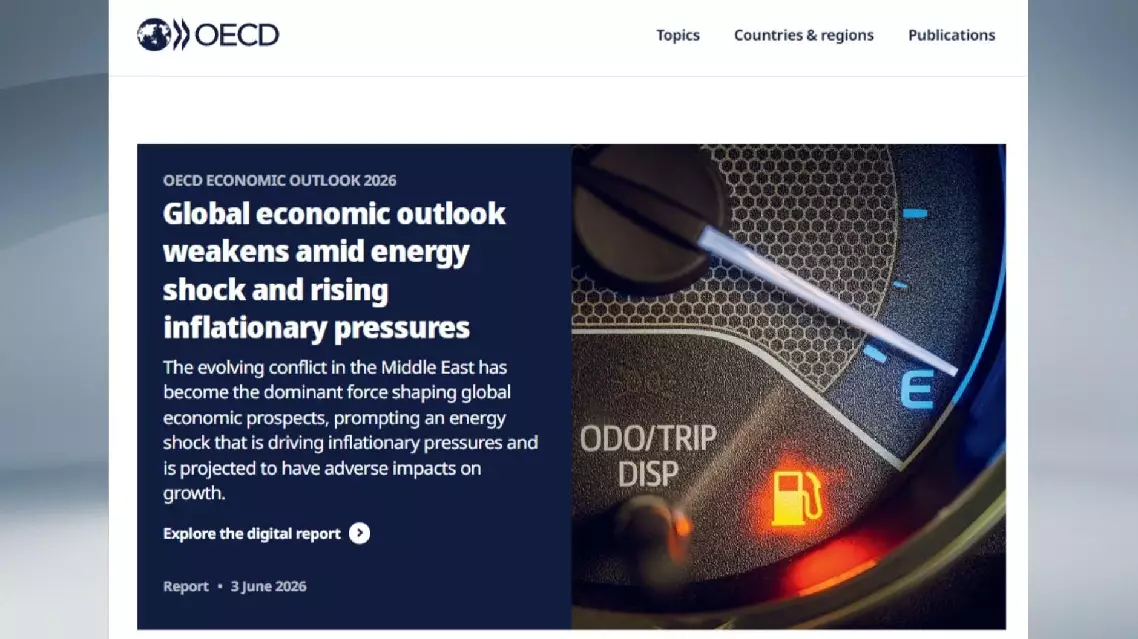
Global economic growth is projected to slow from 3.4 percent in 2025 to 2.8 percent in 2026, before recovering to 3.1 percent in 2027, according to the latest Economic Outlook released by the Organization for Economic Cooperation and Development (OECD) on Wednesday.
The report notes that at the beginning of 2026, investment in the artificial intelligence sector was robust, financial conditions were relatively accommodative, and trade tensions had eased somewhat, leading to better-than-expected global economic performance.
However, the conflict in the Middle East has disrupted energy transportation and supply, driving up prices for energy and key industrial inputs, intensifying inflationary pressures, dampening market confidence, and weighing on household consumption and business activity.
The report warns that the longer the turmoil persists, the greater its economic and social impact. If the relevant disruptions continue into 2027, global economic growth could be further revised downward to 2.1 percent in 2026 and 1.8 percent in 2027, with some economies potentially falling into or nearing recession and unemployment rising as well. The report emphasizes that countries should strengthen supply chain resilience, particularly by promoting diversification of energy supplies and improving energy efficiency. In the short term, measures such as enhancing coordination of strategic energy reserves and implementing temporary demand restraint measures can help mitigate the impact of tight energy supplies. In its report released in March this year, the OECD projected global economic growth of 2.9 percent for 2026, with a slight rebound to 3.0 percent in 2027.
Global economic growth to slow to 2.8 pct in 2026 amid Middle East tensions: OECD
Global economic growth to slow to 2.8 pct in 2026 amid Middle East tensions: OECD