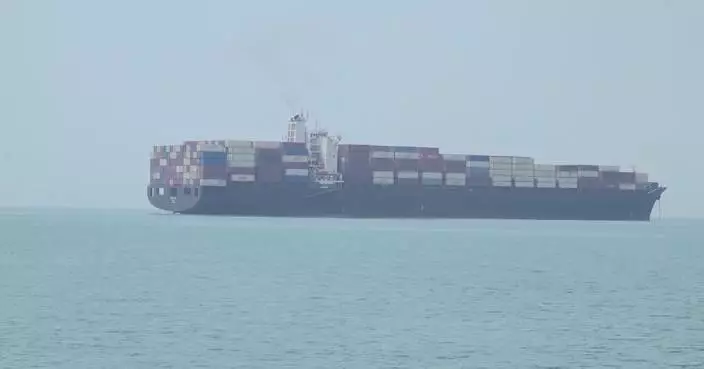
The development of China's new International Land-Sea Trade Corridor (ILSTC), a key logistics route connecting the western part of the country to global markets, has steadily advanced this year, with major infrastructure projects progressing smoothly.
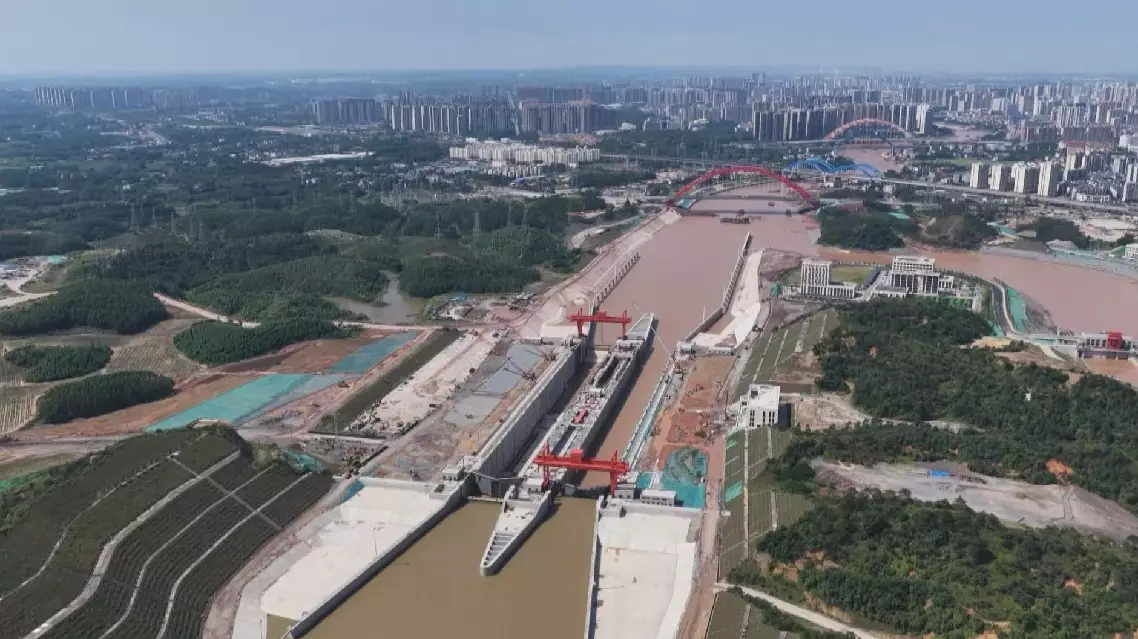
The water channels of the Pinglu Canal, a key ILSTC project that connects inland waterways directly with the sea, have been filled, and the testing and commissioning phase for the canal, which is expected to begin full operations in September, began on Wednesday.
"Full-route real-ship trials will be conducted in August to ensure the canal opens to navigation in September as scheduled," said Pan Jian, chief engineer of Guangxi Pinglu Canal Construction Co., Ltd.
Once operational, the canal will open the shortest, most economical, and most convenient waterway for goods from southwestern China to reach ASEAN countries.
"Beyond a logistics route, this corridor is an economic 'golden line' that greatly enhances the resilience and security of China's industrial and supply chains," said Jia Ruoxiang, director of the Comprehensive Research Office at the National Development and Reform Commission's Institute of Territorial Development and Regional Economy.
The overall plan for the ILSTC designates Chongqing and Chengdu in southwest China as starting points, with eastern, central, and western routes advancing in parallel to create a national strategic corridor to southern seaports.
The corridor's major railroad infrastructure also saw new progress in the first five months of this year.
In early May, a critical tunnel on the Huangbai Railway, connecting Guizhou Province and Guangxi Zhuang Autonomous Region, was successfully drilled. And in Yunnan, all 46 bridges on the Wenshan-Mengzi Railway, a key branch of the ILSTC, have begun construction.
In the meantime, policies, rules, standards, and platforms are being streamlined to encourage participation in trade along the corridor from domestic and international partners.
A promotional event on the United Nations Convention on Negotiable Cargo Documents (NCD) was held in Chongqing Municipality on Monday to boost digitalized, cost-effective, and mutually beneficial international trade and cross-border financing.
Chongqing has pioneered a unified cross-border road bill of lading, which has already been incorporated into the NCD.
Since its pilot run in 2017, the ILSTC has added over 200 operational routes that connect 18 provincial-level regions across the country, and 592 ports in 128 countries and regions. Its cargo types have expanded from 80 to over 1,300.
In the first four months of this year, total imports and exports through the corridor reached 568.24 billion yuan (about 84.03 billion in U.S. dollars), up 17 percent year on year.
China's new international land-sea trade corridor developing steadily