A Chinese research team has successfully mass-produced rocket propellant tank domes using their pioneering cryogenic forming technology, which can reduce production cycle time by more than 90 percent.
The team, from the lab of high-performance precision manufacturing at Dalian University of Technology's School of Mechanical Engineering, has developed the world's first large cryogenic forming press to make one-piece rocket propellant tank domes over two meters in diameter from aluminum alloys.
In cooperation with a Chinese company, they have realized the production capacity of about 1,000 tank domes per year.
"The key to cryogenic forming is cooling large plates into the cryogenic zone. This equipment has broken through the challenges of rapid transport and precise temperature control of large-volume liquid nitrogen, as well as coordinated loading control of multiple parameters, including temperature, pressure, and displacement. It enables the control of liquid nitrogen at minus 190 degrees Celsius, the designed cooling of materials, and thus stable manufacturing of large components. It can reduce the production cycle time by 90 percent from more than one week to just a few hours," said Fan Xiaobo, a researcher at the school.
The cryogenic forming press can make a rocket propellant tank dome out of a four-millimeter aluminum alloy plate in a single step, with a thickness deviation of less than 0.3 millimeters.
The core enabler of the stable operation of this equipment is the aluminum alloy cryogenic forming technology pioneered by the team.
"Generally, metals become brittle at cryogenic temperatures, so they are considered harmful. However, our research team discovered that aluminum alloys in a specific state not only avoid cold brittleness but also exhibit higher elongation and hardening indexes at cryogenic temperatures. Using this abnormal phenomenon, we have developed the world's first aluminum alloy cryogenic forming technology, and transformed the conventional approach of 'heating when ambient temperature fails' to a cryogenic approach, enabling us to make a monolithic tank dome from a thin plate in one go. The forming press can generate a finished product that can be used directly, requiring no further welding or milling," Fan said.
The new tank domes have been successfully applied in flight missions of Long March-12 and Long March-7A Y14 carrier rockets.
"This technology enables the production of one-piece tank domes, which is especially critical for reusable rockets. We will continue to push forward and apply this cryogenic forming technology to enable self-reliance in aircraft and unmanned systems and to promote low-cost manufacturing of thin-walled structures for new-energy vehicles and high-speed trains," said Qi Chang, head of the school.
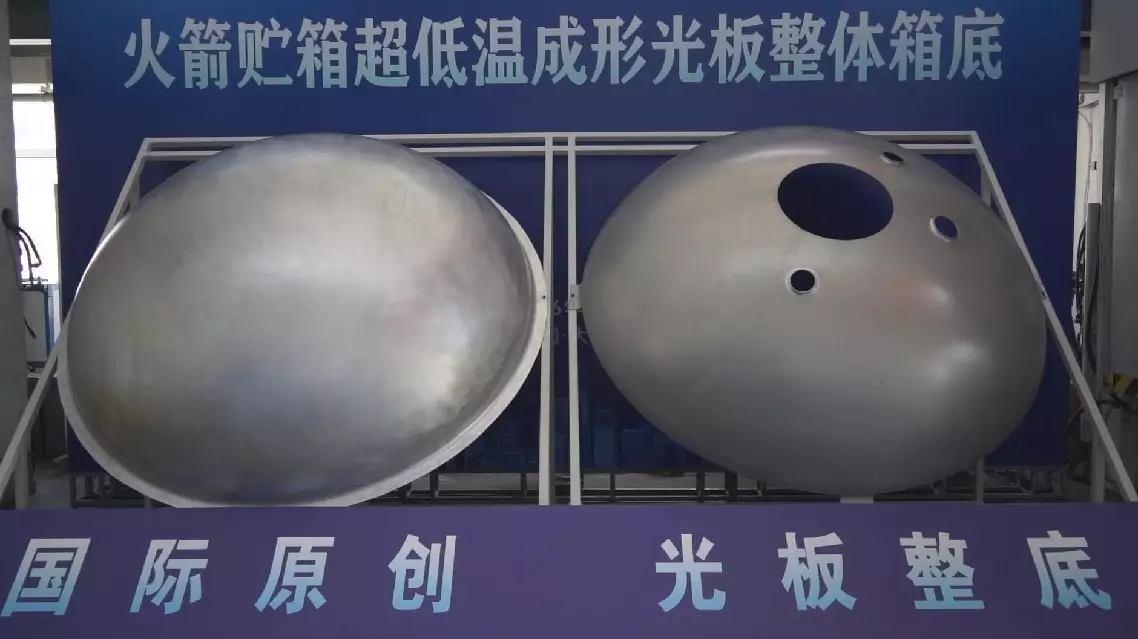
China achieves mass production of rocket propellant tank domes using cryogenic forming technology
China achieves mass production of rocket propellant tank domes using cryogenic forming technology