China's total telecom revenue topped 1.7 trillion yuan (233.45 billion U.S. dollars) in 2024, with a 10 percent year-on-year growth in the annual telecom service volume, according to a senior official from the Ministry of Industry and Information Technology (MIIT) on Tuesday.
Speaking at a press conference in Beijing, Xie Cun, director of the Information and Communication Development Department of the MIIT, said that since the beginning of 2024, China has accelerated the development of new information infrastructure, such as the 5G and industrial internet, fostering greater integration of the telecom service with the real economy.
He said that the country's information and communication industry is expected to achieve upgrade in network evolution, integrated application and innovation capability.
"In 2025, efforts will continue to focus on the 'construction, application and research' strategy, aiming to achieve three key upgrades in the development of the information and communication industry. These include network evolution upgrades, improvement of the 'dual-gigabit' network policy, pilot establishment of the 10 gigabit optical network, and orderly optimization of the layout for computing power centers," he said.
In terms of integrated application upgrade, China will launch in 2025 the "Set Sail" Action Plan for 5G Applications and "5G + industrial internet" upgrades, accelerating all-around and full-chain application of new-generation information technologies, according to officials with the MIIT.
In the area of innovation capability upgrades, efforts will focus on increasing investment in the evolution of 5G and 6G technology innovations, and gradually opening the telecom sector wider to foreign investment when conditions are ripe, said the officials.
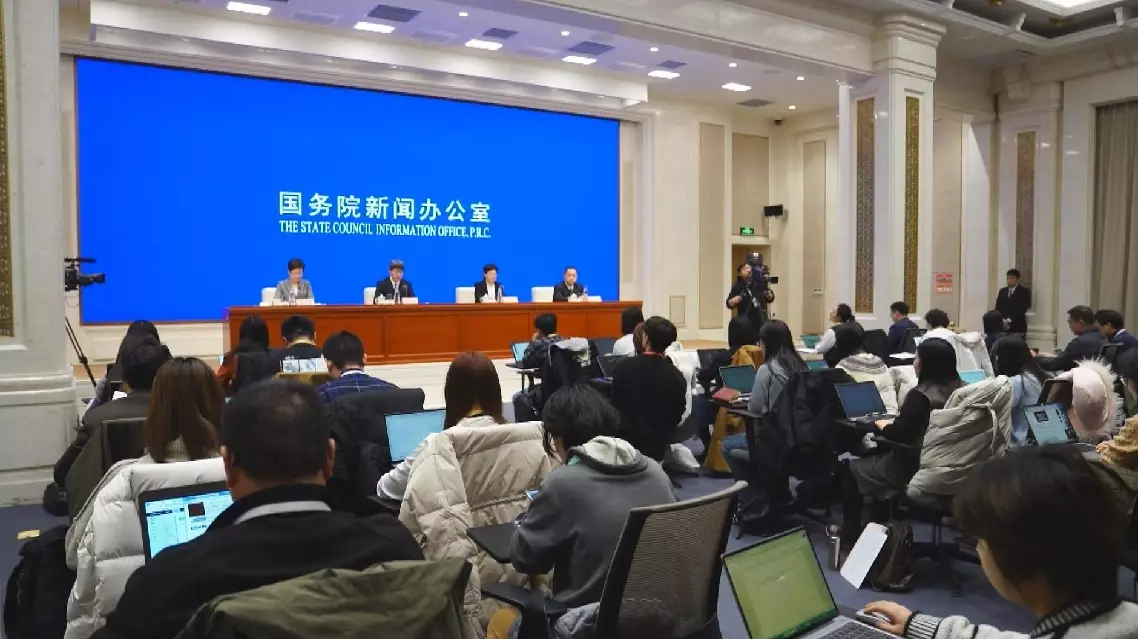
Operating revenue of China's telecom sector tops 1.7 trillion yuan in 2024
The Chinese Embassy in South Sudan and the 12th Chinese Peacekeeping Infantry Battalion to the United Nations Mission in South Sudan on Tuesday donated school supplies, sports gear and cultural equipment to a secondary school in Juba to support local education and promote people-to-people and cultural exchanges.
The donation ceremony, held under the theme "Chinese Culture Enters Campus," took place at the Chinese-built Jubek Model Martyrs Secondary School, bringing together officials, teachers and students to promote educational cooperation and cultural engagement between the two sides.
Peter Lado Tombe, director general of the Ministry of Education and General Instruction in the Central Equatoria State, said the donation is timely amid the significant needs of the state's education sector.
"We thank you for your concern and for coming out with this donation to this school. It speaks volumes," he said.
Tombe noted that improving learning conditions across the country plays a critical role in rebuilding lives and supporting the human development of young people after years of intermittent conflict.
Flora Victor Legge, head teacher of Jubek Model Martyrs Secondary School, said that despite many challenges facing South Sudan, teachers continue to play a vital role in shaping the country's future, working tirelessly to guide, mentor and educate learners with dedication and commitment.
This donation is not only a contribution of materials and resources but also a symbol of partnership, unity and hope for the future of South Sudanese children, said Legge.
Deputy Chief of Mission of the Chinese Embassy in South Sudan Huo Ying said cooperation between China and South Sudan since 2011 has covered political, economic and cultural fields.
Huo said China has consistently supported South Sudan's education sector, working to connect people through education, consolidate the foundation of world peace through youth friendship, and promote mutual learning among civilizations and people-to-people exchanges.
Chinese peacekeeper Wen Haiyuan said that since their deployment, the troops have faithfully fulfilled tasks mandated by the United Nations.
He noted that the battalion has conducted routine patrols and armed escorts, visited villages and schools along mission routes, and carried out civil-military cooperation activities including material donations, free medical services, tree planting and cultural exchanges.
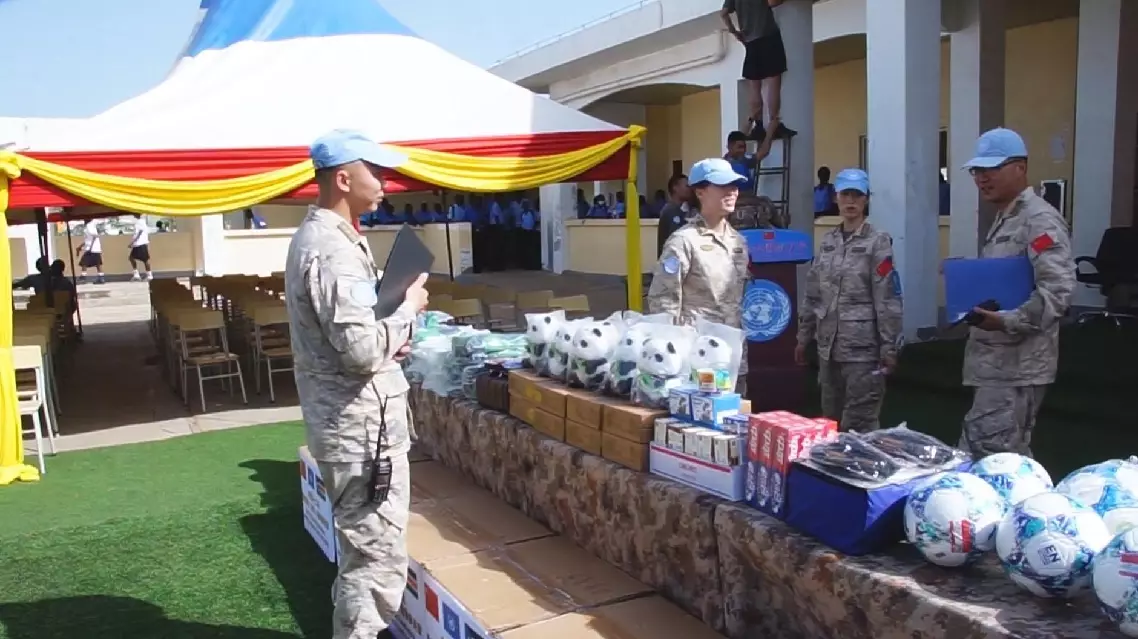
Chinese peacekeepers support education, cultural exchanges in South Sudan