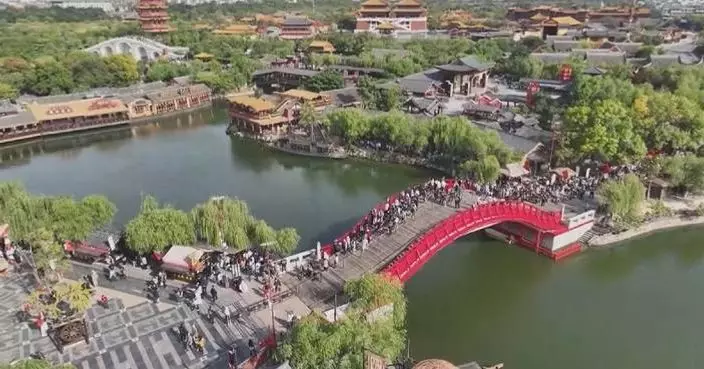
The traditional Xiaonian Festival was observed across China on Wednesday in the run-up to the Chinese Lunar New Year, which is just one week away.
The 23rd day of the 12th month of the lunar year is called the Xiaonian Festival. This is the day when people offer sacrifices to the kitchen god, do a thorough cleaning, and eat a kind of sticky candy. The Xiaonian Festival traditionally marks the start of the countdown to the Chinese Lunar New Year, which starts on Jan. 29 this year.
In Shanghai, both local residents and tourists are seen flocking to an open bazaar to savor characteristic local delicacies, buy Spring Festival goods, and enjoy folk customs performances amid a growing festive atmosphere.
At the open bazaar, visitors can purchase handwritten Spring Festival couplets bearing the Chinese character "Fu," symbolizing fortune and good luck.
"I just saw people writing Spring Festival couplets and you can have a customized one with the character 'Fu' (Good Fortune) on it. It helps to create an atmosphere of the Spring Festival," said Li Yan, a Shanghai resident.
In Tongzi County of southwest China's Guizhou Province, many villagers are used to going to the market on the Xiaonian Festival to prepare goods for the Chinese lunar new year.
The market is brimming with a vibrant assortment of handicrafts, local specialties and delicious snacks, offering a feast for the eyes and senses.
"The Spring Festival is approaching and the children have come back home. So I've come here to the market to buy some food to have a bustling festival," said a local resident named Zhao Taisen.
In the Langzhong ancient town of southwest China's Sichuan Province, a lion dance parade is one of the traditional events celebrated on Xiaonian Festival.
This year, two colorful dragon dance performances are staged in a parade from the east and west of the ancient town, respectively, to the town center, bringing festival joy along the route.
In addition to the folk cultural performances, local delicacies including beef and steamed bun are also attracting many tourists.
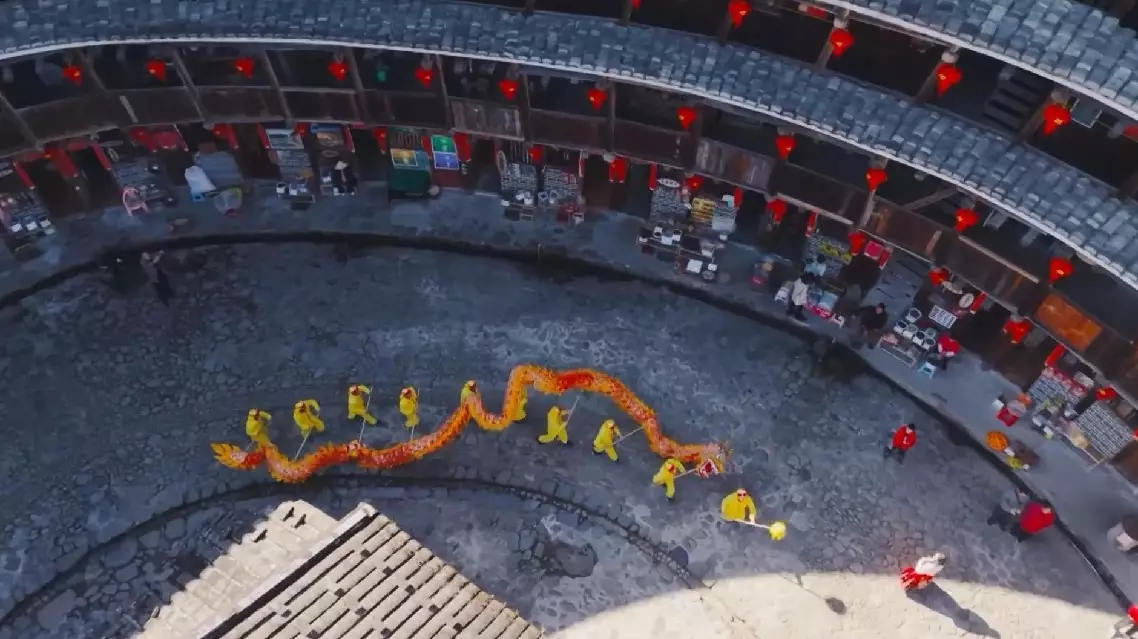
In Zhangzhou City of east China's Fujian Province, the world cultural heritages Fujian Tulou are attracting large numbers of foreign visitors. Fujian Tulou are unique, usually round, fort-like buildings, built with a mixture of clay and sandy soil, dating back to the Song (960–1279) and Yuan (1279–1368) Dynasties. They are a type of Chinese rural dwellings of the ethnic minority Hakka people in the mountainous areas in Fujian Province.
Dragon and lion dance performances are one of the traditional folk customs during the Spring Festival in Zhangzhou.
"I think these places [are] wonderful, because it had a lot of history here, and thousands of years ago that have [there were] people living here. And for us foreigners, we don't know this kind of things. So it's nice to come to experience with the local people, the local things, the local buildings, architecture and all the magnificent history that have [are] here. So I think it's pretty good to come to these kinds of places," said Quintero Candela Alejandra, a visitor from Colombia.
Xiaonian Festival observed in China in run-up to Chinese Lunar New Year