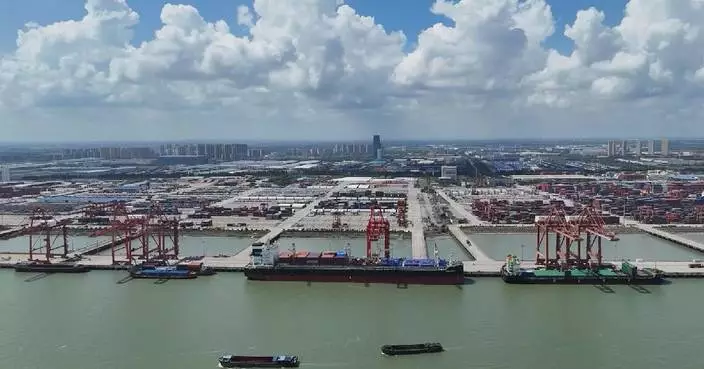
The Chinese financial hub of Shanghai will further promote economic growth in 2025 by advancing scientific and technological progress, according to Gong Zheng, mayor of the city.
In 2024, Shanghai's GDP grew by about 5 percent, marking the city's economic scale surpassing 5 trillion yuan (about 690 billion U.S. dollars). The three leading industries - integrated circuits, biomedicine and artificial intelligence - reached a combined scale of 1.8 trillion yuan, and the total import and export volume of foreign trade hit a record high of 4.27 trillion yuan.
"Shanghai has prioritized the primary task of promoting high-quality development and the strategic goal of building a new development pattern. We have accelerated the construction of the five centers, further comprehensively deepened reforms, effectively navigated external shocks and economic downward pressure, and achieved the main goals and tasks of economic and social development," said Gong.
The "five centers" refer to the international centers of economy, finance, trade, shipping and sci-tech innovation in Shanghai.
In the new year, Shanghai will cultivate and expand strategic emerging industries and future industries such as new energy vehicles, smart terminals and low-altitude economy, and accelerate the establishment of four major industrial clusters in electronic information, life sciences, automobiles and high-end equipment.
"We will use scientific and technological innovation as our guiding principle and vigorously cultivate and develop new quality productive forces. We will carry out the artificial intelligence plus initiative, strengthen essential supports such as intelligent computing power and industry corpus, as well as create more benchmark scenarios with a strong driving force and a great influence. We will focus on building a modern industrial system to continuously improve industries' high-end, intelligent, green and integrated capabilities," said Gong.
In the new year, Shanghai will also implement targeted initiatives to boost consumption and promote the expansion and upgrading of service consumption, deepen the development of an international consumption center and enhance the synergy among business, travel, culture, sports and exhibitions.
Shanghai to advance scientific progress for economic growth in 2025: mayor
A former television host from Taiwan, Zhai Xuan, has made a pivotal decision to leave mainstream broadcasting in order to create content that provides a better understanding of the Chinese mainland and cross-strait relations.
Zhai, a seasoned television host with over a decade of experience in Taiwan's media landscape, recently addressed an audience at an event in Beijing, where she revealed her complete transition into independent online media.
In her remarks, she articulated her aspiration to bridge what she perceives as a significant information gap between audiences on both sides of the Strait, highlighting her commitment to fostering a deeper understanding and connection through her new endeavors.
"I was really surprised by all the fake news. There were stories saying people on the mainland can't afford tea eggs or that they live in mud houses and in Taiwan, this was the main information many people received," said Zhai.
Zhai said she initially began producing online videos to challenge such perceptions while continuing her work as a television host.
In April 2025, she travelled to the mainland with her father to fulfill her late grandfather's wish to return to his hometown. The trip, which reunited family members separated since 1949, was recorded in a video series titled "Journey to Find Our Roots", drawing attention from viewers in both Taiwan and the mainland.
"Many people in Taiwan told me that after watching, they wanted to apply for a mainland travel permit immediately and go looking for their relatives. Some had long forgotten these things, but after seeing my story, they began thinking about their hometowns and family members they had never met and decided to search for their roots," Zhai shared her story at the event.
By mid-2025, Zhai said she began to feel increasing pressure amid rising political tensions and a tightening atmosphere around cross-Strait exchanges in Taiwan.
After more than 12 years in the industry, Zhai resigned from her position, believing it was the right thing to do.
"At that moment, I felt this was a major issue,not just for me, but for Chinese people on both sides of the Strait. If I backed down then, I wouldn’t be standing on the right side," said Zhai.
Since leaving television, Zhai has broadened her online programming to encompass a range of daily-life topics, including practical guidance on applying for a mainland travel permit and using commonly employed mobile applications, in addition to content that delves into historical memory and cultural connections across the Strait.
As the debate over cross-Strait relations continues in Taiwan, Zhai said she remains committed to her current path.
Former Taiwan TV host bridges cross-Strait divide via online media