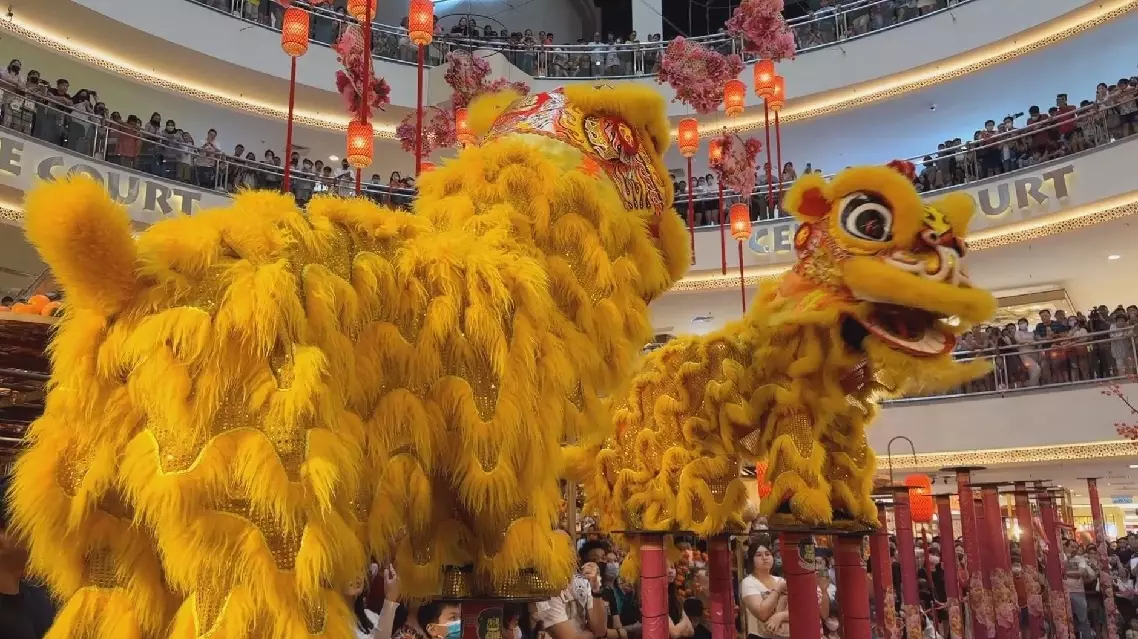
Younger generations and artistic masters in China and Malaysia have been sparing no efforts to carry forward and innovate lion dance, an ancient tradition captivating audience across Asia.
The lion dance, with hundreds of years of history, has been transforming from a festival celebrating performance to a competitive spectacle.
China and Malaysia have signed an agreement to jointly nominate the lion dance for the United Nations Educational, Scientific and Cultural Organization (UNESCO) Representative List of the Intangible Cultural Heritage of Humanity.
The lion dance has become a much-loved artistic form in Malaysia, with not only Chinese young people, but also Malay youths joining local lion dance associations.
"So I saw Faris, my lion head (partner), and I asked him, 'do you want to try jumping?' He said he was scared. I told him, 'don't be scared,' but actually, I was scared too. My goal is to go overseas to perform or compete," said Muhamad Syahmi Hafiz, a Malay lion dancer.
Malaysia is considered the birthplace of the high-flying lion dance style, with figures like Siow Ho-phiew, Chinese lion dance and lion head-making master in Malaysia, playing key roles in its evolution.
Siow believes that in addition to its acrobatic displays, lion dance is also symbolic of peace and prosperity.
"The most important is that in lion dance, I can express the spirits through painting. When we do lion dancing, actually it's a symbol that the country is peaceful, without wars," he said.
Though Malaysia has developed its own distinctive style, the deep connection to its Chinese origins remains evident, with every lion dance in different parts of the country tells different stories.
In a 600-year-old village in Guangzhou, capital city of south China's Guangdong Province, lion dance master Gong Guidong, who is also the deputy director of the city's lion and dragon dance association, has been busy teaching the art to younger generations.
The lion dance there is rooted in southern martial arts and emphasizes storytelling.
"In second grade, Master Gong introduced lion dance to my school. As a kid, I was fascinated by its majesty. Over time, lion dance taught me etiquette, teamwork, and the joy of following my passion," said Wu Jiajun, a 22-year-old lion dance performer who won his first provincial competition at the age of 10.
According to Gong, though lion dances are more and more popular across the world, there are still challenges for the younger generations to view it as their career.
"The biggest challenge is society's lack of understanding. Many parents ask, how much can you really earn from lion dancing? But it's about more than money - it's 2,000 years of tradition. United Nations Educational, Scientific and Cultural Organization (UNESCO) world heritage recognition will help elevate it to a more official and global platform," said Gong.
With China and Malaysia joining hands to preserve and promote the lion dance, this century-old tradition is poised to reach new heights.
China, Malaysia take lion dance to new heights