As the Spring Festival approaches, China is filled with excitement and anticipation, as the country celebrates its most beloved holiday with a vibrant display of cultural traditions and festivities, including lantern shows, folk performances and parades.
This year, the Chinese New Year or Spring Festival takes place on January 29, marking the beginning of the Year of the Snake. As the most significant holiday on the Chinese calendar, it serves as a cherished opportunity for families to come together and celebrate.
In Pingluo County, Ningxia Hui Autonomous Region in northwest China, a Shehuo parade, featuring dragon and lion dances, Yangko dances, and gongs and drums performances, gained waves of cheers from the audience.
In Yutian County of northwest China's Xinjiang Uygur Autonomous Region, 20 Shehuo teams paraded through streets to extend New Year wishes to local residents of various ethnic groups.
In Xiaxian County of north China's Shanxi Province, people presented puppet shows and land boat dances to express aspirations for a better life.
In Jiangjin District of southwest China's Chongqing Municipality, villagers staged self-written plays to show the new changes in their life.
In Jiang'an County of southwest China's Sichuan Province, people enjoyed a feast of nine kinds of festival food, such as steamed pork belly and steamed pork with rice powder, while watching local opera performances.
The Huai Opera Town in Jianhu County, east China's Jiangsu Province has held a series of activities for locals to experience New Year customs and taste traditional cuisine, creating a strong festive vibe.
"We watched Huai Opera and acrobatic performances together and sensed a very traditional festive vibe. It's the first time for my son to watch such performances, so it's very meaningful," said Sun Hang, one of the visitors.
In Yanqing District of Beijing, a lantern art festival featuring a light show and a parade was held to present to residents a New Year scene integrating culture, art and entertainment.
In Xiamen City, east China's Fujian Province, a lantern show brought many classic characters from myths to reality, providing an immersive cultural experience for the visitors.
In Yuexiu District, Guangzhou City of south China's Guangdong Province, many people gathered at the West Lake flower market to watch Yingge Dance performances.
In Yixian County, north China's Hebei Province, an intangible cultural heritage experiencing zone has been set up, allowing visitors to participate in seal carving, rubbing, paper cutting, and making woodblock New Year paintings.
In Longhui County of central China's Hunan Province, a special exhibition has been held for visitors to appreciate intangible cultural heritages, interact with the inheritors, and purchase cultural products.
"I saw several national-level intangible cultural heritages, such as Tantou-style New Year pictures and Huayao cross-stitch handicrafts. I like all these things very much and have felt the profoundness of our cultural heritage," said Feng Aihua, one of the visitors.
In Nanjian Yi Autonomous County of southwest China's Yunnan Province, many Yi people gathered at a feast, with food served by their peers in costumes while dancing to music.
"On every festival, we gather here to sing and dance. Everyone is very happy," said He Zhengliang, a villager.
In the Hong Kong Special Administrative Region (HKSAR), the festive vibe can be sensed at every corner of the streets, where people are busy buying couplets and other kinds of Spring Festival goods.
The SAR will hold parades and firework shows to celebrate the Chinese New Year.
In the Macao SAR, New Year-themed lights have been put up on the streets.
The Tap Seac Square is hosting a market to sell a dazzling variety of Spring Festival goods and stage art performances, including Cantonese Opera, singing and dancing, and musical instrument performances.
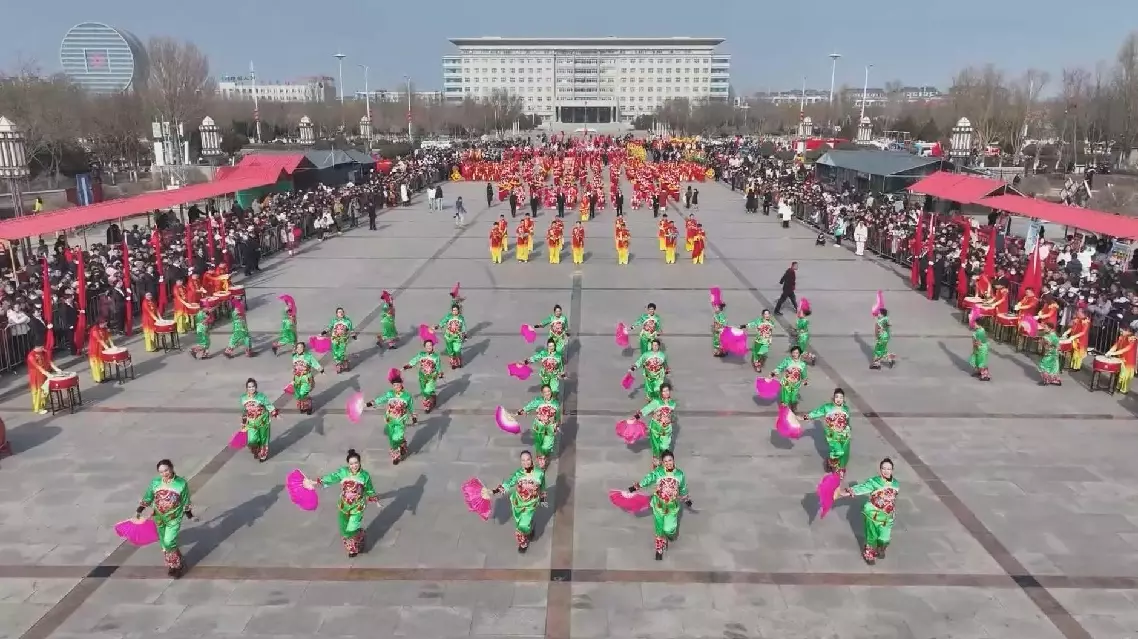
Vibrant celebrations held across China to usher in Spring Festival