Skip to Content Facebook Feature Image

China braces for record 190 million passenger trips on Chinese New Year's Eve

China

China

China

China braces for record 190 million passenger trips on Chinese New Year's Eve

2025-01-28 21:00 Last Updated At:21:47

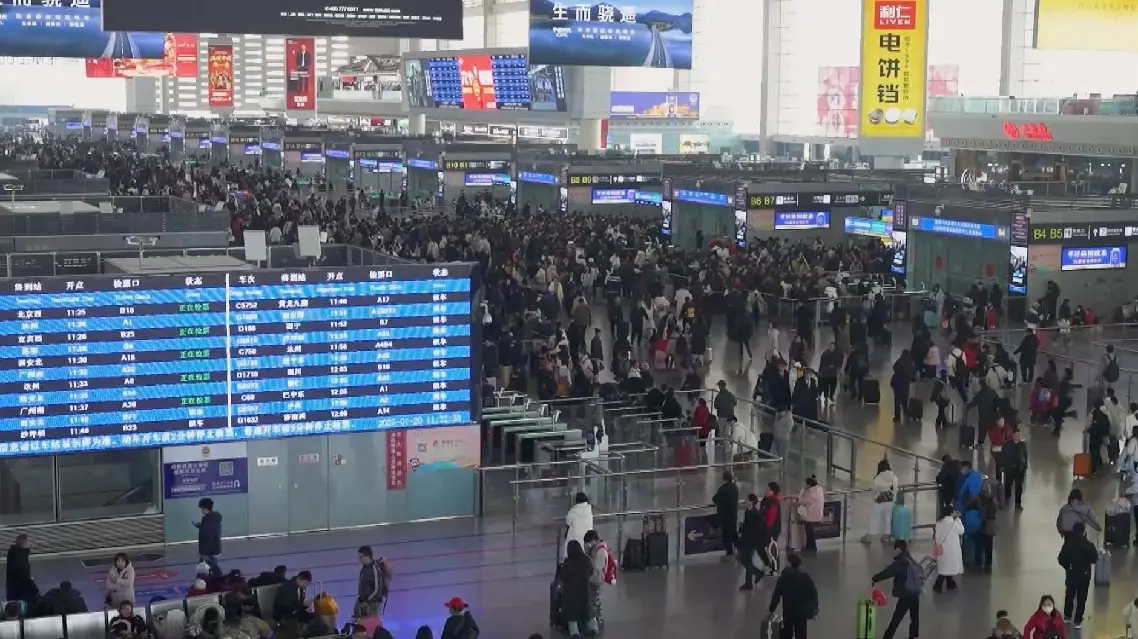
China's transportation system is bracing for the busiest day of the Spring Festival travel rush, with a record 190 million passengers expected to travel on Tuesday's Chinese New Year's Eve.

The travel rush, known as 'chunyun' in Chinese, is considered the world's largest annual human migration and coincides with China's biggest traditional celebration, the Spring Festival, a time when Chinese people return home for family reunions to celebrate the Chinese New Year, which falls on Jan 29 this year.

This year's Spring Festival travel rush runs from Jan 14 to Feb 22.

On Tuesday, the country's railway network is estimated to transport 7.8 million passengers, with 423 trains added to accommodate the surging demand.

Road trips are mostly short, and the road traffic flow is expected to remain at a relatively low level on Tuesday and Wednesday, until it rises again on Thursday.

The civil aviation sector is estimated to handle 16,640 flights on Tuesday.
China braces for record 190 million passenger trips on Chinese New Year's Eve
China braces for record 190 million passenger trips on Chinese New Year's Eve
The long-term economic sanctions imposed by the United States on Venezuela have hindered the Latin American country's development gravely despite its abundant crude oil resources, a Venezuelan expert said recently.

Venezuela holds the world's largest proven oil reserves. According to a poll on December 2 by a Venezuelan research institute, 90 percent of respondents believe the true purpose behind recent U.S. threats is to overthrow the government of Venezuelan President Nicolas Maduro and seize the country oil resources.

According to the U.S. Energy Information Administration, Venezuela's oil reserves stand at 303 billion barrels, approximately one-fifth of the world's total crude oil reserves and the largest known single deposit globally.

Currently, Venezuela's daily crude oil production hovers around 1 million barrels.

Despite the rich natural resources, Venezuela's GDP ranks in the lower-middle tier among the South American nations, a result from years of heavy U.S. economic sanctions.

"The scope of U.S. sanctions is extremely broad. They prohibit free trade, prevent the free exchange of technologies, and restrict the free flow of currencies, all of which are crucial for any nation's development. Furthermore, persistent military and psychological threats from the United States have hindered the national development and deterred international investment in Venezuela. Compounded by the U.S. government's forced border closures, foreign capital faces numerous barriers to enter Venezuela," Ramiro Royero, a professor at the School of Petroleum Engineering of Central University of Venezuela, said in a recent interview with the China Central Television (CCTV) . Royero said that while the United States is an oil-producing nation itself, it maintains high demand for Venezuelan crude. This stems from Venezuela's supply of heavy crude oil, which the United States lacks, creating strong market complementarity.

Royero said that due to insufficient domestic heavy crude oil production, the U.S. refineries rely heavily on imports to efficiently produce heavy diesel, marine fuel oil, lubricants, and asphalt.

Venezuela's production costs are lower due to different production methods, with some projects costing less than 20 U.S. dollars per barrel, far below U.S. production costs.

Royero said Venezuela is a sovereign country and is able to solve its own problems without foreign intervention.

"Despite sanctions, threats, and the current woes, Venezuela maintains daily crude exports of approximately 200,000 barrels, accounting for about 27 percent of U.S. crude imports from South America. This positions Venezuelan as a vital global crude supplier of refined products, particularly for that of the United States. The purpose of U.S. military actions is twofold: geopolitical control and economic dominance over Latin America's raw materials. However, Venezuela is a sovereign country which will resolve its domestic problems independently and advance steadily without external interference," said Royero.

US long-term sanctions shackle Venezuela's development: expert

US long-term sanctions shackle Venezuela's development: expert

Recommended Articles