ST. LOUIS--(BUSINESS WIRE)--Jan 28, 2025--
Benson Hill, Inc. (Nasdaq: BHIL, the “Company” or “Benson Hill”), a seed innovation company, partnered with a major poultry integrator to complete a second commercial feeding trial to validate the value of including soybean meal derived from Benson Hill’s Ultra-High Protein, Low Oligosaccharide (UHP-LO) soybeans in poultry diets.
This press release features multimedia. View the full release here: https://www.businesswire.com/news/home/20250128090311/en/
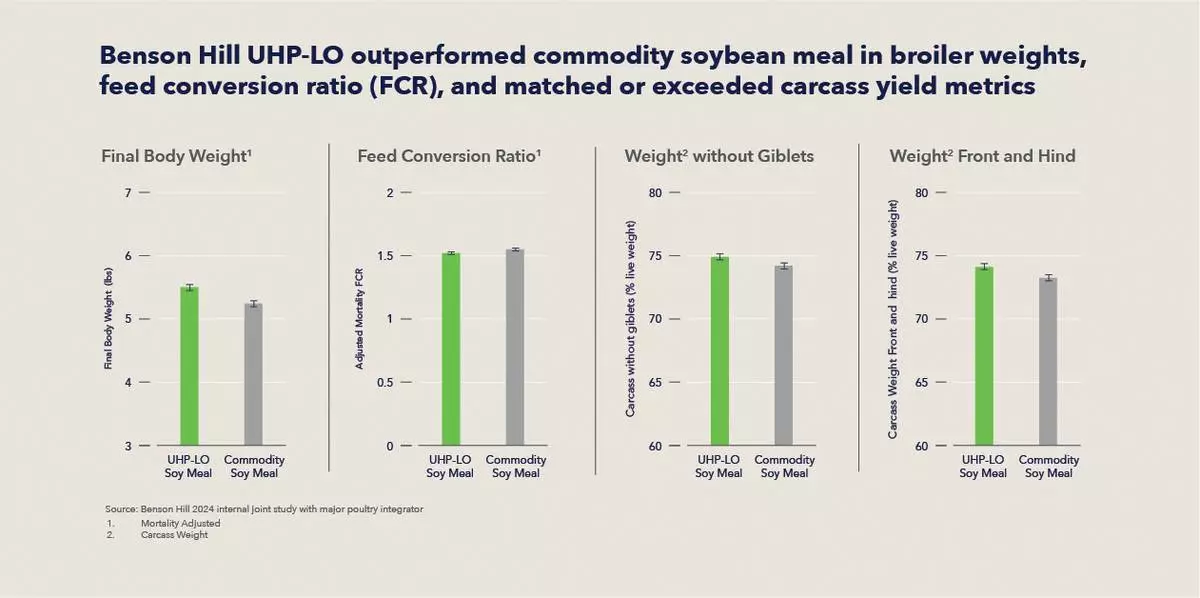
The results confirm that incorporating UHP-LO soybean meal (SBM) in commercial broiler diets substantially improved feed conversion and resulted in heavier broilers, reflecting the higher protein and metabolizable energy present in Benson Hill’s proprietary soybean genetics. These observations reinforce findings from the Company’s first broiler feeding study released in May 2024.
In the six-week trial, broilers fed a diet containing UHP-LO SBM weighed more at processing and grew more muscle versus broilers fed a diet formulated with commodity soybean meal. For this group of broilers, replacing commodity soybean meal in the diet with UHP-LO SBM improved broiler weights by 5.4 percent and feed conversion ratios by 3.2 percent.
Poultry producers have enhanced flexibility with UHP-LO to formulate feeding rations for cost advantage (up to 5 percent in prior studies) and bird performance gains (up to 5.4 percent in this study). These gains are significant and translate across the value chain.
“This latest feeding trial showcases the transformative impact of switching from commodity soybean meal to a high-protein, nutritious option that is truly Made from Better ™,” said Deanie Elsner, Chief Executive Officer of Benson Hill. “These study results not only reaffirm the value of our UHP-LO soybean meal for poultry producers seeking specific outcomes like feed efficiency, but they are also supported by more than two decades of soybean breeding and our technology core. We estimate that choosing specialty soy from Benson Hill can generate approximately $2.2 billion of value annually for the broiler industry.”
Benson Hill will continue to pursue broadacre expansion in feed and expects to broaden its soybean portfolio to more than 35 varieties for the 2025 crop year. Non-GMO UHP-LO soybean varieties, destined for animal feed, demonstrate strong yield performance relative to elite commercial varieties, with herbicide-tolerant varieties expected to be available for the 2026 growing season. For more information on Benson Hill and its proprietary soybean seed portfolio, visit https://bensonhill.com/products/seeds/.
About Benson Hill
Benson Hill is a seed innovation company that unlocks nature’s genetic diversity in soy quality traits through a combination of its proprietary genetics, its AI-driven CropOS ® technology platform, and its Crop Accelerator. Benson Hill collaborates with strategic partners to create value throughout the agribusiness supply chain to meet the demand for better feed, food, and fuel. For more information, visit bensonhill.com or X, formerly known as Twitter at @bensonhillinc.
Cautionary Note Regarding Forward-Looking Statements
Certain statements in this press release may be considered “forward-looking statements” within the meaning of Section 27A of the Securities Act of 1933, as amended, and Section 21E of the Securities Exchange Act of 1934, as amended. Forward-looking statements generally relate to future events or the Company’s future financial or operating performance and may be identified by words such as “may,” “should,” “expect,” “intend,” “will,” “estimate,” “anticipate,” “believe,” “predict,” or similar words. These forward-looking statements are based upon assumptions made by the Company as of the date hereof and are subject to risks, uncertainties, and other factors that could cause actual results to differ materially from those expressed or implied by such forward-looking statements. These forward-looking statements include, among other things, statements regarding: the Company’s progress toward an asset-light business model, and the anticipated pace of such transition; the Company’s financial and operating performance during its business transition; the Company’s cost-cutting measures under its expanded Liquidity Improvement Plan and other cost-saving measures, actions to implement such plan, and the anticipated benefits of and timeline to implement such plans; the Company’s current expectations and assumptions regarding the industries and markets in which it operates; potential strategic partnership and licensing opportunities; the Company’s anticipated liquidity, path to profitability, and runway for growth; expectations regarding the sources of expected revenues, costs, profit and earnings; projections of market opportunity; the anticipated advantages, potential and capabilities of the Company’s seed portfolio and innovation pipeline and the expected timeline for the commercialization of the Company’s current and anticipated innovations; anticipated demand for quality soy traits and the Company’s seed innovations; the expected timeline for the expansion of the Company’s seed portfolio; the expected timing and results of planned academic studies and commercial feeding trails; current projections and assumptions regarding the Company’s business and the industries and markets in which the Company currently operates or plans to operate; expectations regarding the Company’s ability to continue as a going concern; execution of the Company’s business plan and the strategic review of the Company’s business; any financial or other information based upon or otherwise incorporating judgments or estimates relating to future performance, events or expectations; the Company’s strategies, positioning, resources, capabilities, and expectations for future performance; estimates and forecasts of financial and other performance metrics; the Company’s outlook, and financial and other guidance; and management’s strategy and plans for growth. Factors that may cause actual results to differ materially from current expectations include, but are not limited to: risks associated with the Company’s ability to generally execute on its business strategy, including its transition to an asset-light business model in a timely manner with sufficient liquidity; risks relating to acreage acquisition; risks associated with developing and maintaining partnering and licensing relationships in an asset-light business model, and maintaining relationships with customers and suppliers; risks associated with realizing the anticipated advantages of the Company’s seed innovations and products; the risk that the Company will not realize the anticipated benefits of the divestiture of its soy processing facilities; risks associated with the loss of revenues from the Company’s divestiture of its soy processing facilities; risks associated with growing and managing capital resources; risks associated with changing industry conditions and consumer preferences; risks associated with the Company’s cost-cutting measures under its expanded Liquidity Improvement Plan and other cost saving measures, including potentially adverse impacts on the Company’s business and prospects even if such plans are successful; the risk that the Company’s actions relating to cost-cutting measures under its expanded Liquidity Improvement Plan and other cost saving measures may be insufficient to achieve the objectives of such plans; liquidity and other risks relating to the Company’s ability to continue as a going concern; risks associated with the Company’s ability to grow and achieve growth profitably, including continued access to the capital resources necessary for growth; risks relating to the failure to raise additional financing to satisfy the Company’s cash needs; risks relating to maintaining key employee, customer, partner and supplier relationships; risks relating to the Company’s exploration of strategic alternatives; risks associated with the failure to realize the anticipated commercial or nutritional benefits of the Company’s UHP-LO soybeans; risks that the benefits validated by the recent trial may not be able to be repeated or improved upon in the future; risks associated with the accuracy and repeatability of feeding trials generally; risks associated with the effects of global and regional economic, agricultural, financial and commodities market, political, social and health conditions; the effectiveness of the Company’s risk management strategies; and other risks and uncertainties set forth in the sections entitled “Risk Factors” and “Cautionary Note Regarding Forward-Looking Statements” in our filings with the SEC, which are available on the SEC’s website at www.sec.gov. The Company can make no assurances that it will be able to raise additional financing, improve its liquidity position, or continue as a going concern. Nothing in this press release should be regarded as a representation by any person that the forward-looking statements set forth herein will be achieved or that any of the contemplated results of such forward-looking statements will be achieved. There may be additional risks about which the Company is presently unaware or that the Company currently believes are immaterial that could also cause actual results to differ from those contained in the forward-looking statements. The reader should not place undue reliance on forward-looking statements, which speak only as of the date they are made. The Company expressly disclaims any duty to update these forward-looking statements, except as otherwise required by law.
Benson Hill, Inc. (Nasdaq: BHIL, the “Company” or “Benson Hill”), a seed innovation company, partnered with a major poultry integrator to complete a second commercial feeding trial to validate the value of including soybean meal derived from Benson Hill’s Ultra-High Protein, Low Oligosaccharide (UHP-LO) soybeans in poultry diets. (Graphic: Business Wire)
Benson Hill, Inc. (Nasdaq: BHIL, the “Company” or “Benson Hill”), a seed innovation company, partnered with a major poultry integrator to complete a second commercial feeding trial to validate the value of including soybean meal derived from Benson Hill’s Ultra-High Protein, Low Oligosaccharide (UHP-LO) soybeans in poultry diets. (Graphic: Business Wire)