Russia said on Wednesday that its troops had controlled the settlement of Novoyelizavetovka in Donetsk, while Ukraine said it repelled several Russian offensives in the Kursk Region in the past day.
The Russian Defense Ministry said on Wednesday that Russian servicemen raised the Russian flag over the settlement of Novoyelizavetovka in Donetsk in the past day, and attacked Ukrainian troops and equipment on multiple battle lines.
The Ukrainian armed forces lost over 420 soldiers in the Kursk Region over the past day, the Russian Defense Ministry said.
Front line commanders said on Wednesday that Russian servicemen had controlled most areas of Ukraine's Chasov Yar city.
On the same day, the General Staff of the Ukrainian Armed Forces reported 91 battles at the front lines over the past day, noting that missile and artillery forces hit Russia targets including ammunition depots and personnel. The General Staff said Ukrainian forces repelled several Russian offensives in the Kursk Region.
The Ukrainian national news agency Ukrinform reported on Wednesday that Ukrainian drone attacks targeted a warehouse storing missiles, guided bombs and artillery ammunition in Russia's Tver Region, as well as the Andreapol oil pumping station in the village of Erokhino.
The conflict between Russia and Ukraine has shown obvious changes, with the Russian army claiming progresses in several directions, and the Ukrainian troops taking a defensive posture and withdrawing from several strategic points.

Russia controls Donetsk settlement, Ukraine repels Russian offensives in Kursk
Exploring the Chinese capital by bike and on foot, American vlogger Cooley Gavin Andrew embraced Beijing's unique daily rhythm, uncovering a city where timekeeping tradition and modern living melt into one another seamlessly.
The young man started his morning near the Drum and Bell Towers, a historical landmark that once served as the city's official timekeeping center some eight centuries ago. Near the site, he enjoyed a traditional local breakfast at Yaoji Chaogan, which specializes in chaogan -- a popular Beijing stew of pork liver and intestines -- to mark the true start of a Beijing day.
"This is the chaogan. As many things that I've had in Beijing, I've actually never had this before, so I'm pretty excited. The consistency looks a little bit interesting, you know, very gooey and like slimy looking. But I'm interested to try it, so let's see. It's really good. Very garlicky, but still meaty. Very rich in flavor, too," Andrew said, tasting the meal.
Throughout the morning, he listened to the ancient drums and gazed down at the Beijing Central Axis. Recognized as a UNESCO World Heritage Site in 2024, the 7.8-kilometer north-south axis comprises 15 heritage elements and has anchored Beijing's center for over 700 years.
"From up here, you can see that Beijing didn't grow randomly. The Drum Tower is located at the north end of old Beijing. And the central axis line that runs all along here goes from south to north, connecting the city's layout and order," Andrew said.
He then had coffee on a terrace overlooking the hutongs and Shichahai, gaining a glimpse into the traditional Beijing way of life. He also sampled delicate, imperial-style pastries at Fuhuazhai, a restaurant founded by Wang Xifu, the grandson of a Qing Dynasty (1644–1911) imperial chef.
In his taste test at Fuhuazhai, Andrew sampled two traditional Chinese snacks. The first item, despite its name "ox tongue," contains no meat but consists of crushed peanuts and sesame seeds shaped to resemble the organ. He noted the pastry delivered an unexpectedly savory and salty flavor profile with a notably flaky texture, rather than the anticipated sweetness. He expressed even greater surprise at the second item, "watermelon cheese," which the vlogger described as a refreshing watermelon-flavored jelly.
In the afternoon, the tour moved to Longfusi, a nearly 600-year-old temple in Beijing's Dongcheng District that once hosted one of the city's most important temple fairs. Today, its ceiling features a striking 3D-printed design.
Andrew then sampled a range of classic Beijing bakery offerings, including traditional souvenir pastries from the renowned Daoxiangcun.
He wrapped up the day-long journey at the Drum Tower's courtyard, where he enjoyed an outdoor movie in the evening.
"So if you come to Beijing, don't just rush around landmark to landmark. Take it slow, ride a bike. You never know what you'll find," Andrew said.
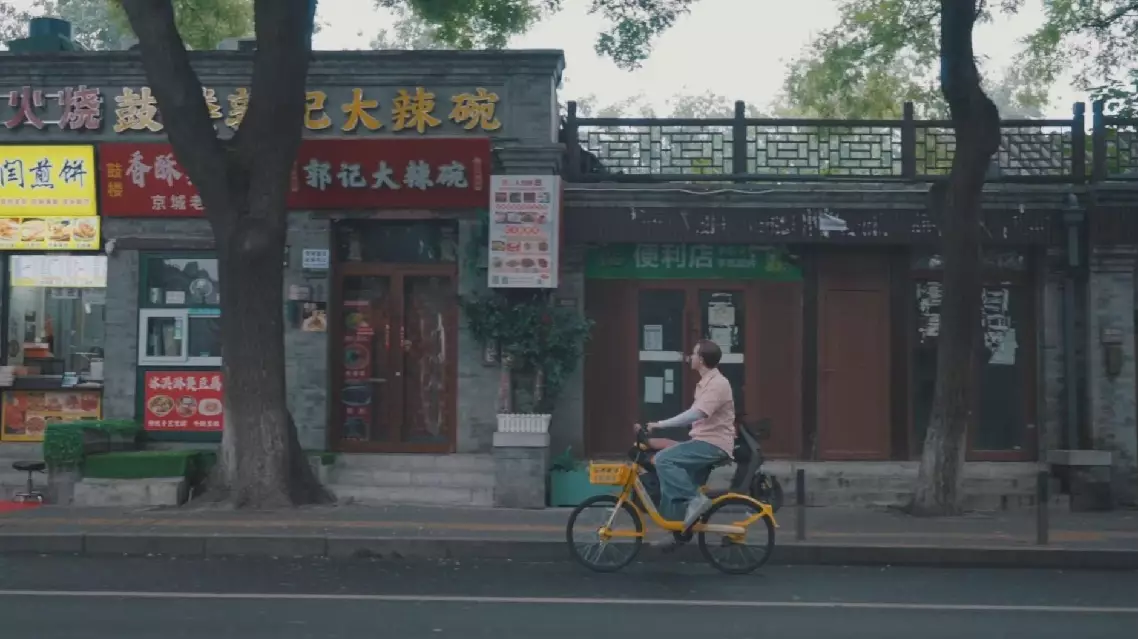
American vlogger explores Beijing's unique rhythm in one day