The China Media Group (CMG) presented a barrier-free broadcast of its Spring Festival Gala for the first time in its history this year, with Tuesday night's broadcast marking a major milestone in accessibility for audiences with disabilities by virtue of cutting-edge technology.
First held in 1983, the Spring Festival Gala, also known as "Chunwan", has become a cultural hallmark of Chinese New Year celebrations in China, with the hours-long television extravaganza entertaining audiences around the world and gaining over a billion views, making it the world's most-watched annual TV show.
In order to make the event even more inclusive, organizers called in the China Disabled People's Performing Art Troupe -- who became famous for performing their stunning Thousand-hand Bodhisattva dance on the gala exactly 20 years ago -- to deliver a key role in interpreting the Gala's performances through sign language. They served not just as interpreters but as cultural ambassadors, using visual elements, costumes, and facial expressions to bridge the gap and better connect with the hearing-impaired community.
The troupe dispatched a group of 13 talented young performers to participate in this landmark barrier-free broadcast, each responsible for interpreting multiple segments of the gala. Despite the grueling hours of rehearsal in the lead up to the Chinese New Year's Eve, they worked tirelessly to fine-tune every gesture, facial expression, and rhythm.
The program was led by Tai Lihua, herself a renowned deaf dancer and head of China Disabled People's Performing Art Troupe, who said the undertaking eventually became much bigger than expected, as the group provided complete coverage of all acts of the variety show.
"When I first received this task, I initially thought we'd only be performing sign language for the song and dance performances. But as rehearsals progressed, we began adding more intricate performances like the 'cross-talk' [comedic dialog], comedy skits, and even the traditional opera. It's important that the hearing-impaired people understand the rhythm of music, which is a real challenge for us. We must use very precise sign language to convey the meaning behind each program to our hearing-impaired friends, allowing them to truly feel the essence of every performance," she said.
The ultimate objective of the barrier-free broadcast was to make sign language not only functional but artistic, culturally rich, and enchanting. The job was particularly tricky for the comedy segments where humor often relies on verbal puns and wordplay that must be accurately conveyed through sign language.
"Take homophonic puns for example. In sign language, they are interpreted in completely different ways, so it may not be easy for our hearing-impaired friends to understand why something is said like that or where the humor lies. This is a point we often need to study and refine. Interpreters of those comedy programs would perform for both hearing-impaired and hearing colleagues, asking, 'Do you understand it?' 'Is it funny?'. We incorporate their feedback and make continuous adjustments," said Wang Yuchen, a hearing-impaired dancer from the troupe.
"I think it's very meaningful to have this opportunity to help hearing-impaired people across the country immerse in the atmosphere," Wang added.
The concept of a "Barrier-Free Spring Festival Gala" was proposed by Zhao Zhihui, who spearheaded the effort to transform the initial idea of sign language interpretation into a truly inclusive gala.
While the gala has long featured performances by disabled artists, Zhao wanted to take it a step further. However, the journey was far from easy, as the team had no existing examples to follow.
"Turning this into reality was incredibly hard. Every step was a struggle, as there were few precedents to follow. There were many times when we were almost hopeless and felt like we couldn't go on. But in the end, with the support of the entire team, we completed our first trial broadcast on January 5. That day, the studio walls were completely black, with no stage or lighting like what we have now. Yet, our young performers were all full of energy in front of those black walls. That moment wasn't just about being emotional, it was about realizing that we had finally reached this point, that we could finally be seen," Zhao said.
In addition to the sign language broadcast, a separate audio description service was introduced for the visually impaired, with narrators providing vivid and expressive descriptions of the live performances as they played out on screen.
"I've met people [with disabilities] in my work. They also have a deep desire for art and a profound understanding of life. So, when I took on the task of narrating this time, I immersed myself wholeheartedly in it," said Wang Yabin, a young dancer who served as one of the narrators.
With China home to over 45 million people with hearing impairments and 17 million with visual impairments, the barrier-free broadcast sought to bridge the gap, ensuring that more people could join in the festivities on the Chinese New Year's Eve.
For hearing-impaired viewers like Beijing resident Zhu Yilin, the experience was deeply moving as she watched the show alongside her family.
"The fact that a barrier-free broadcast of the Spring Festival Gala was specifically designed for us, the hearing-impaired community, is truly moving. This form is especially heartwarming, making us feel more connected and more immersed," said Zhu.
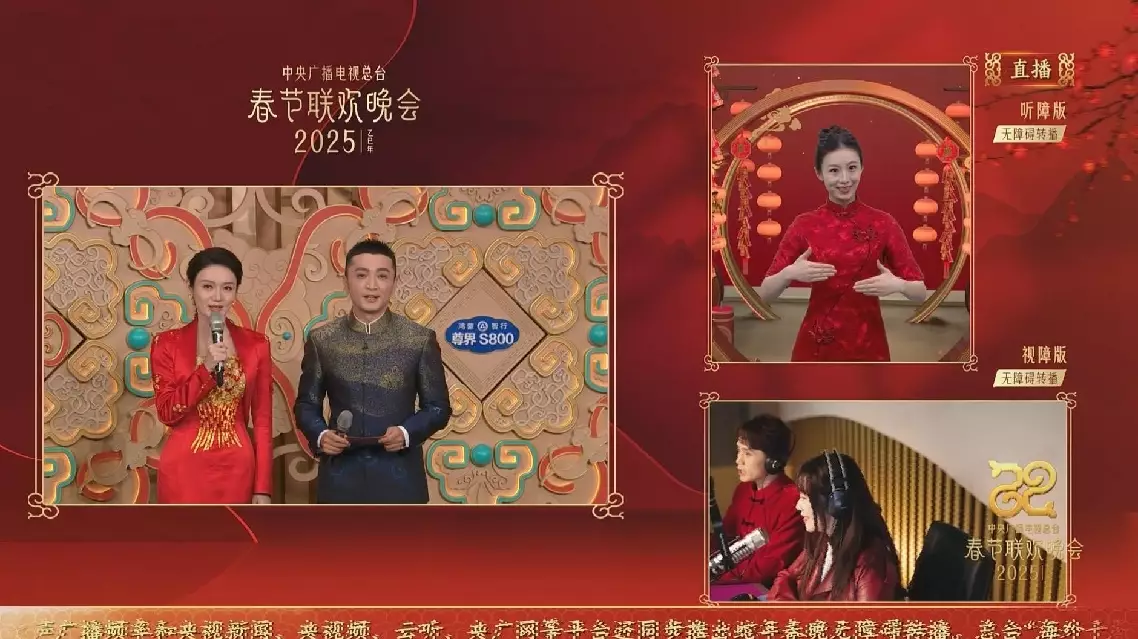
Spring Festival Gala embraces inclusivity with groundbreaking barrier-free broadcast