From snacks to calligraphy, traditional Chinese culture is being showcased at an ongoing temple fair in downtown Beijing, as part of the city's Spring Festival celebrations. Originating about 400 years ago, the Changdian temple fair is being held on a 800-meter-long street home to stores offering a good range of Chinese calligraphy, paintings, antiques and other cultural products.
Besides, during the fair, festive items including lanterns and pinwheels, and streets food such as "tanghulu", a traditional Chinese snack of sugar-coated fruits, have reminded people of good old days, according to visitor of older age.
"I used to come here often when I was a kid. I brought a very small amount of money to Changdian and bought a bunch of hawthorn fruits and hung them around my neck," said Ms. Liu, a visitor.
Younger visitors said they strongly feel the festive vibe at the fair.
"Walking on this street, I see red lanterns, glazed roof tiles, and people's happy faces. This is what exactly the Spring Festival means," said Ms. Zhao, a visitor.
At the close of 2024, UNESCO added the Spring Festival to its Representative List of the Intangible Cultural Heritage of Humanity.
To promote the Spring Festival, most stores on the street, which usually shut their doors during the holiday, have been encouraged to remain open this year.
"The joint efforts of all sides can increase the festive atmosphere. Each store has something unique. In this way, we can further promote our traditional culture," said Cheng Yuan, president of Beijing Chunshu Street chamber of commerce.
Many stores engage visitors in trying traditional techniques such as brush- and ink-making and rubbing to copy an inscription of the Chinese character Fu meaning "good fortune" or "happiness".
"Writing Spring Festival couplets during the Spring Festival is actually a kind of cultural inheritance and a custom," said Wei Guangyao, inheritor of ink-making technique.
In addition, visitors said they have been impressed by shows telling the story of brush, ink, paper and ink stone, which are used in Chinese calligraphy and called "Four Treasures of the Study".Visitors could also enjoy themselves by listening to cross-talks, clapper talks, Peking opera, and other performing arts at the fair.
"I was so excited to watch them performing. Being together with these young people makes us feel we are still young," said Zuo Fengxia, a visitor.
An official said efforts have been made to use the fair as a platform to showcase traditional Chinese culture, including Beijing culture.
"We try to showcase the festive atmosphere and the unique Beijing culture of the Changdian temple fair. We try to show traditional Chinese culture and Beijing culture to every visitor to the Changdian temple fair, and pass the culture to the next generation," said Jin Zhen, director of the Cultural and Tourism Bureau of Xicheng District.
For Chinese across the world, the Spring Festival is a time for family reunions, festive celebrations, holiday shopping and diverse cultural and tourism activities. It fell on Wednesday this year.
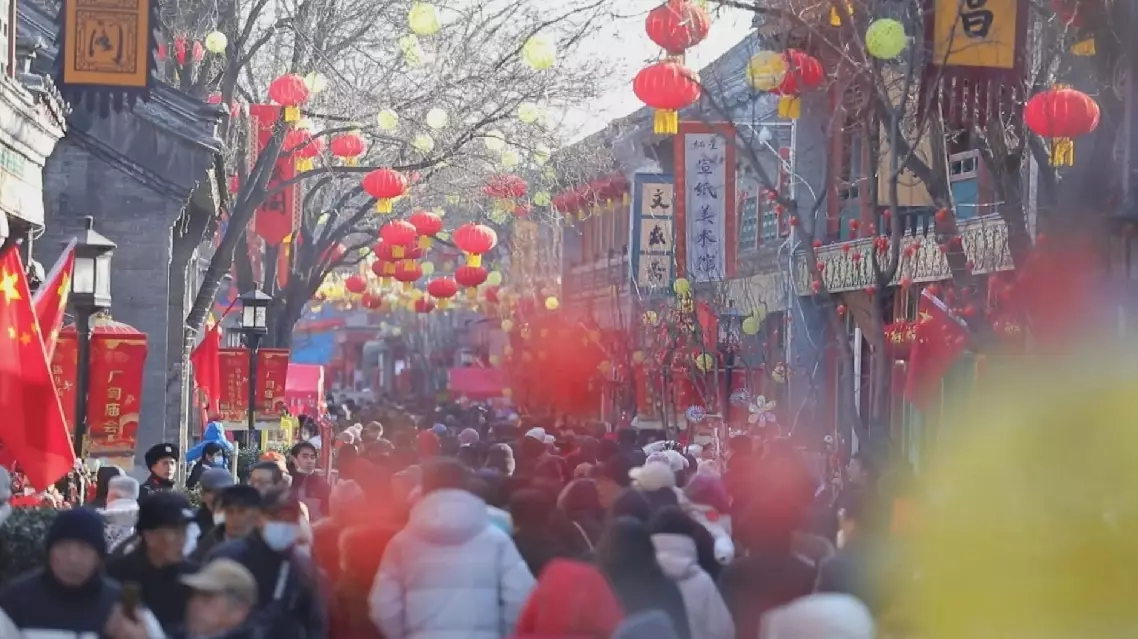
Traditional Chinese culture showcased at Beijing's temple fair
A new round of trade-in subsidy program is energizing China's consumer market these days, with provinces across the country seeing a surge in demand for cars, home appliances and digital devices.
In north China's Shanxi Province, the new trade-in subsidy program, which started on January 9, has further helped boost sales in home appliances and digital devices which are covered by the new round of subsidies.
To enjoy the subsidies, six types of home appliances, including refrigerators and washing machines, must meet national Level 1 energy-efficiency or water-efficiency standards. Digital and smart products include four types, such as mobile phones and tablets, with a sales price cap of 6,000 yuan (about 800 U.S. dollars) per item.
In both categories, subsidies are set at 15 percent of the final transaction price. For home appliances, the maximum subsidy is 1,500 yuan per item. For digital products, the cap is 500 yuan per item. Each consumer can receive a subsidy for one unit in each category.
Neighboring Shanxi, Hebei Province kicked off the year of 2026 with the new round of trade-in subsidy program starting on January 1.
The subsidies cover automobiles, home appliances, and digital products. Individual consumers who purchase designated Level 1 energy-efficiency appliances or eligible digital products priced at no more than 6,000 yuan can receive subsidies equal to 15 percent of the transaction price. The maximum subsidy is 1,500 yuan per appliance and 500 yuan per digital or smart device, with each person limited to one subsidized item in each category.
Data showed that from Jan 1 to 9, Hebei's home appliance trade-in program alone disbursed more than 130 million yuan in subsidies, driving sales of over 920 million yuan.
In east China's Jiangsu Province, the new trade-in subsidy program, taking effect for two weeks, has brought the province a boom in trade-in.
At a local 4S store in Jiangsu's Suqian City, showroom traffic has spiked as salespeople walked customers through the new benefits from the trade-in subsidy program.
"Under the scrappage-and-replacement scheme, customers who buy a new energy vehicle (NEV) can receive a subsidy worth 12 percent of the vehicle price, capped at 20,000 yuan (about 2,860 U.S. dollars). For combustion-engine cars, the subsidy is 10 percent, with an upper limit of 15,000 yuan. For trade-ins, NEVs are able to receive a subsidy worth 8 percent of the vehicle price, up to 15,000 yuan, while combustion-engine cars will receive a 6-percent subsidy, with a cap of 13,000 yuan," said Sun Yue, a saleswoman at the store.
In the home appliance sector, Jiangsu's policy this year stipulates that only products that meet China's Level 1 energy-efficiency standard are eligible for subsidies. The scheme covers six major categories, including refrigerators and washing machines.
Consumers who purchase qualifying appliances can receive a subsidy equal to 15 percent of the final retail price, up to a maximum of 1,500 yuan per item. Each person is limited to one subsidized unit per product category.
Four types of digital and smart products, such as mobile phones and tablets, are eligible for a 15-percent subsidy capped at 500 yuan per unit, with a retail price no more than 6,000 yuan.
"With the national subsidy policy back in place this year, I went to the store to check what discounts I could get. It knocked 500 yuan off the price. [The discounted price is] very reasonable," said Wang Kang, a resident of Jiangsu's Xuzhou Province.
To enhance the shopping experience for consumers, many retailers are pairing subsidies with "one-stop" services that combine the delivery of new products with on-site collection of old ones.
"After consumers place an order for new home appliances, our staff will schedule a time to pick up the old units. Recycling the old appliance can also further offset the purchase price of the new one," said Yang Jie, a sales supervisor at a major home appliance company.
China's new trade-in program sparks consumption boom