China's visual intelligence industry has rapidly developed and found widespread applications over the past decade, particularly in the production of high-precision games, driven by collaboration between upstream and downstream industries to enhance product implementation.
One striking example is the Chinese video game "Black Myth: Wukong," an action role-playing game released last year by Shenzhen-based startup Game Science.
This game has captivated players worldwide and signaled a new era for Chinese game development. Inspired by the 16th-century classic novel "Journey to the West," the game allows players to embody the legendary Monkey King, Sun Wukong, on a thrilling quest to conquer monstrous foes.
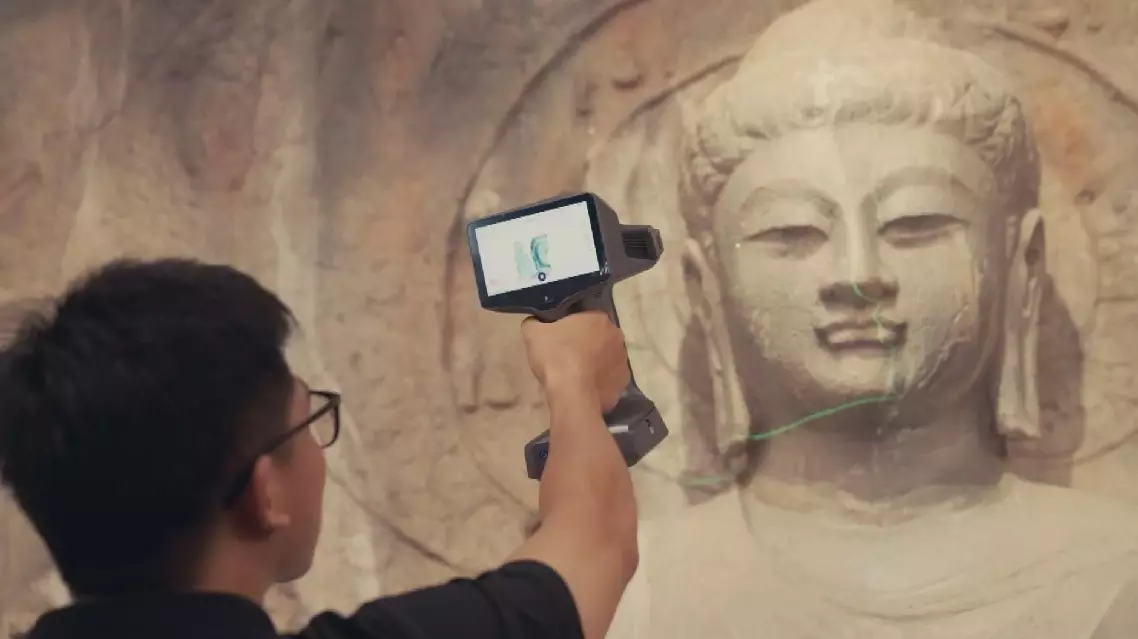
One of the game's most lauded features is its breathtakingly realistic depiction of ancient Chinese architecture and culturally rich environments. The game blurs the lines between virtual and real, showcasing intricate details like temple murals and statue carvings with stunning fidelity, even under intense magnification.
This remarkable realism is powered by cutting-edge 3D scanning technology developed by a company at the "China Vision Valley" in Hangzhou, capital city of east China's Zhejiang Province.
"Our products, mainly based on high-precision 3D visual technology, are capable of high-precision three-dimensional modeling of real objects," explained Liu Haihua, brand manager at SHINING 3D.
The company's latest 3D scanning device, small enough to be held in one hand, can capture over 2 million data points for a medium-sized statue, and up to 10 million data points for larger historical monuments, with the ability to accurately reproduce their materials and colors. This level of details previously required a cumbersome array of interconnected equipment.
"In the past, we had to connect the scanner, computer and power supply with cables. Every time the engineers go out for scanning work, they had to carry this large amount of equipment. With our new product, users can start scanning as soon as they turned on the power. In the past, equipment preparation alone took a couple of hours," said Liu.
This leap in efficiency and portability is the result of nearly a decade of innovation in algorithms, hardware, and control systems. SHINING 3D's early development was hampered by a lack of domestic hardware suppliers, making it difficult to bring their designs to market. The establishment of "China Vision Valley" in 2022 addressed this challenge by fostering a complete visual intelligence ecosystem, attracting complementary businesses across the supply chain.
Now, the tech company is collaborating closely with neighboring electronics manufacturers, accelerating product development and pushing the boundaries of scanning technology.
Designed products can quickly be put into use, and collaborative research and development with upstream and downstream partners can yield greater results. Today, not only are the equipment becoming increasingly compact, but also the precision is constantly improving.
The company's latest scanner can now record over 6 million points per second, enabling scanning of products ranging from ancient buildings covering tens of square meters to small items measuring just a few millimeters. All indicators have reached international leading levels, while maintaining a competitive price compared to imported products.
"With the maturity of the current ecosystem, revenue has increased exponentially, marking the arrival of an explosive period, maintaining a growth rate of over 30 percent," said Luo Weijie, general manager of the Zhejiang Visual Intelligence Innovation Center, which oversees the "China Vision Valley" project.
SHINING 3D's products are now being exported to over 100 countries and regions worldwide. With the enormous success of "Black Myth: Wukong," the company has seen a growing number of clients seeking collaborations, spanning diverse applications, from industrial manufacturing to customized dental products.
"The technology can be applied not only to mechanical manufacturing and equipment production, but also to more personalized applications, such as in the dental industry," said one visitor to the company's showroom.
"It can even scan clothing, accurately capturing the color and sheen of the fabrics," another visitor remarked, highlighting the technology's ability to achieve a remarkably high level of realism.
China's visual intelligence industry flourishes with widespread applications