Skip to Content Facebook Feature Image

Robotic exoskeletons help visitors climb Mount Tai during Spring Festival holiday

China

China

China

Robotic exoskeletons help visitors climb Mount Tai during Spring Festival holiday

2025-02-01 18:40 Last Updated At:20:27

Mount Tai in Tai'an City, east China's Shandong Province introduced robots to help people climb mountain as throngs of visitors have flocked to the scenic area during the Chinese New Year holiday.

Regarded as the foremost one of the Five Sacred Mountains of China, Mount Tai is over 1,500 meters above sea level, and its crest could only be reached after ascending thousands of steps. The scenic area has seen a surge in visitors since the eight-day holiday began on Tuesday, who are eager to witness the sunrise and breathtaking views from the summit.

"I came to climb Mount Tai, taking advantage of this Spring Festival holiday. I want to challenge myself while experiencing the mountain's magnificence firsthand," said Li Zhijia, a visitor from Beijing.

Over the first three days of the holiday, the mountain saw the arrivals of 160,000 visitors. Along with the stunning scenery, visitors enjoyed an array of cultural activities, including traditional folk performances like drum parades, dragon and lion dances, and shadow puppet shows, as well as local delicacies.

Among the crowd, climbers with robotic exoskeletons have stolen the show. The robot is introduced to assist elderly visitors and those with limited physical strength.

With advanced ergonomics, power systems, electronics, and AI algorithms, these wearable robots are able to anticipate the wearer's leg movements to provide assistance with each step.

"It feels like my legs are being lifted automatically. Climbing the mountain with this feels even easier than walking on the ground," said Wang, a visitor from Jinan City.

Robotic exoskeletons help visitors climb Mount Tai during Spring Festival holiday

Robotic exoskeletons help visitors climb Mount Tai during Spring Festival holiday

Robotic exoskeletons help visitors climb Mount Tai during Spring Festival holiday

Robotic exoskeletons help visitors climb Mount Tai during Spring Festival holiday

The Langqi passenger terminal in Fuzhou of east China's Fujian Province officially commenced a new departure tax refund initiative for travelers heading on the "mini three links" route on Tuesday, with streamlined measures boosting the efficiency of tax refunds and speeding up customs clearance procedures.

The "mini three links" refers to direct trade, postal and transport services launched in 2001 between Fujian Province and the Taiwan-administered Kinmen and Matsu islands. It serves as a vital, convenient cross-strait passage for personnel exchanges and economic and trade interactions between the Chinese mainland and the Taiwan region.

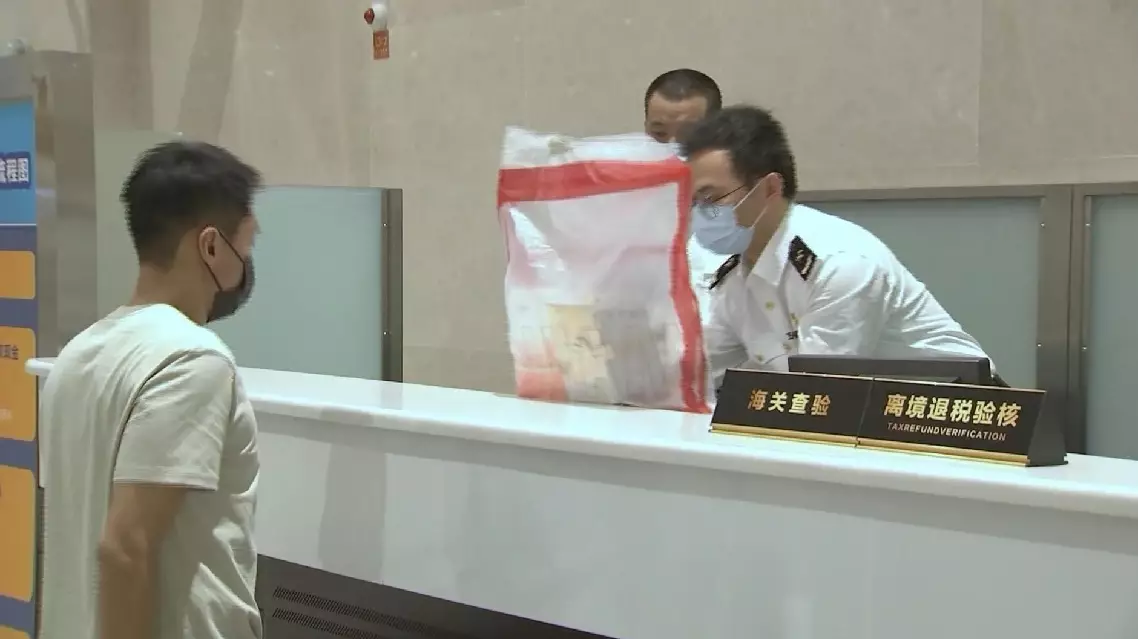
At the heart of the upgraded service is an optimized procedure dubbed the "one document, one bag, one code" process, a simple and streamlined model designed to shorten clearance time for outbound passengers.

Under this framework, travelers who make purchases at designated pilot tax refund stores can have their qualified goods consolidated into a single sealed bag, with all corresponding tax refund information integrated into a unique QR code printed on the tax refund application form.

When departing via the Langqi passenger terminal, on-site customs officers only need to scan the QR code to retrieve and verify the details relating to the applicant's tax refund application. Travelers can then get quick customs clearance once the information is confirmed to be accurate, with no requirement to open their sealed shopping bags for repeated inspections.

Departure tax refund services launched at "mini three links" port in Fuzhou

Departure tax refund services launched at "mini three links" port in Fuzhou

Recommended Articles