Skip to Content Facebook Feature Image

Unexploded ordnances in Gaza pose deadly threat to people

China

China

China

Unexploded ordnances in Gaza pose deadly threat to people

2025-02-04 13:47 Last Updated At:02-05 00:07

Despite the Israeli military withdrawal from several areas of Gaza as part of the first phase of the ceasefire deal, its military operations have left a large number of unexploded bombs and land mines in Gaza, posing a severe threat to civilians.

The Israeli government and military have yet to disclose the total amount of bombs used during the operations in Gaza.

However, according to Palestinian sources, at least 85,000 tonnes of bombs were dropped by Israeli forces in Gaza.

The United Nations estimates that 5 percent to 10 percent of these bombs failed to detonate.

"After the ceasefire, we returned home from the shelters. The destroyed houses and the bombs inside them terrified us. We are very worried and immediately reported it to the municipal bomb disposal teams. This is not an isolated incident; it's common sight at almost every corner in Gaza," said a Gaza resident.

Nasser Hospital, one of the largest hospitals in southern Gaza, has received a large number of patients wounded by the explosion of explosive remnants over the past few days.

A large number of the injured are in critical condition, including many children.

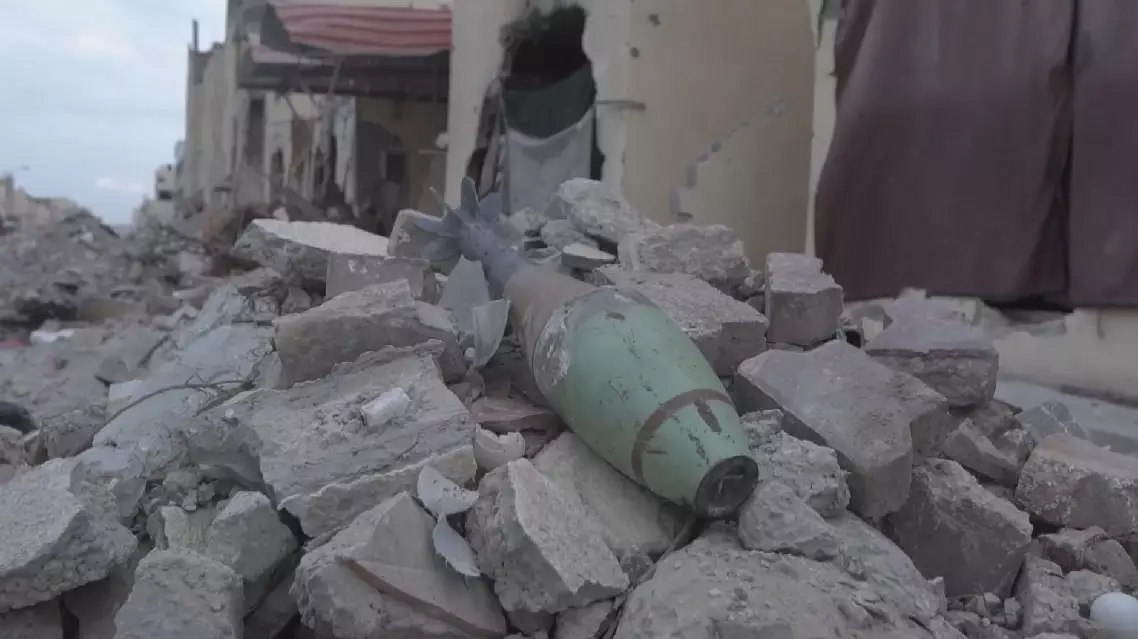
"We've taken numerous photos of objects like these canisters and warned people, especially children, who might mistake for food cans, to stay away. As we all know, the people of Gaza have been suffering from starvation for over a year due to the blockade. So, these canister-like objects are very attractive to children, which will ultimately lead to them getting injured or even losing their lives," said Muhammad Saqr, spokesman of the hospital.

Following the implementation of the first phase of the ceasefire agreement, Israel still maintains a tight blockade on Gaza, preventing international bomb disposal teams from entering.

Local teams are left to handle the situation alone.

The head of the Rafah civil defense bomb disposal team reported that in just a few days, he has personally cleared over 140 explosive devices of different kinds.

"In the areas of Rafah previously occupied by Israeli forces, the most common unexploded ordnances we have found are aerial bombs, especially nearly 1,000 kilograms of MK84 bombs. These unexploded devices are very common in residential areas," said Muhammad Muqdad, head of the bomb disposal team in Rafah.
Unexploded ordnances in Gaza pose deadly threat to people
Unexploded ordnances in Gaza pose deadly threat to people
Unexploded ordnances in Gaza pose deadly threat to people

Unexploded ordnances in Gaza pose deadly threat to people

Unexploded ordnances in Gaza pose deadly threat to people
Unexploded ordnances in Gaza pose deadly threat to people

The Houthis in Yemen are ready to coordinate countermeasures with Iran in response to a U.S. blockade on the Strait of Hormuz, a top adviser said on Tuesday, warning that the Bab al-Mandab Strait could also be blocked if red lines are crossed.

The United States imposed a blockade on the Strait of Hormuz to prevent ships from accessing Iranian ports, which took effect after the Iran-U.S. peace talks, held in Pakistan's capital Islamabad late last week, failed to yield a deal to end the war that the Unite States and Israel launched against Iran on Feb. 28. A two-week ceasefire is set to expire next week.

In an interview with China Global Television Network (CGTN) in Sanaa on Tuesday, Mohammed Taher Anam, an advisor to Yemen's Houthi Supreme Political Council, said these unilateral American actions must be rejected and confronted, so that the United States does not later impose blockades on other countries.

"We reject this blockade and call for confronting it through various means. We are also waiting for Iranian measures and are ready to take similar steps in our region," said Anam.

He said that the Bab al-Mandab Strait and nearby areas can be blocked at any time if red lines are crossed. They are coordinating with their Iranian allies and closely monitoring developments he said, and, at the right moment, they are ready to expand the confrontation against the U.S. and its allies.

The Bab el-Mandeb Strait, a strategic chokepoint linking the Suez Canal and the Red Sea with the Gulf of Aden, serves as a vital corridor for global trade, particularly oil and gas shipments between Europe and Asia.

"We remain ready to take any measures. We are coordinating with our allies in Iran and with friendly countries around the world if needed. One possible step is imposing a blockade against the American blockade. The Americans think they can impose a blockade on the Strait of Hormuz, but this is very difficult. We know Iranian missiles can reach up to 1,000 kilometers to target American ships, keeping them far from the Strait of Hormuz. If the U.S. continues on this path, we in Yemen can take similar steps to Iran, and the Americans will suffer greatly," said Mohammed.

The Houthi group, which has controlled Yemen's capital Sanaa and most northern provinces since late 2014, has voiced full solidarity with Iran since the U.S.-Israeli strikes against the Islamic Republic started.

Houthi official warns of possible key Red Sea strait closure as U.S. continues Hormuz blockade

Houthi official warns of possible key Red Sea strait closure as U.S. continues Hormuz blockade

Recommended Articles