China's countermeasures against the U.S. imposition of a 10-percent additional tariff on Chinese imports are tough, timely and accurate, commented by Yuyuantantian, a new media arm of China Media Group (CMG), on Tuesday.
An edited English-language version of the commentary is as follows:
The Customs Tariff Commission of China's State Council announced on Tuesday a decision to levy additional tariffs on certain imported commodities originating from the United States starting from Feb. 10.
We believe that this action demonstrates China's position and attitude of firmly opposing the unilateralist and hegemonic approaches of the United States and resolutely safeguarding its legitimate rights and interests, while also leaving sufficient means for the two sides to resolve the issue through consultation on the basis of equality and mutual respect.
A noteworthy detail is that the announcement of the Customs Tariff Commission was posted at 13:01 on Feb. 4, which was the time when the 10-percent additional tariff on goods imported from China in the executive order signed by U.S. President Trump officially took effect. The Chinese side immediately made a strong response to the U.S. actions by retaliating with counter tariffs.
Ying Pinguang, a professor at the School of Trade Negotiations of Shanghai University of International Business and Economic, also noted the timing. He said this action shows that China has made a comprehensive and mature analysis of "Trump 2.0", so that it can respond in a timely and accurate manner.
This time, the U.S. imposed additional tariffs on Chinese imports under the pretext of the so-called fentanyl-related issues. In recent years, the U.S. has time and again scapegoated China on its own fentanyl abuse problem, using it as an excuse to impose sanctions on Chinese entities. In fact, the root cause of the fentanyl crisis in the U.S. lies in serious abuse of fentanyl-type substances and incompetence in regulation.
China is one of the world's toughest countries on counter-narcotics both in terms of policy and its implementation. In 2019, China become the first country globally to add the entire category of fentanyl-related substances in its controlled regulatory list. The U.S. itself has admitted that "almost no fentanyl or fentanyl analogues have been detected entering" the U.S. from China since China implemented controls over fentanyl-related substances as a class in 2019.
This time, the U.S. repeated the same old rhetoric again, even linked the so-called fentanyl issue with the unrelated tariff issue. The amateurish and far-fetched approach fully shows the U.S. side's hegemonic nature of trumping up a charge without any justification. Of course, China is firmly opposed to this.
In the face of such actions by the U.S. side, China responded immediately to counter the U.S. move with corresponding tariff levy, which fully demonstrates China's position and attitude of resolutely fighting back and firmly safeguarding its legitimate rights and interests. This action is tough enough.
According to the statement from the Customs Tariff Commission, an additional 15-percent tariff will be imposed on imported coal and liquefied natural gas originating from the U.S., while crude oil, agricultural machinery, high-emission vehicles, and pickup trucks will be subject to an additional tariff of 10 percent.
China's action has three features: First, it is accurate.
We found such a set of figures -- according to estimates, in 2024, China's coal imports from the U.S. accounted for about 12.8 percent of the total coal exports of the U.S.
Crude oil, agricultural machinery, large-emission vehicles, and pickup trucks are industries where the United States holds comparative advantages. However, the imposition of tariffs would greatly diminish their competitiveness in the Chinese market, potentially compelling the U.S. to explore alternative export destinations, said Ying, the School of Trade Negotiations of Shanghai University of International Business and Economic professor.
In the current world economic situation, this is undoubtedly unrealistic.
As the saying goes, hit where it hurts. China's countermeasures are meant to make the U.S. side feel the pain.
Second, it demonstrates China's focus on the bigger picture and commitment to multilateral trade.
What the U.S. has imposed is a 10-percent tariff hike on all imports from China, but what China has announced is a decision to levy additional tariffs on certain U.S. goods. As for the effectiveness of China's countermeasures, we have just explained.
We believe that the reason why China has not taken the same measures as the U.S. is precisely the difference between China and the U.S. -- China is a staunch champion of the multilateral trading system.
There is no bottom line in imposing tariffs. As China is a major trading country, if China raises its tariffs too high against the United States, it will have an impact on the stabilization of the global industrial and supply chains, which is what China does not wish to see. Therefore, 10-percent or 15-percent tariffs essentially reflect China's consideration of the overall situation, Ying analyzed.
Third, the scale of China's tariff hikes means that if the United States insists on going even further down the wrong path, then China still has enough room to take countermeasures and strike.
Cui Fan, a professor at the School of International Trade and Economics of the University of International Business and Economics, said that in a coming period of time, the Chinese government may continue to dynamically adjust the relevant countermeasures in accordance with further moves taken by the U.S.
China's attitude in this action is very clear: if the United States wants to wage a trade war, China will not flinch. Of course, if it wants dialogue, China's door remains open.
There is no winners in a trade war. China is committed to resolving issues through consultation.
The Chinese side always believes that China and the U.S. should respect each other, coexist peacefully and cooperate for win-win outcome. The nature of China-U.S. economic and trade relations is mutually beneficial. Confrontation and conflict should not be our choice.
The failure of predecessors teaches one a good lesson on what happened afterwards. What the U.S. side needs to consider is not to fall twice in the same pit.
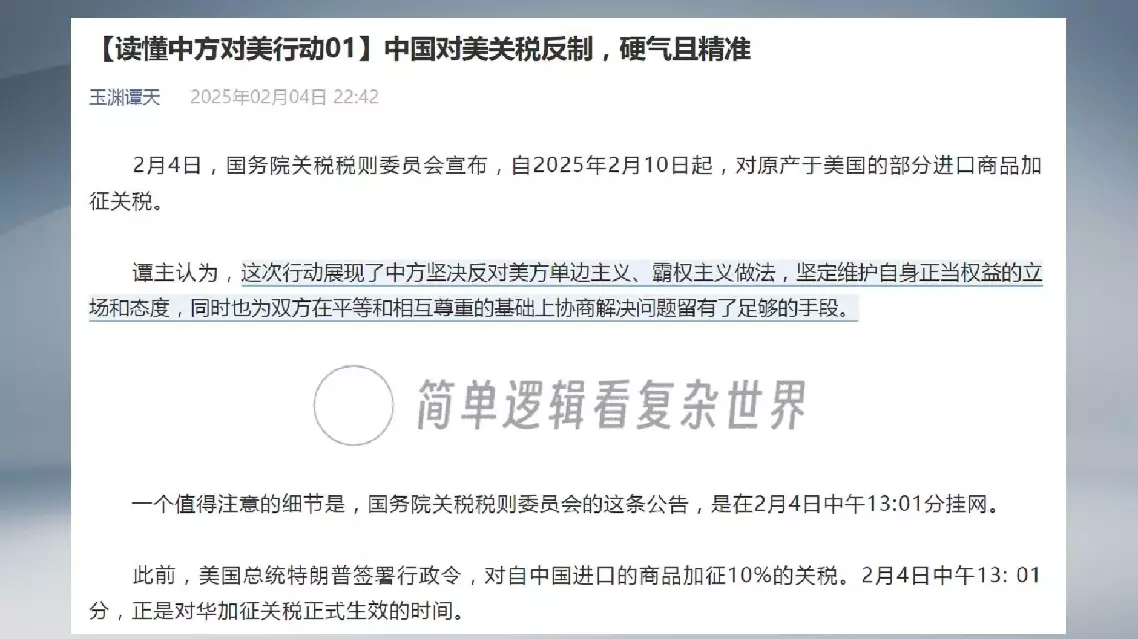
China's countermeasures against U.S. tariff hikes tough, accurate: CMG commentary