CHEYENNE, Wyo. (AP) — Putting carbon dioxide from power plants and industrial facilities underground where it won’t contribute to global warming could see less federal support and enthusiasm under President Donald Trump. But experts and industry advocates doubt demand for the technology will go away as long as utilities face state-level climate change goals.
Trump has vowed to “drill, baby, drill” for fossil fuels and ordered the U.S. to withdraw from the landmark Paris agreement to try to limit Earth's warming. Meanwhile, his new energy secretary, Chris Wright, has vowed to prioritize “affordable, reliable and secure energy” in a policy-setting order that criticizes zero-carbon goals and makes no mention of carbon capture.
Carbon capture's doubters include both conservative policy organizations and environmental groups . Even so, its outlook in the U.S. isn't all bleak.
Carbon capture got a $12 billion boost under Joe Biden through increased tax incentives and funding through the Inflation Reduction Act and Bipartisan Infrastructure Law. With projects scattered nationwide, including dozens in Republican states, there may be less appetite to include them in budget cuts, said analyst Rohan Dighe with the energy and resources research firm Wood Mackenzie.
But a broader trend away from “environmental, social and governance” investing, or ESG, could sap momentum for carbon capture, Dighe said by email.
“So even absent government rollback of funding, we could see fewer project announcements and movements due to lower interest in decarbonizing,” Dighe wrote.
Carbon capture involves separating carbon dioxide from the emissions of power plants and other industrial facilities and pumping it underground. The goal can be either to store it permanently so it doesn't contribute to climate change, or to pressurize an oilfield to help increase production.
Carbon capture has deep support in Republican Wyoming, home to projects including an ExxonMobil plant that separates CO2 from sour gas wells for use in aging oilfields and another experimenting with putting power plant CO2 underground.
In 2021, GOP Gov. Mark Gordon pledged to make the sparsely populated state — which exports 12 times more energy than it consumes — not just carbon neutral but “carbon negative.”
Carbon capture features prominently in that plan. In 2020, Wyoming, which contributed tens of millions of dollars for a carbon capture research facility at an operating power plant, became one of the first states to regulate underground carbon dioxide injection itself rather than through the EPA. That list now also includes Louisiana, North Dakota and West Virginia.
But there’s also growing skepticism in Wyoming, the nation's top coal producer. With Trump back in office, some question the need for greenhouse gas goals.
One state lawmaker recently proposed legislation titled “Make Carbon Dioxide Great Again” that would back off carbon capture including a 2020 state law requiring utilities to study how much it would cost to install at the state's fossil-fuel-fired power plants.
No other lawmakers supported the bill and it failed.
Meanwhile, Gordon is sticking with carbon capture to help protect Wyoming's coal industry. Eighteen states that account for almost two-thirds of Wyoming's coal market have renewable energy and carbon-neutrality goals, Gordon spokesman Michael Pearlman said by email.
"To keep that market, we have to use carbon capture," Pearlman wrote.
The billions of dollars in federal grants for carbon capture approved under Biden have aided dozens of carbon capture projections nationwide through the Department of Energy’s CarbonSAFE program. Seven are in Wyoming.
The future of the “45Q” tax credit for carbon capture projects especially worries the Carbon Capture Coalition, a group of more than 100 environmental groups, unions and companies. It recently urged Congress to uphold the credit, which was included in the Inflation Reduction Act.
To date, the Petra Nova facility outside Houston, whose CO2 is used to increase production at nearby oilfields, is the nation's only power plant that puts the greenhouse gas underground on a commercial scale. More could be coming eventually. Government support helped spur 270 carbon capture projects across the U.S. in the past few years, the coalition wrote to congressional leaders.
“We wanted to kind of put a stake in the ground,” said Madelyn Morrison, the group’s government affairs director.
Republicans have voted dozens of times, unsuccessfully, to repeal portions of the Inflation Reduction Act when they held a minority in the Senate, according to the Brookings Institution. Now that they control the Senate, House and White House, the bar to repeal is lower.
That would have support from the conservative Heritage Foundation, a longstanding opponent of carbon capture. Requiring carbon capture for coal- and gas-fired power plants would be costly just when electric vehicles are increasing energy demand, the group argued in a paper last year.
Others on the right say building out the network of pipelines and injection wells necessary for carbon capture threatens to trample on private property rights.
“Carbon capture and storage projects are nothing more than an opportunistic scheme to make vast sums of money from a problem that arguably does not exist,” concluded a January report by the conservative Heartland Institute that recommended abolishing the 45Q tax credit.
Earthjustice and other environmental groups oppose carbon capture largely because they see it as dubious cover to maintain fossil fuel production.
For the Carbon Capture Coalition, the technology is a middle ground recognizing that neither carbon-free energy production nor an end to burning fossil fuels will happen overnight. Even if Trump is all in for fossil fuels, U.S. consumers and the global market will demand the technology, the group says.
“In order for these American industries to really remain competitive, not only in domestic markets, but really in the global marketplace, their businesses really depend on investing in innovative solutions like carbon management,” Morrison said.
The Associated Press’ climate and environmental coverage receives financial support from multiple private foundations. AP is solely responsible for all content. Find AP’s standards for working with philanthropies, a list of supporters and funded coverage areas at AP.org.
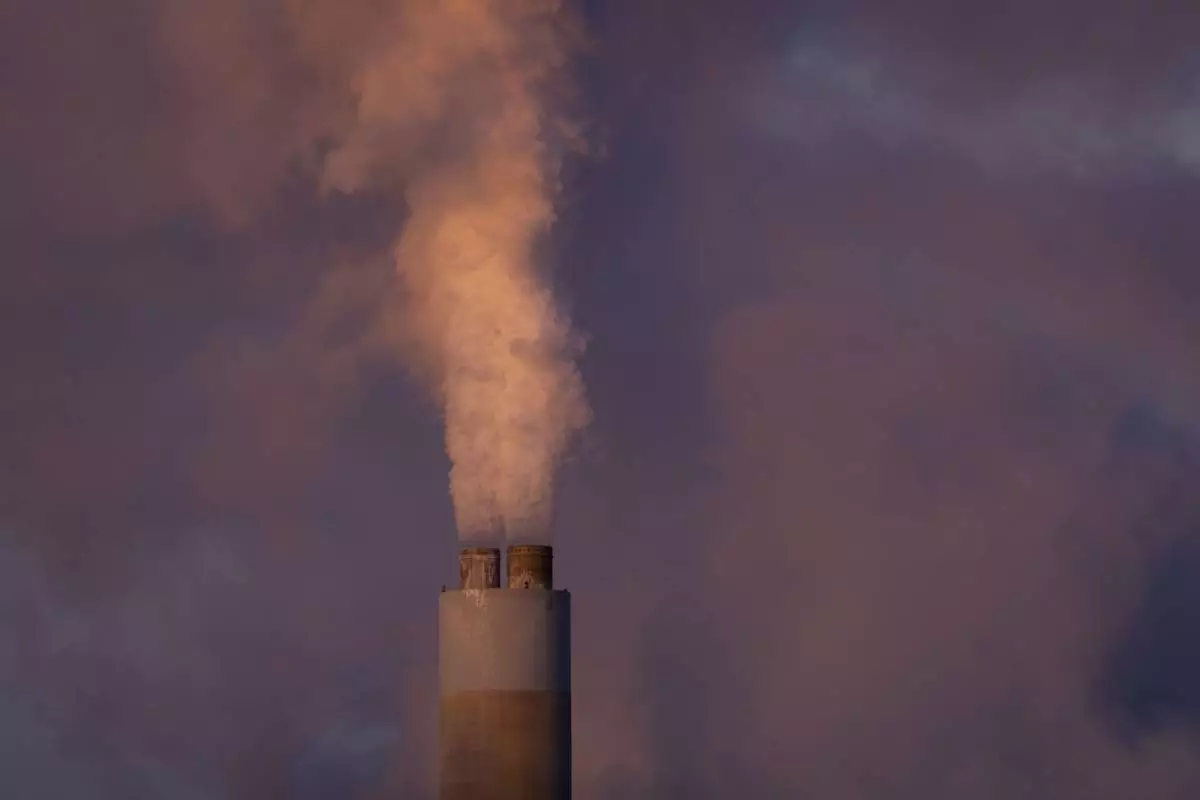
FILE - Carbon dioxide and other pollutant billows from a stack at PacifiCorp’s coal-fired Naughton Power Plant, near where Bill Gates company, TerraPower plans to build an advanced, nontraditional nuclear reactor, Jan. 13, 2022, in Kemmerer, Wyo. (AP Photo/Natalie Behring, File)