SEOUL, South Korea (AP) — Ahn Sung-ki, one of South Korean cinema’s biggest stars whose prolific 60-year career and positive, gentle public image earned him the nickname “The Nation’s Actor,” died Monday. He was 74.
Ahn, who had blood cancer for years, died at Seoul's Soonchunhyang University Hospital, his agency, the Artist Company, and hospital officials said.
“We feel deep sorrow at the sudden, sad news, pray for the eternal rest of the deceased and offer our heartfelt condolences to his bereaved family members," the Artist Company said in a statement.
President Lee Jae Myung issued a condolence message, saying Ahn provided many people with comfort, joy and time for reflection. “I already miss his warm smile and gentle voice,” Lee wrote on Facebook.
Born to a filmmaker in the southeastern city of Daegu in 1952, Ahn made his debut as a child actor in the movie “The Twilight Train” in 1957. He subsequently appeared in about 70 movies as a child actor before he left the film industry to live an ordinary life.
In 1970, Ahn entered Seoul’s Hankuk University of Foreign Studies as a Vietnamese major. Ahn said he graduated with top honors but failed to land jobs at big companies, who likely saw his Vietnamese major as largely useless after a communist victory in the Vietnam War in 1975.
Ahn returned to the film industry in 1977 believing he could still excel in acting. In 1980, he rose to fame for his lead role in Lee Jang-ho’s “Good, Windy Days,” a hit coming-of-age movie about the struggle of working-class men from rural areas during the country’s rapid rise and transition. Ahn won the best new actor award in the prestigious Grand Bell Awards, the Korean version of the Academy Awards.
He later starred in a series of highly successful and critically acclaimed movies, sweeping best actor awards and becoming arguably the country’s most popular actor in much of the 1980s-90s.
Some of his memorable roles included a Buddhist monk in 1981’s “Mandara,” a beggar in 1984’s “Whale Hunting,” a Vietnam War veteran-turned-novelist in 1992’s “White Badge,” a corrupt police officer in 1993’s “Two Cops,” a murderer in 1999’s “No Where To Hide,” a special forces trainer in 2003’s “Silmido” and a devoted celebrity manager in 2006’s “Radio Star.”
Ahn had collected dozens of trophies in major movie awards in South Korea, including winning the Grand Bell Awards for best actor five times, an achievement no other South Korean actor has matched.
Ahn built up an image as a humble, trustworthy and family-oriented celebrity who avoided major scandals and maintained a quiet, stable personal life. Past public surveys chose Ahn as South Korea’s most beloved actor and deserving of the nickname “The Nation’s Actor.”
Ahn said he earlier felt confined with his “The Nation's Actor” labeling but eventually thought that led him down the right path. “I felt I should do something that could match that title. But I think that has eventually guided me in a good direction,” Ahn said in an interview with Yonhap news agency in 2023.
In media interviews, Ahn couldn’t choose what his favorite movie was, but said that his role in “Radio Star” as a dedicated, hardworking manger for a washed-up rock singer played by Park Jung-hoon resembled himself in real life the most.
Ahn was also known for his reluctance to do love scenes. He said said he was too shy to act romantic scenes and sometimes asked directors to skip steamy scenes if they were only meant to add spice to movies.
“I don’t do well on acting like looking at someone who I don’t love with loving eyes and kissing really romantically. I feel shy and can’t express such emotions well,” Ahn said in an interview with the Shindonga magazine in 2007. “Simply, I’m clumsy on that. So I couldn’t star in such movies a lot. But ultimately, that was a right choice for me.”
Ahn is survived by his wife and their two sons. A mourning station at a Seoul hospital was to run until Friday.

FILE - South Korean actor Ahn Sung-ki smiles for a photo on the red carpet at the 56th Daejong Film Awards ceremony in Seoul, South Korea, June 3, 2020. (AP Photo/Ahn Young-joon, File)

FILE - South Korean actor Ahn Sung-ki attends an event as part of the 11th Pusan International Film Festival in Busan, South Korea, Oct. 13, 2006. (AP Photo/Kin Cheung, File)
CAPE CANAVERAL, Fla. (AP) — NASA’s Artemis II astronauts fired their engines and blazed toward the moon Thursday night, breaking free of the chains that have trapped humanity in shallow laps around Earth in the decades since Apollo.
The so-called translunar ignition came 25 hours after liftoff, putting the three Americans and a Canadian on course for a lunar fly-around early next week. Their Orion capsule bolted out of orbit around Earth right on cue and chased after the moon to nearly 250,000 miles (400,000 kilometers) away.
“Ladies and gentlemen, I am so, so excited to be able to tell you that for the first time since 1972 during Apollo 17, human beings have left Earth orbit,” NASA’s Lori Glaze announced at a news conference.
The engine firing was flawless, she noted.
Canadian astronaut Jeremy Hansen said he and his crewmates were glued to the capsule's windows as they left Earth in the rearview mirror, taking in the “phenomenal” views. Their faces were pressed so tightly against the windows that they had to wipe them clean.
“Humanity has once again shown what we are capable of, and it’s your hopes for the future that carry us now on this journey around the moon,” Hansen said.
NASA had the Artemis II crew stick close to home for a day to test their capsule’s life-support systems before clearing them for lunar departure.
Now committed to the moon, the Artemis II test flight is the opening act for NASA’s grand plans for a moon base and sustained lunar living.
Commander Reid Wiseman, pilot Victor Glover, Christina Koch and Hansen will dash past the moon then hang a U-turn and zip straight home without stopping on land. In the process, they will become the farthest humans have ever traveled from Earth, breaking the Apollo 13 distance record set in 1970. They also may become the fastest during their reentry at flight’s end on April 10.
Glover, Koch and Hansen already have made history as the first Black, the first woman and the first non-U.S. citizen to launch to the moon. Apollo’s 24 lunar travelers were all white men.
To set the mood for the day’s main event, Mission Control woke up the crew with John Legend’s “Green Light” featuring Andre 3000 and a medley of NASA teams cheering them. “We are ready to go,” Glover said.
Mission Control gave the final go-ahead minutes before the critical engine firing, telling the astronauts that they were embarking on “humanity’s lunar homecoming arc” to bring them back to Earth. The capsule is relying on the gravity of Earth and the moon — termed a free-return lunar trajectory — to complete the round-trip figure-eight loop. The engine accelerated their capsule to more than 24,000 mph (38,000 kph) to shove them out of Earth's orbit.
“With this burn to the moon, we do not leave Earth. We choose it,” Koch said.
Flight director Judd Frieling said he and his team were all business while on duty but will likely reflect on the momentousness of it all once they go home. “I suspect everybody understands that this is a once-in-a-lifetime moment," he told reporters.
The next major milestone will be Monday’s lunar flyby.
Orion will zoom 4,000 miles (6,400 kilometers) beyond the moon before turning back, providing unprecedented and illuminated views of the lunar far side, at least for human eyes. The cosmos will even treat the Artemis II astronauts to a total solar eclipse as the moon temporarily blocks the sun from their perspective.
While awaiting their orbital departure earlier Thursday, the astronauts savored the views of Earth from tens of thousands of miles high. Koch told Mission Control that they can make out the entire coastlines of continents and even the South Pole, her old stomping ground.
NASA is counting on the test flight to kickstart the entire Artemis program and lead to a moon landing by two astronauts in 2028.
The so-called lunar loo may need some design tweaks, however.
Orion's toilet malfunctioned as soon as the Artemis crew reached orbit Wednesday evening. Mission Control guided astronaut Koch through some plumbing tricks and she finally got it going, but not before having to resort to using contingency urine storage bags.
The urine pouches are serving double duty. Mission Control ordered the crew to fill a bunch of the empty bags with water from the capsule’s dispenser on Thursday. A valve issue arose with the dispenser following liftoff, and NASA wanted plenty of drinking water on hand for the crew in case the problem recurred. The astronauts used straws and syringes to fill the pouches with more than 2 gallons (7 liters) worth before pivoting to the moon.
The Associated Press Health and Science Department receives support from the Howard Hughes Medical Institute’s Department of Science Education and the Robert Wood Johnson Foundation. The AP is solely responsible for all content.
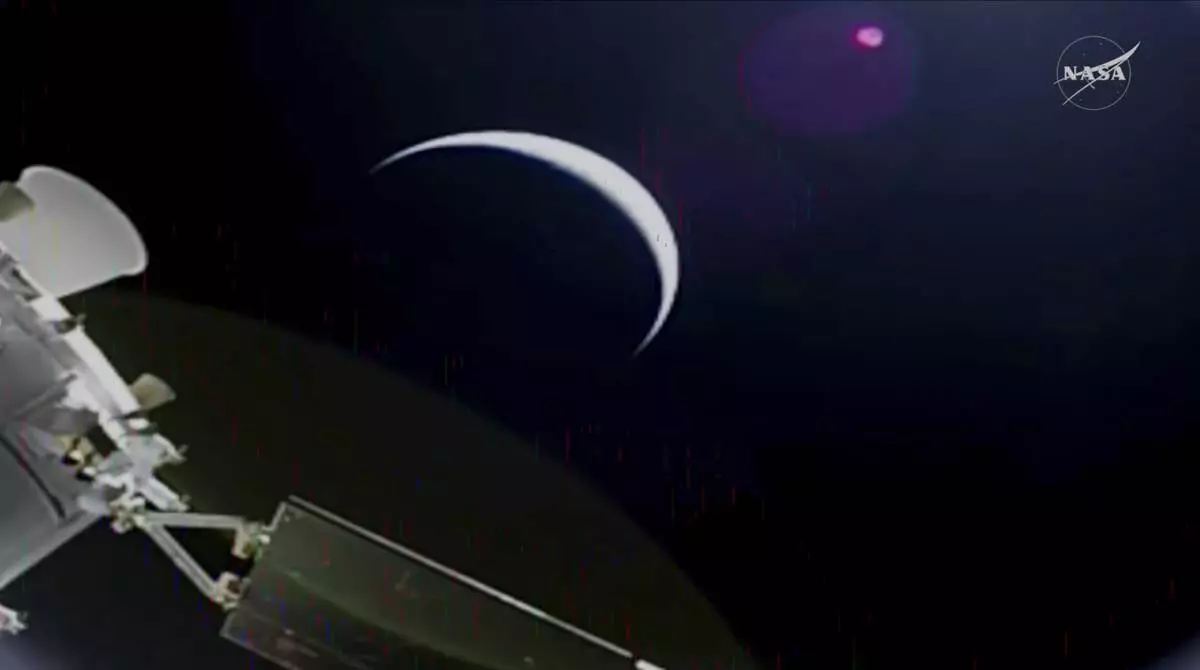
This image released by NASA on Thursday, April 2, 2026, shows NASA’s Orion spacecraft with Earth in the background. (NASA via AP)

This image taken from video provided by NASA shows the Earth, left, from NASA's Orion spacecraft as it fired its engines heading toward the moon Thursday, April 2, 2026. (NASA via AP)
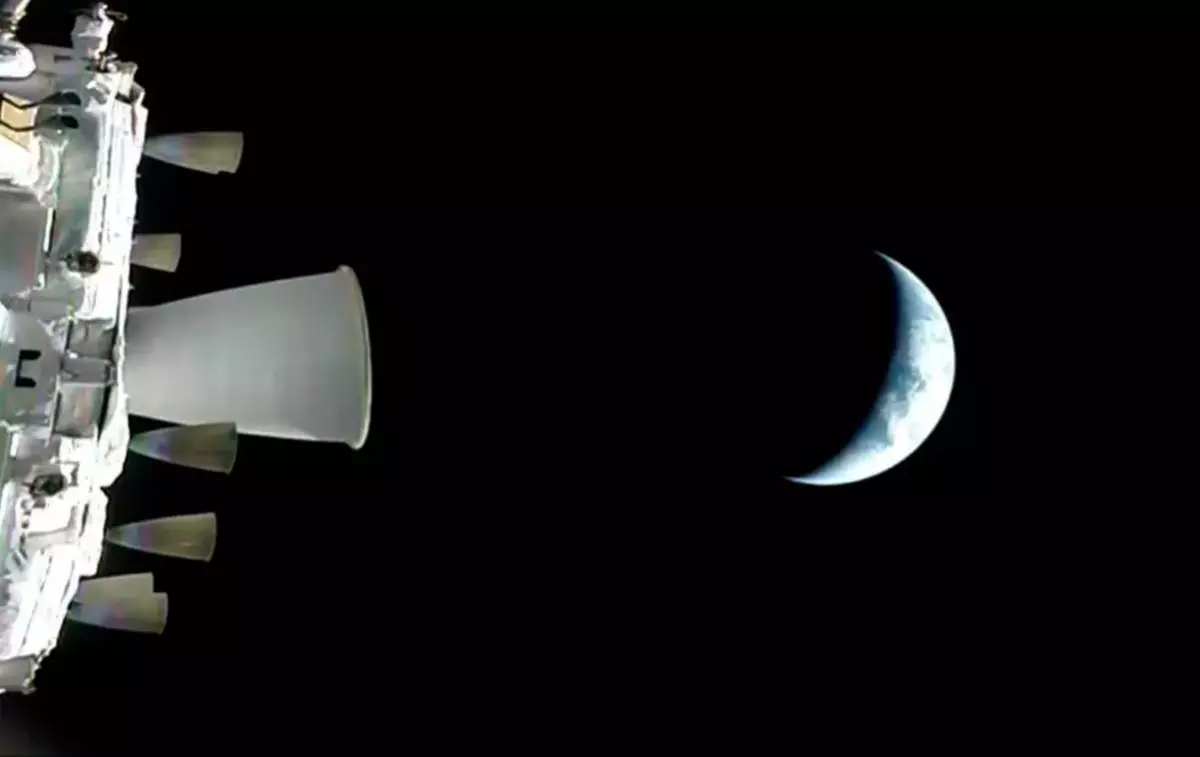
In this photo provided by NASA, a view of the Earth from NASA's Orion spacecraft as it orbits above the planet during the Artemis II test flight, on Thursday, April 2, 2026. (NASA via AP)
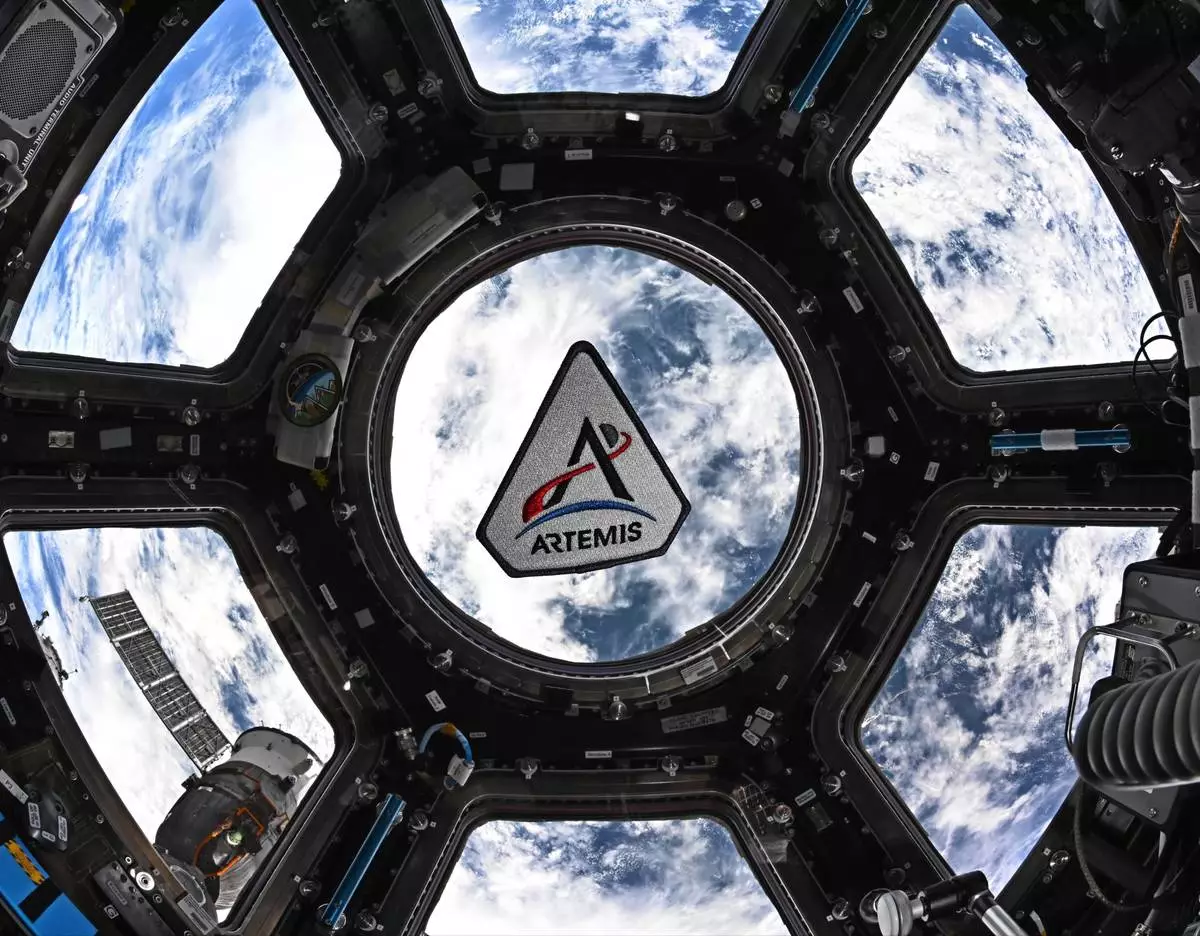
In this photo provided by NASA, an Artemis program patch floating in the International Space Station's cupola, on March 30, 2026. (Jessica Meir/NASA via AP)

Spectators view NASA's Artemis II moon rocket launch from the A. Max Brewer Bridge, Wednesday, April 1, 2026, in Titusville, Fla. (AP Photo/Phelan M. Ebenhack)
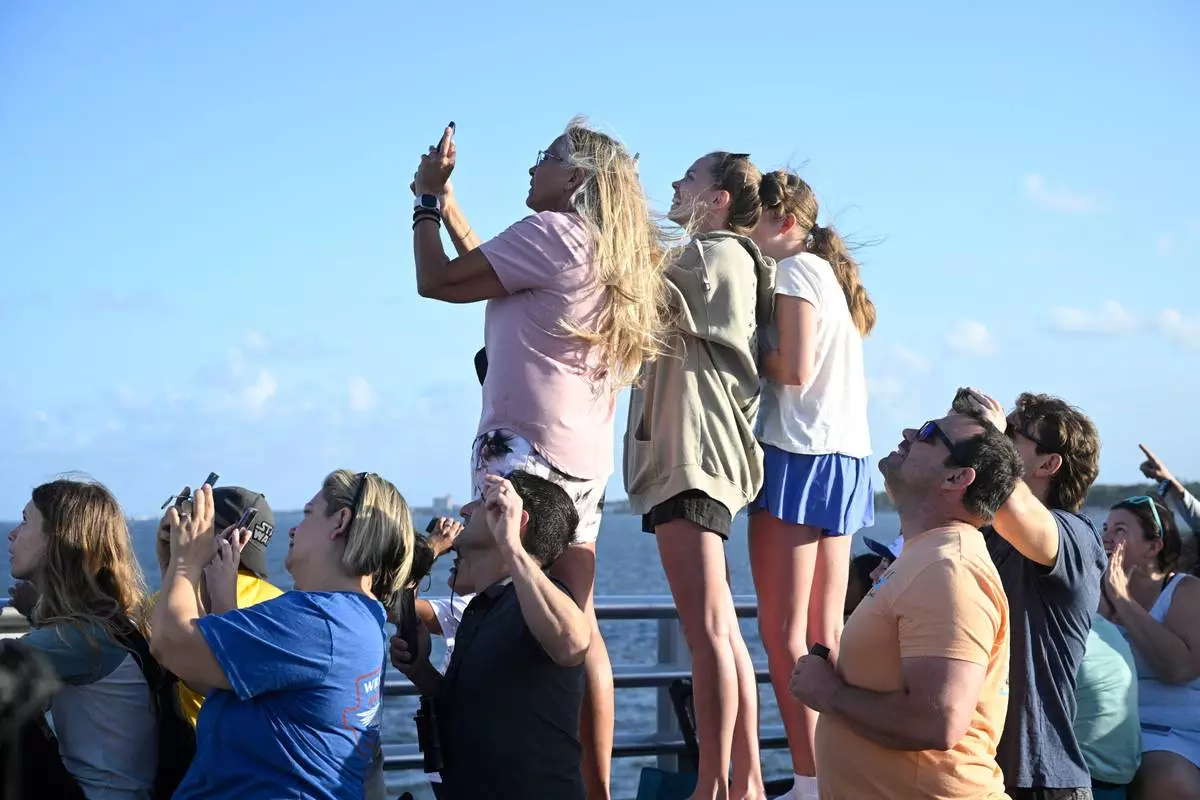
Spectators view NASA's Artemis II moon rocket launch from the A. Max Brewer Bridge, Wednesday, April 1, 2026, in Titusville, Fla. (AP Photo/Phelan M. Ebenhack)

NASA's Artemis II moon rocket lifts off from the Kennedy Space Center's Launch Pad 39-B Wednesday, April 1, 2026, in Cape Canaveral, Fla. (AP Photo/Chris O'Meara)
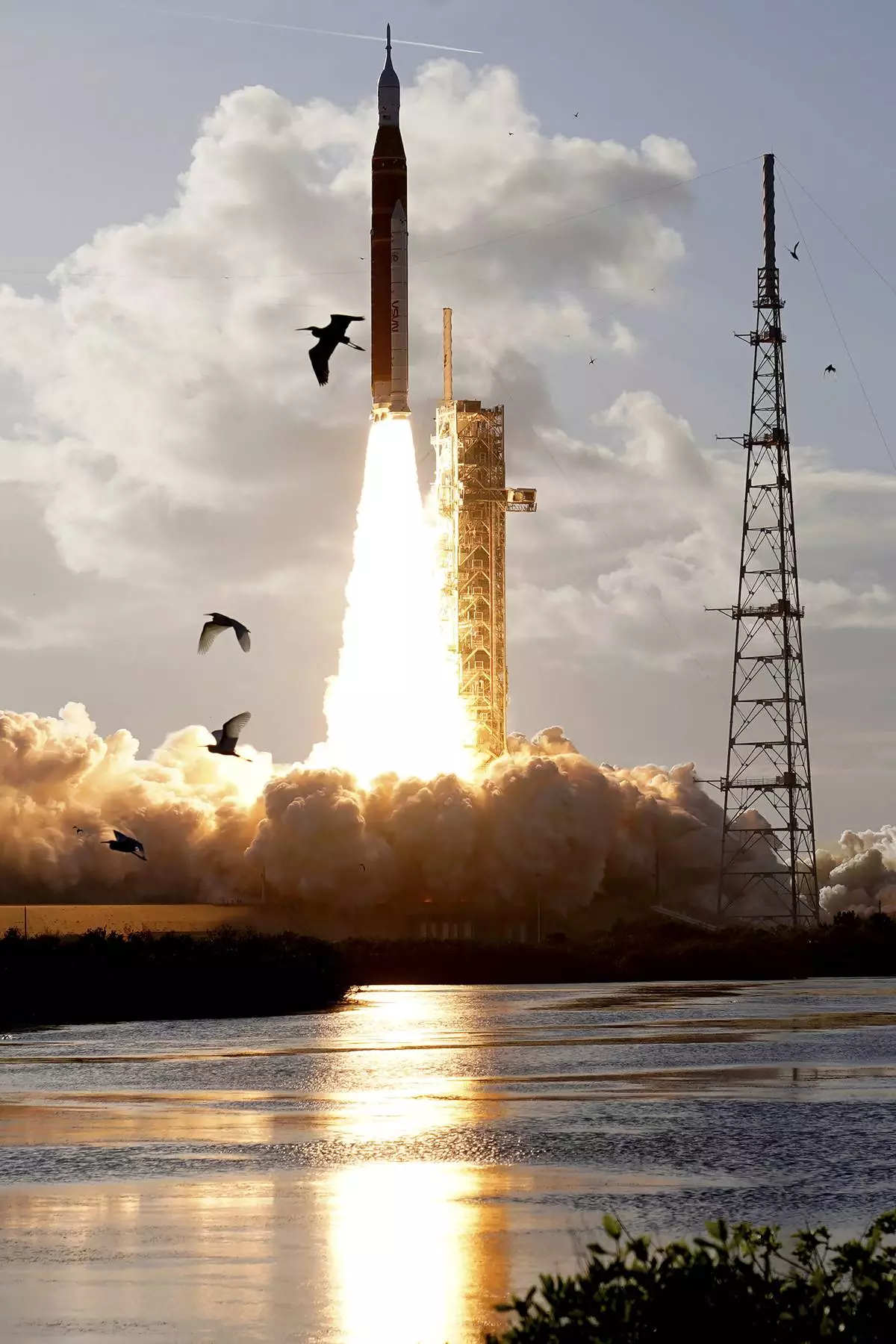
NASA's Artemis II moon rocket lifts off from the Kennedy Space Center's Launch Pad 39-B Wednesday, April 1, 2026, in Cape Canaveral, Fla. (AP Photo/Chris O'Meara)
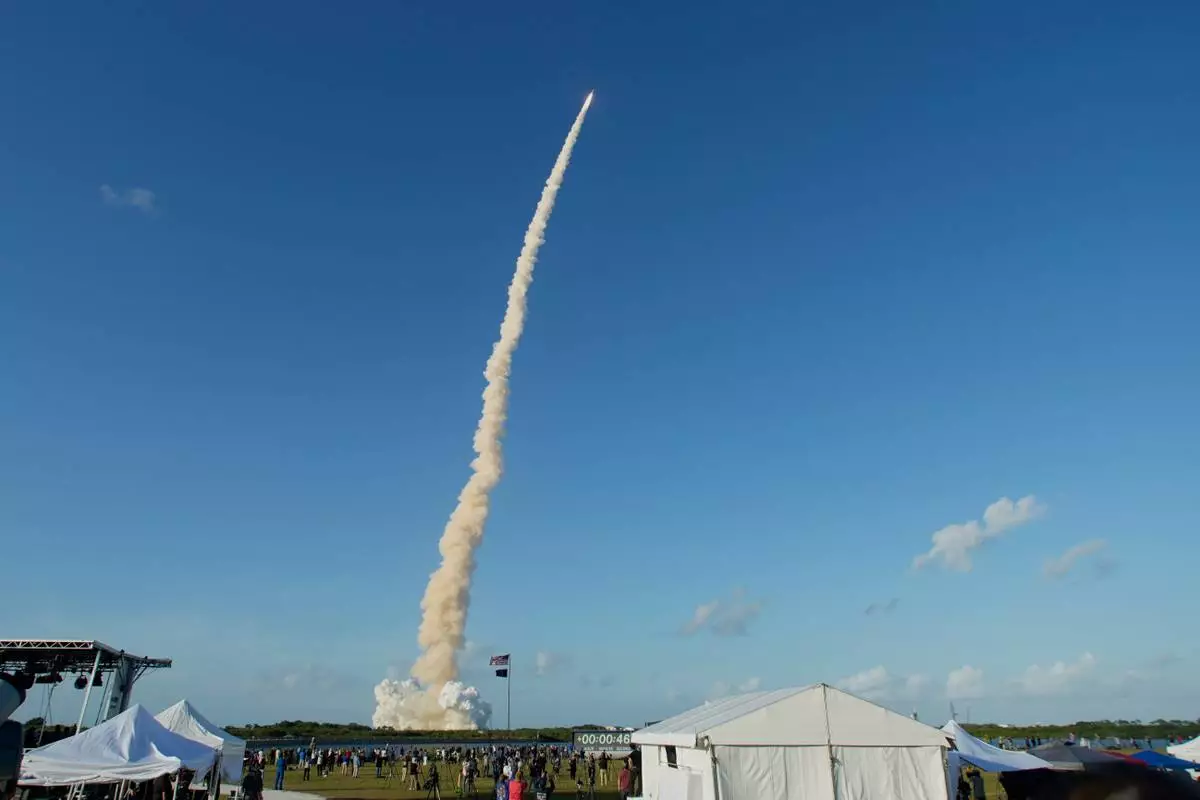
NASA's Artemis II moon rocket lifts off from the Kennedy Space Center's Launch Pad 39-B Wednesday, April 1, 2026, in Cape Canaveral, Fla. (AP Photo/John Raoux)