DUBAI, United Arab Emirates (AP) — A performer at Kendrick Lamar’s Super Bowl halftime show unfurled a flag emblazoned with the words Sudan and Gaza in a protest over the two wars that are roiling the Middle East.
Security at the stadium detained the performer shortly after waving the flag atop a car used as a prop in the performance. The New Orleans police said Monday the performer would face no charges.
The NFL said the person would be banned for life from NFL stadiums and events, while the company behind the halftime show said it was not part of the planned performance.
So, what was this protest about, what's happening in the Gaza Strip and Sudan — and how does it affect the wider world?
Here is what's going on:
The Gaza Strip is an enclave along the Mediterranean Sea bordered by Egypt and Israel. It covers some 360 square kilometers (140 square miles) — about twice the size of Washington and 3½ times the size of Paris. But it's incredibly densely populated and was home to 2.3 million Palestinians before the start of the 2023 Israel-Hamas war.
The war began when Hamas, a militant group that's ruled Gaza since 2007, stormed across the border into Israel, killing some 1,200 people and taking 250 hostage. Israel responded with a devastating ground and air campaign across Gaza, killing more than 47,000 Palestinians, according to local health authorities, who do not differentiate between fighters and noncombatants in their count. Much of the territory has been left in ruins, and it's unclear how it could be rebuilt.
A ceasefire in the war began on Jan. 19. Palestinian militants have freed hostages while Israel has released Palestinians held in prisons there. However, worries remain over whether the peace will hold.
Comments by President Donald Trump, who was on hand Sunday night for the Super Bowl, suggesting the U.S. was “committed to buying and owning Gaza,” also have upended discussions about the enclave's future. Hamas said Monday it will delay the further release of hostages in the Gaza Strip after accusing Israel of violating the ceasefire as Israel canceled leave for soldiers assigned to Gaza.
The Palestinians want the Gaza Strip and the West Bank for a future state of their own, with east Jerusalem as its capital. That long-sought, two-state solution for the decadeslong conflict is backed by Mideast nations and much of the international community. Israel has expressed openness to the idea of resettling Gaza’s population, with Israeli Prime Minister Benjamin Netanyahu on Sunday calling it "a revolutionary, creative vision." Hamas, the Palestinians and much of the world have rejected it.
Sudan, a nation in northeastern Africa, has been unstable since a popular uprising forced the removal of longtime autocratic President Omar al-Bashir in 2019. A short-lived transition to democracy was derailed when army chief Gen. Abdel-Fattah Burhan and Gen. Mohammed Hamdan Dagalo of the paramilitary Rapid Support Forces led a military coup in 2021.
The RSF and Sudan’s military began fighting each other in 2023. Their conflict has killed more than 28,000 people, forced millions to flee their homes and left some families eating grass in a desperate attempt to survive as famine sweeps parts of the country. Other estimates suggest a far higher death toll in the civil war.
In recent weeks, Burhan's forces, including Sudan's military and allied militias, have advanced against the RSF. They retook a key refinery north of Khartoum, Sudan's capital. They've also pushed in on RSF positions around Khartoum itself. The fighting has led to an increase in civilian casualties. From Jan. 31 until Feb. 5, the U.N.s' Human Rights Office documented at least 275 civilian deaths from artillery, airstrikes and drone assaults.
“Indiscriminate attacks, as well as threats and attacks directed against civilians, must cease immediately,” said Seif Magango, a spokesperson for the Human Rights Office. “The Sudanese Armed Forces and the Rapid Support Forces — and their allied movements and militias — must respect their international law obligations and take concrete steps to protect civilians from harm, including humanitarian workers and human rights defenders.”
Online, activists have sought to draw attention to both Gaza and Sudan, though the conflicts have different roots and participants. The idea of the two conflicts being linked by their devastation has been made by celebrities.
In August, American rapper Macklemore said he canceled a concert in Dubai over the United Arab Emirates’ role “in the ongoing genocide and humanitarian crisis” in Sudan through its reported support of the paramilitary RSF. While the UAE repeatedly has denied arming the RSF, U.N. experts reported “credible” evidence last year showed that the Emirates sent weapons to the RSF several times a week from northern Chad.
Macklemore at the time said he reconsidered the show in part over his recent, public support of Palestinians over the Israel-Hamas war. He has been performing a song called “Hind’s Hall,” in honor of a young girl named Hind Rajab who was killed in Gaza in a shooting that Palestinians have blamed on Israeli forces opening fire on a civilian car.
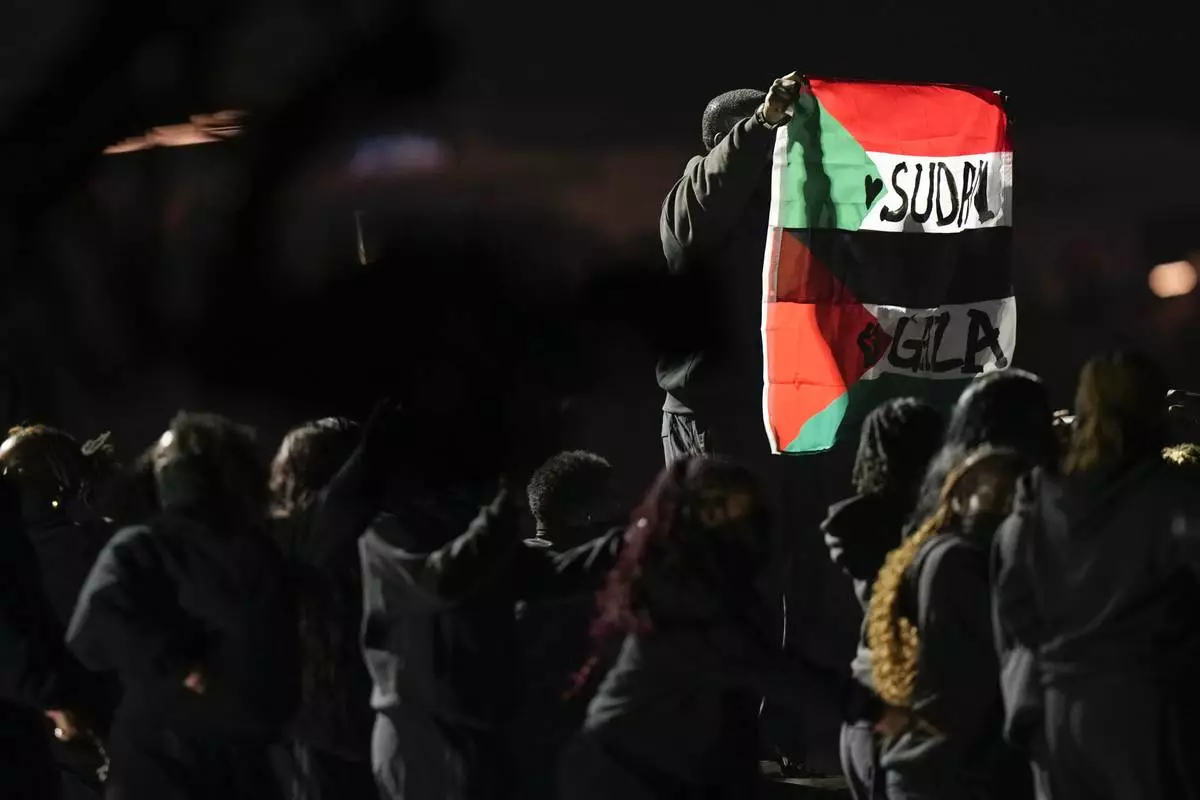
An attendee holds flags during halftime of the NFL Super Bowl 59 football game between the Kansas City Chiefs and the Philadelphia Eagles, Sunday, Feb. 9, 2025, in New Orleans. (AP Photo/Frank Franklin II)
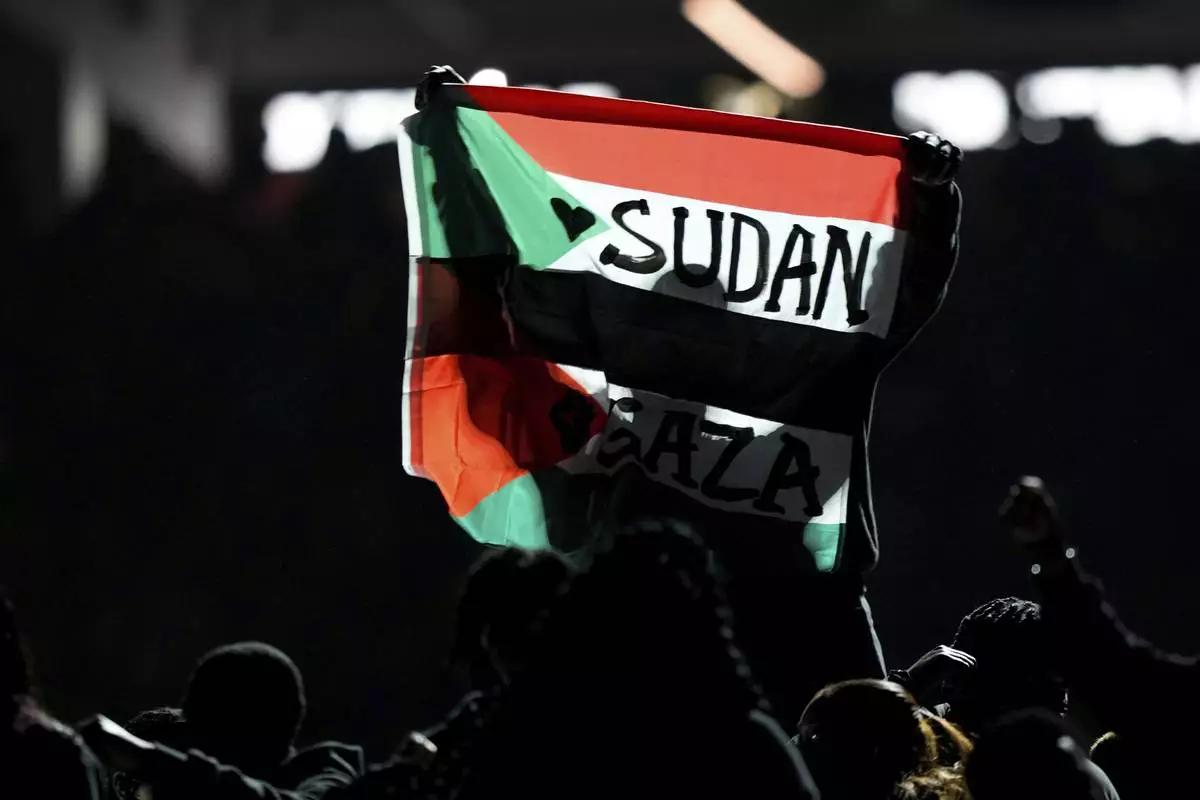
A flag is raised during halftime of the NFL Super Bowl 59 football game between the Kansas City Chiefs and the Philadelphia Eagles, Sunday, Feb. 9, 2025, in New Orleans. (AP Photo/Matt Slocum)
PITTSBURGH (AP) — Lamar Jackson thought it was over. That the Baltimore Ravens' unwieldy season would end up in a familiar spot: the playoffs.
Then, rookie kicker Tyler Loop's potential game-winning field goal from 44 yards out drifted a little right. And then a little further right. And then a little further right still.
By the time it fluttered well wide of the goalposts, the playoffs were gone. So was Jackson's certainty after a 26-24 loss to Pittsburgh on Sunday night sent the Ravens into what could be a turbulent offseason.
“I'm definitely stunned, man,” Jackson said. “I thought we had it in the bag. ... I don't know what else we can do.”
Jackson, who never really seemed fully healthy during his eighth season as he battled one thing after another, did his part. The two-time NFL MVP passed for 238 yards and three touchdowns, including two long connections with Zay Flowers in the fourth quarter that put the Ravens (8-9) in front.
It just wasn't enough. Baltimore's defense, which played most of the second half without star safety Kyle Hamilton after Hamilton entered the concussion protocol, wilted against 42-year-old Steelers quarterback Aaron Rodgers.
Rodgers passed for a season-high 294 yards, including a 26-yard flip to a wide-open Calvin Austin with 55 seconds to go after a defender slipped, symbolic of a season in which Baltimore's defense only occasionally found its form.
Still, the Ravens had a chance when Jackson found Isaiah Likely for a 28-yard gain on fourth down from midfield. A couple of snaps later, the 24-year-old Loop walked on to try to lift Baltimore to its third straight division title.
Instead, the rookie said he “mishit” it. Whatever it was, it never threatened to sneak between the goalposts.
“It’s disappointing,” Loop said.
Loop was talking about the game. He might as well have been talking about his team's season.
The Ravens began 1-5 as Jackson dealt with injuries and the defense struggled to get stops. Baltimore found a way to briefly tie the Steelers for first in late November, only to then split its next four games, including a home loss to Pittsburgh.
Still, when Jackson and the Ravens walked onto the Acrisure Stadium turf on Sunday night in the 272nd and final game of the NFL regular season, Baltimore was confident. The Ravens drilled Pittsburgh in the opening round of the playoffs a year ago behind the ever-churning legs of running back Derrick Henry.
When Henry ripped off a gain of 40-plus yards on the game's first offensive snap, it looked like it was going to be more of the same. While Henry did rush for 126 yards and joined Hall of Famer Barry Sanders as the only running backs in NFL history to have five 1,500-yard seasons, he was less effective in the second half.
Even that first run was telling of what night it was going to be, as an illegal block by wide receiver Zay Flowers cost Baltimore some field position. The Ravens ended up scoring on the drive anyway, thanks to a 38-yard fourth-down flip from Jackson to a wide-open Devontez Walker, but it started a pattern that was hard to shake as several steps forward were met with one step back on a night the Ravens finished with nine penalties for 78 yards.
“We were having a lot of penalties, which kept stopping drives," Jackson said. “But I'm proud of my guys because we kept overcoming. We kept overcoming adversity and situations like this. Divisional games (can) be like that sometimes.”
Particularly when the Steelers are on the other side of the line of scrimmage. Pittsburgh has won 10 of the last 13 meetings. And while a handful of them have been in late-season matchups with the Ravens already assured of reaching the playoffs, the reality is the Steelers have been able to regularly do something that most others have not: found a way to beat Jackson.
“It comes down to situations like this,” Jackson said. “Two-point conversion one year. Field goal another year. And again this year. Just got to find a way to get that win here.”
And figure out who is going to be around to help get it.
Head coach John Harbaugh's 18th season in Baltimore ended with the Ravens missing the playoffs for just the second time in eight years. Jackson turns 29 this week and is still one of the most electric players in the league.
Yet Harbaugh and Jackson have yet to find a way to have that breakthrough season that Harbaugh enjoyed with Joe Flacco in 2013 when the Ravens won the Super Bowl.
There was hope when the season began that the roadblocks that have long been in the franchise's way — Kansas City and Patrick Mahomes chief among them — would be gone.
While the Ravens did get their way in a sense — the Chiefs will watch the playoffs from afar for the first time in a decade after a nightmarish season of their own — it never all came together.
Jackson declined to endorse Harbaugh returning for a 19th season, saying the loss was still too fresh to zoom out on what it might mean for the franchise going forward.
Harbaugh, for his part, certainly seems up for running it back in the fall.
“I love these guys,” he said afterward. “I love these guys.”
AP NFL: https://apnews.com/hub/nfl
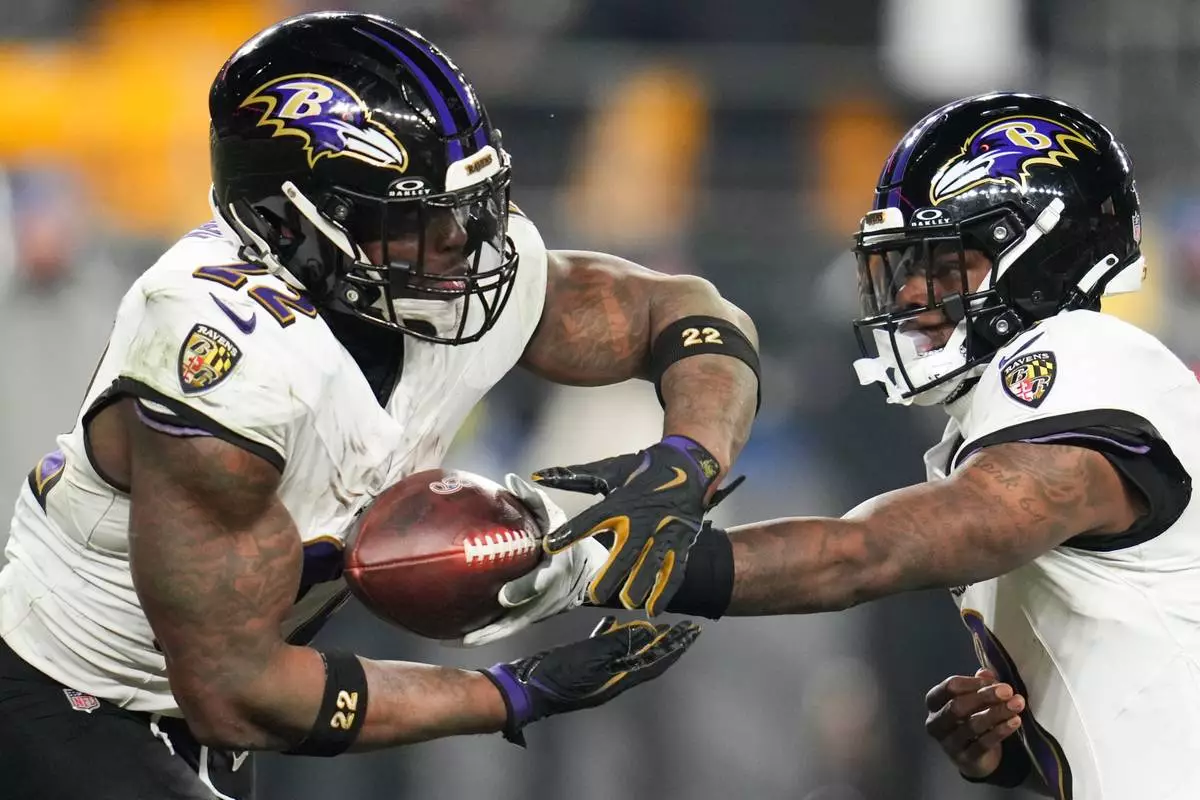
Baltimore Ravens quarterback Lamar Jackson, right, hands the ball off to running back Derrick Henry (22) during the first half of an NFL football game against the Pittsburgh Steelers, Sunday, Jan. 4, 2026, in Pittsburgh. (AP Photo/Gene J. Puskar)
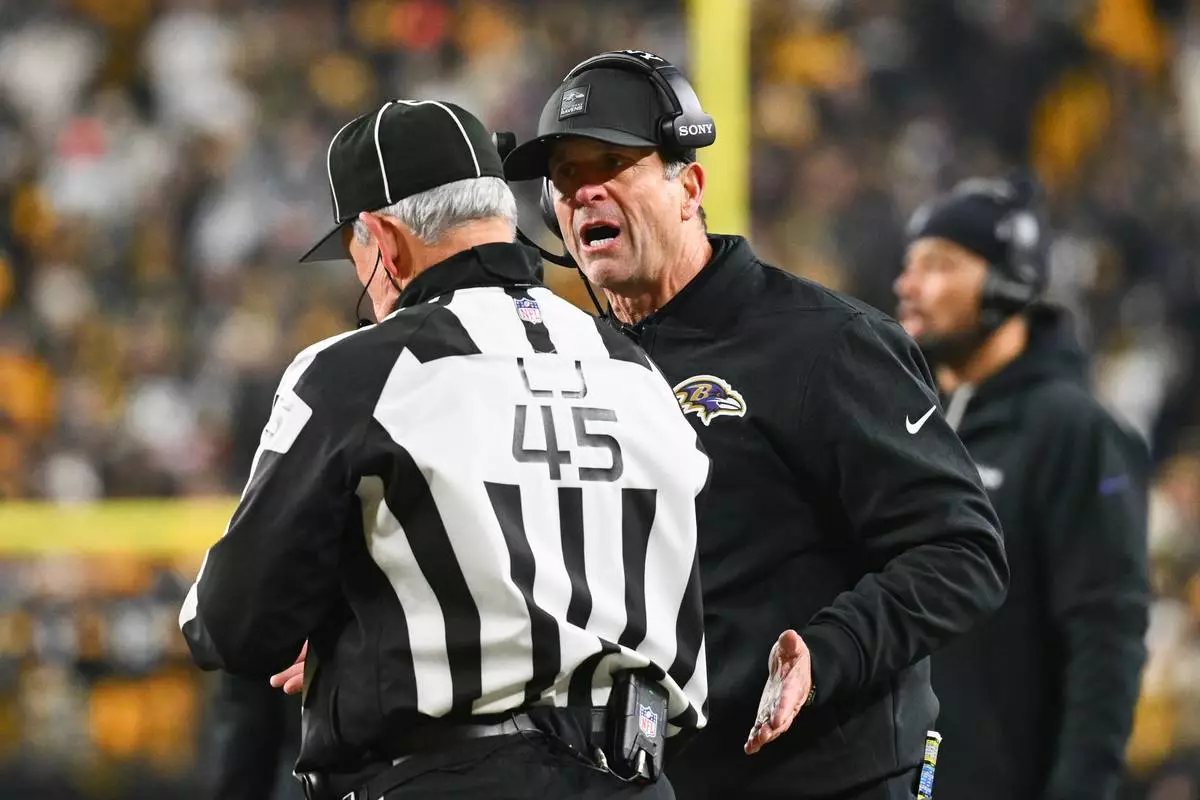
Baltimore Ravens head coach John Harbaugh talks with an offical during the second half of an NFL football game against the Pittsburgh Steelers, Sunday, Jan. 4, 2026, in Pittsburgh. (AP Photo/Justin Berl)
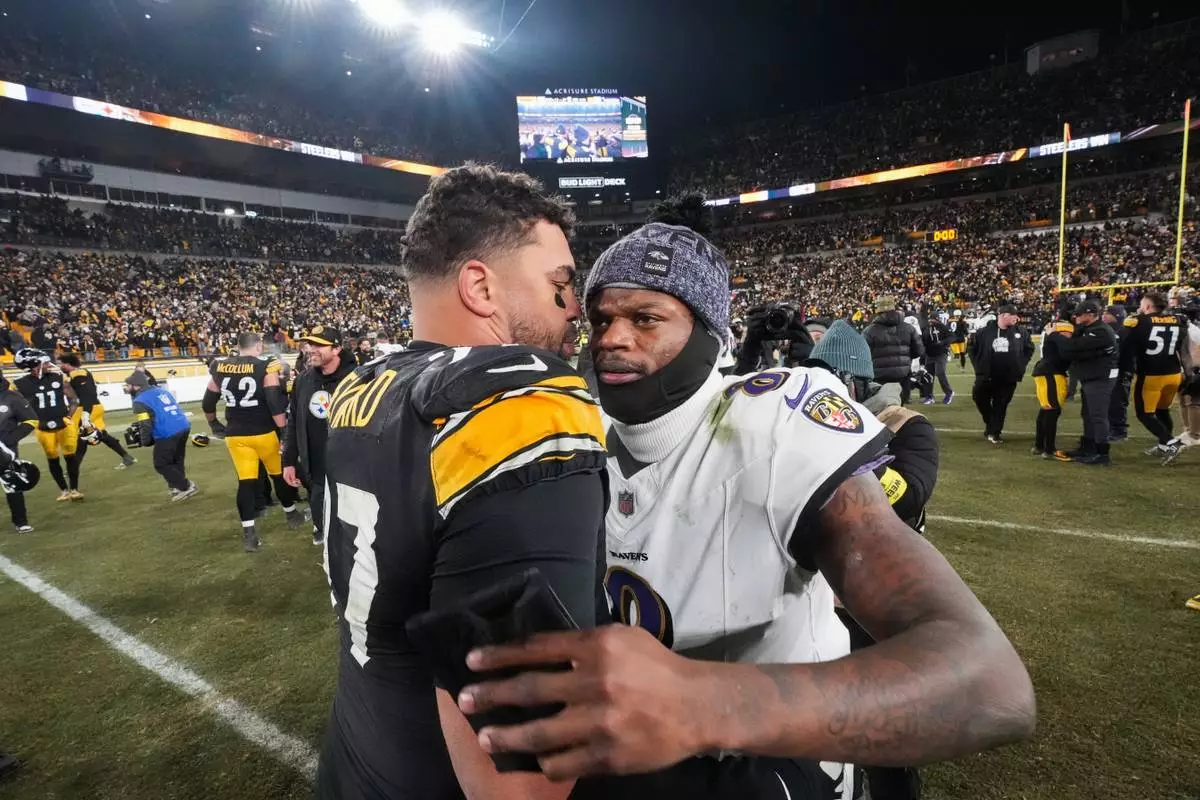
Pittsburgh Steelers defensive tackle Cameron Heyward, left, greets Baltimore Ravens quarterback Lamar Jackson (8) after an NFL football game Sunday, Jan. 4, 2026, in Pittsburgh. (AP Photo/Gene J. Puskar)
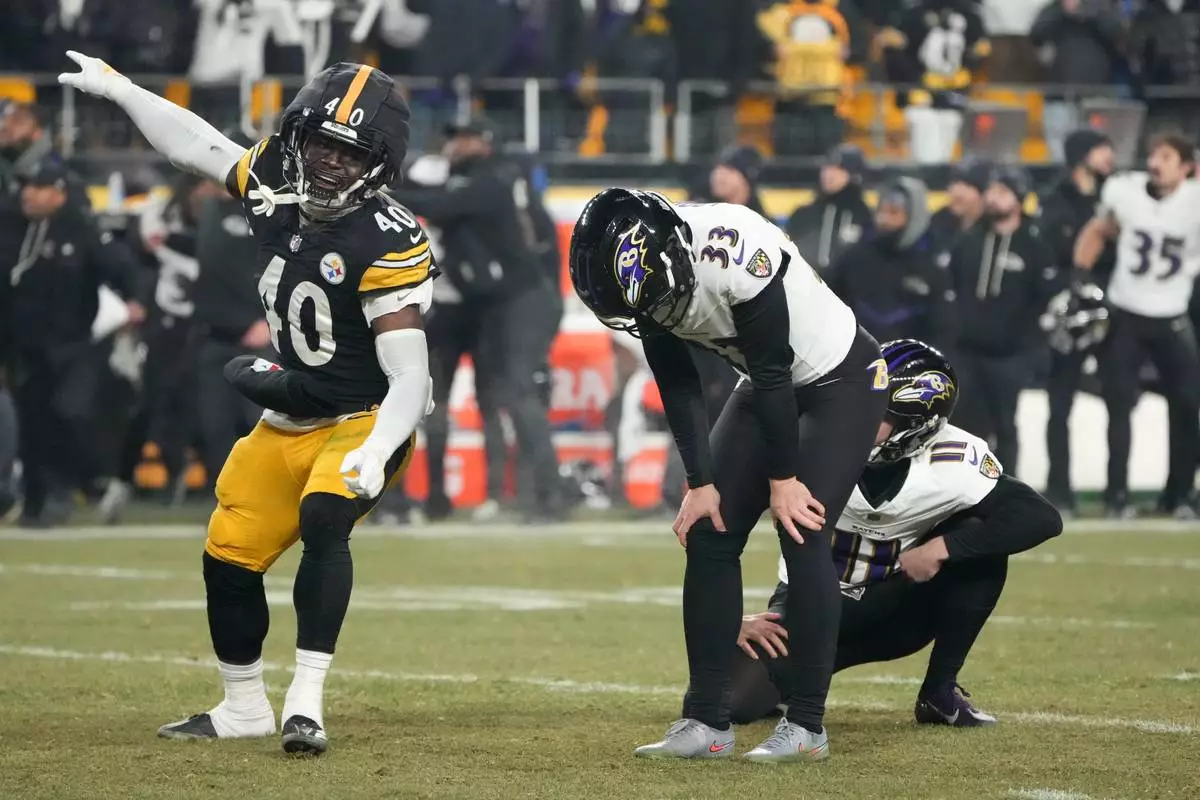
Pittsburgh Steelers safety Jabrill Peppers (40) reacts after Baltimore Ravens kicker Tyler Loop (33) missed a field goal attempt in the second half of an NFL football game against the Pittsburgh Steelers, Sunday, Jan. 4, 2026, in Pittsburgh. (AP Photo/Gene J. Puskar)