SANTA FE, N.M. (AP) — A police officer was found guilty Wednesday of voluntary manslaughter in the fatal shooting of a Black man during a 2022 confrontation at a New Mexico gas station.
Las Cruces police Officer Brad Lunsford's verdict in a jury trial is the latest outcome in cases that prosecutors have linked to systematic brutality against Black people by members of law enforcement, nearly five years after the May 2020 killing of George Floyd by a white police officer in Minneapolis.
Lunsford, who is white, had pleaded not guilty. His attorney, Jose Coronado, said he will ask the judge to review the verdict for its legal sufficiency.
“While I respect the jury’s verdict, I am extremely disappointed in it. I don’t believe the state met its burden,” he said in an email to The Associated Press.
Prosecutors said he shot Presley Eze at point-blank range in a scuffle after police responded to a 911 call from a gas station attendant who reported that Eze stole beer. Eze allegedly placed his hand on a second officer’s stun gun before being shot.
Attorney General Raúl Torrez said the use of deadly force was not reasonable, noting that Lunsford immediately drew his service weapon and shot Eze in the back of the head.
“Today’s verdict reaffirms a fundamental principle: no one is above the law — not even those sworn to uphold it. Officer Lunsford’s actions were not just a tragic lapse in judgment; they were an egregious abuse of power that cost Presley Eze his life,” Torrez said in a statement after the verdict was announced.
The charge of voluntary manslaughter with a firearms enhancement carries a possible sentence of up to nine years in prison. Evidence at trial included police body camera video of the confrontation, in which police pulled Eze from a vehicle and the struggle ensued.
Philip Stinson, a professor of criminal justice at Bowling Green State University in Ohio, said most fatal shootings by on-duty officers are determined to be legally justified under precedent stemming from two 1980s-era U.S. Supreme Court rulings.
“It is incredibly difficult for a prosecutor to obtain a conviction in a jury trial in one of these cases, and that’s because jurors are very reluctant to second guess the split-second, often life-or-death decisions of an on-duty police officer in a potentially violent street encounter,” Stinson said. “Anything can happen, but it’s only in the most egregious cases.”
Records compiled by Stinson, university colleagues and students through the Police Integrity Research Group show that 205 nonfederal law enforcement officers have been arrested on criminal charges of homicide or manslaughter over the past 20 years, resulting in 66 convictions, 27 convictions of them for manslaughter or homicide.
“If you do get a conviction, it’s often for the lesser offense,” Stinson said.
More than 900 fatal shootings by on-duty state and local law enforcement officers typically take place each year in the U.S., he said
In pursuing a criminal charge against Lunsford, Torrez described the killing of Eze as a tragedy and “yet another example of poor police tactics resulting in an unjustifiable use of force to subdue an individual resisting arrest for the commission of a minor crime.”
This story has been corrected to show that Lunsford is currently employed as a police officer in Las Cruces.
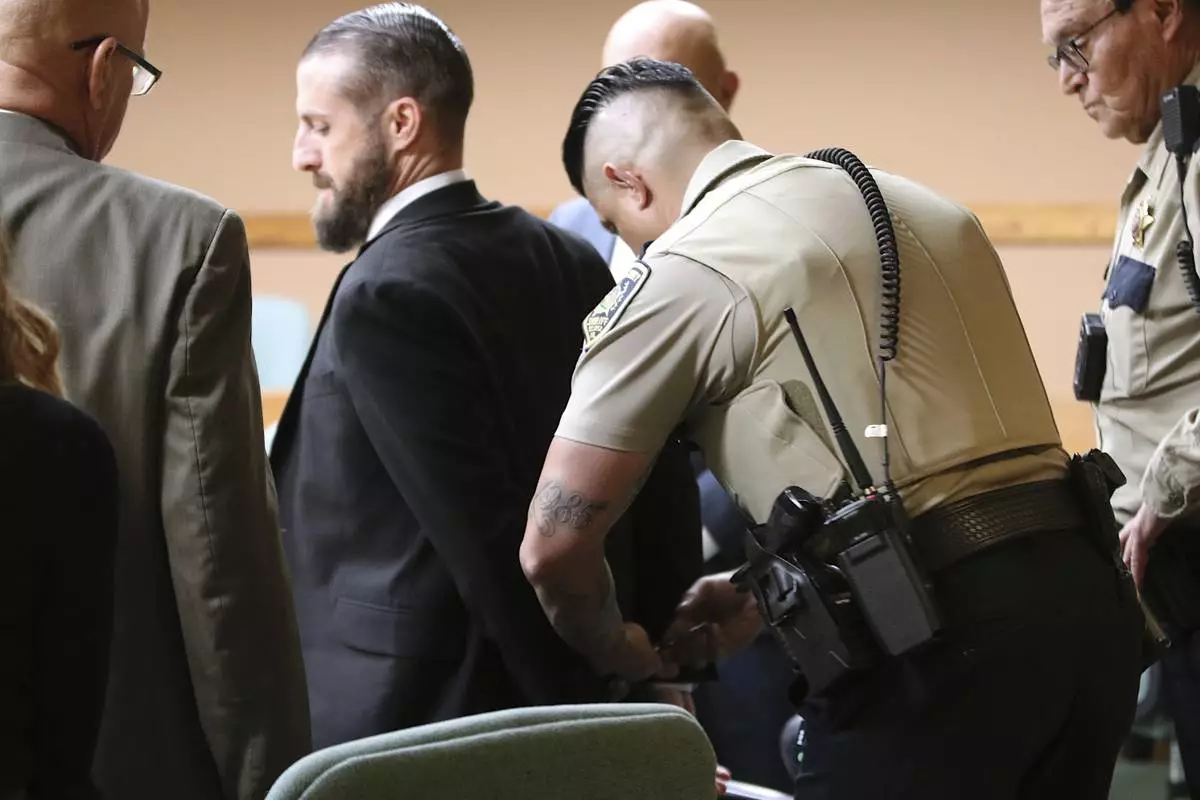
Former Las Cruces Police officer Brad Lunsford, who was convicted of killing Presley Eze, is handcuffed and taken to jail after his trial on Wednesday, Feb. 12, 2025, in Las Cruces, N.M. (Justin Garcia/Pool Photo via AP)
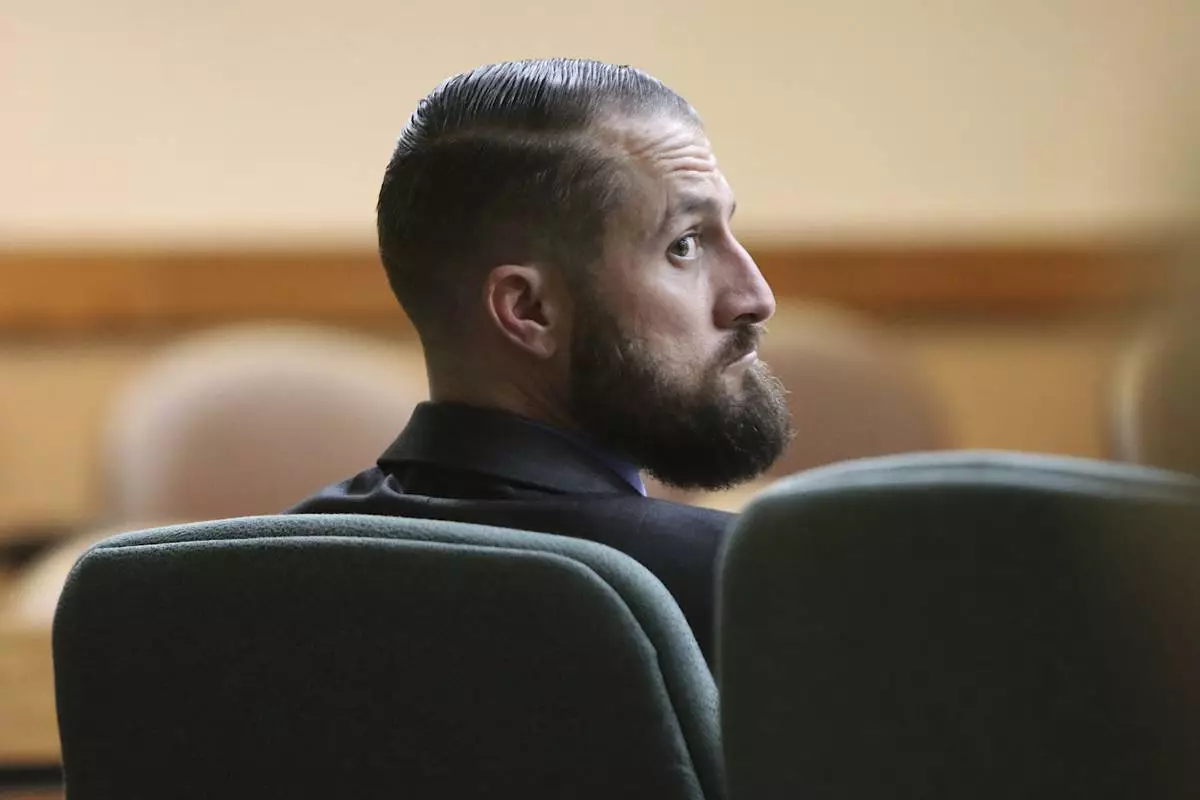
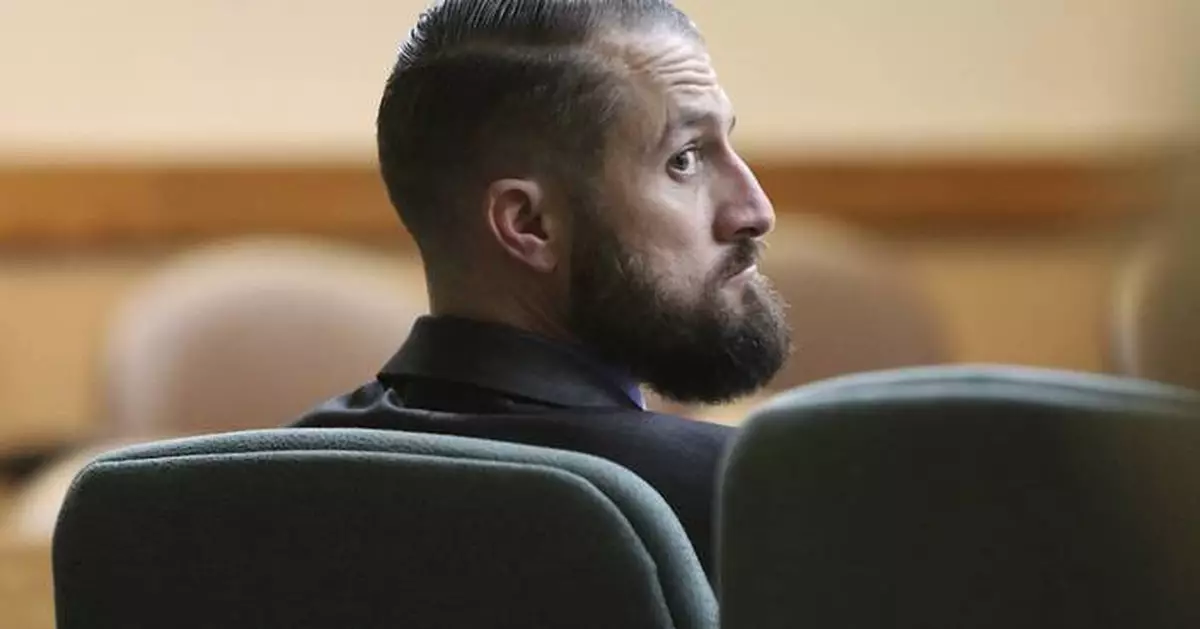
Former Las Cruces Police officer Brad Lunsford looks toward the gallery during his trial in the fatal shooting of Presley Eze, in Las Cruces, N.M., on Feb. 4, 2025. (Justin Garcia/Pool Photo via AP)
WASHINGTON (AP) — Becky Pepper-Jackson finished third in the discus throw in West Virginia last year though she was in just her first year of high school. Now a 15-year-old sophomore, Pepper-Jackson is aware that her upcoming season could be her last.
West Virginia has banned transgender girls like Pepper-Jackson from competing in girls and women's sports, and is among the more than two dozen states with similar laws. Though the West Virginia law has been blocked by lower courts, the outcome could be different at the conservative-dominated Supreme Court, which has allowed multiple restrictions on transgender people to be enforced in the past year.
The justices are hearing arguments Tuesday in two cases over whether the sports bans violate the Constitution or the landmark federal law known as Title IX that prohibits sex discrimination in education. The second case comes from Idaho, where college student Lindsay Hecox challenged that state's law.
Decisions are expected by early summer.
President Donald Trump's Republican administration has targeted transgender Americans from the first day of his second term, including ousting transgender people from the military and declaring that gender is immutable and determined at birth.
Pepper-Jackson has become the face of the nationwide battle over the participation of transgender girls in athletics that has played out at both the state and federal levels as Republicans have leveraged the issue as a fight for athletic fairness for women and girls.
“I think it’s something that needs to be done,” Pepper-Jackson said in an interview with The Associated Press that was conducted over Zoom. “It’s something I’m here to do because ... this is important to me. I know it’s important to other people. So, like, I’m here for it.”
She sat alongside her mother, Heather Jackson, on a sofa in their home just outside Bridgeport, a rural West Virginia community about 40 miles southwest of Morgantown, to talk about a legal fight that began when she was a middle schooler who finished near the back of the pack in cross-country races.
Pepper-Jackson has grown into a competitive discus and shot put thrower. In addition to the bronze medal in the discus, she finished eighth among shot putters.
She attributes her success to hard work, practicing at school and in her backyard, and lifting weights. Pepper-Jackson has been taking puberty-blocking medication and has publicly identified as a girl since she was in the third grade, though the Supreme Court's decision in June upholding state bans on gender-affirming medical treatment for minors has forced her to go out of state for care.
Her very improvement as an athlete has been cited as a reason she should not be allowed to compete against girls.
“There are immutable physical and biological characteristic differences between men and women that make men bigger, stronger, and faster than women. And if we allow biological males to play sports against biological females, those differences will erode the ability and the places for women in these sports which we have fought so hard for over the last 50 years,” West Virginia's attorney general, JB McCuskey, said in an AP interview. McCuskey said he is not aware of any other transgender athlete in the state who has competed or is trying to compete in girls or women’s sports.
Despite the small numbers of transgender athletes, the issue has taken on outsize importance. The NCAA and the U.S. Olympic and Paralympic Committees banned transgender women from women's sports after Trump signed an executive order aimed at barring their participation.
The public generally is supportive of the limits. An Associated Press-NORC Center for Public Affairs Research poll conducted in October 2025 found that about 6 in 10 U.S. adults “strongly” or “somewhat” favored requiring transgender children and teenagers to only compete on sports teams that match the sex they were assigned at birth, not the gender they identify with, while about 2 in 10 were “strongly” or “somewhat” opposed and about one-quarter did not have an opinion.
About 2.1 million adults, or 0.8%, and 724,000 people age 13 to 17, or 3.3%, identify as transgender in the U.S., according to the Williams Institute at the UCLA School of Law.
Those allied with the administration on the issue paint it in broader terms than just sports, pointing to state laws, Trump administration policies and court rulings against transgender people.
"I think there are cultural, political, legal headwinds all supporting this notion that it’s just a lie that a man can be a woman," said John Bursch, a lawyer with the conservative Christian law firm Alliance Defending Freedom that has led the legal campaign against transgender people. “And if we want a society that respects women and girls, then we need to come to terms with that truth. And the sooner that we do that, the better it will be for women everywhere, whether that be in high school sports teams, high school locker rooms and showers, abused women’s shelters, women’s prisons.”
But Heather Jackson offered different terms to describe the effort to keep her daughter off West Virginia's playing fields.
“Hatred. It’s nothing but hatred,” she said. "This community is the community du jour. We have a long history of isolating marginalized parts of the community.”
Pepper-Jackson has seen some of the uglier side of the debate on display, including when a competitor wore a T-shirt at the championship meet that said, “Men Don't Belong in Women's Sports.”
“I wish these people would educate themselves. Just so they would know that I’m just there to have a good time. That’s it. But it just, it hurts sometimes, like, it gets to me sometimes, but I try to brush it off,” she said.
One schoolmate, identified as A.C. in court papers, said Pepper-Jackson has herself used graphic language in sexually bullying her teammates.
Asked whether she said any of what is alleged, Pepper-Jackson said, “I did not. And the school ruled that there was no evidence to prove that it was true.”
The legal fight will turn on whether the Constitution's equal protection clause or the Title IX anti-discrimination law protects transgender people.
The court ruled in 2020 that workplace discrimination against transgender people is sex discrimination, but refused to extend the logic of that decision to the case over health care for transgender minors.
The court has been deluged by dueling legal briefs from Republican- and Democratic-led states, members of Congress, athletes, doctors, scientists and scholars.
The outcome also could influence separate legal efforts seeking to bar transgender athletes in states that have continued to allow them to compete.
If Pepper-Jackson is forced to stop competing, she said she will still be able to lift weights and continue playing trumpet in the school concert and jazz bands.
“It will hurt a lot, and I know it will, but that’s what I’ll have to do,” she said.
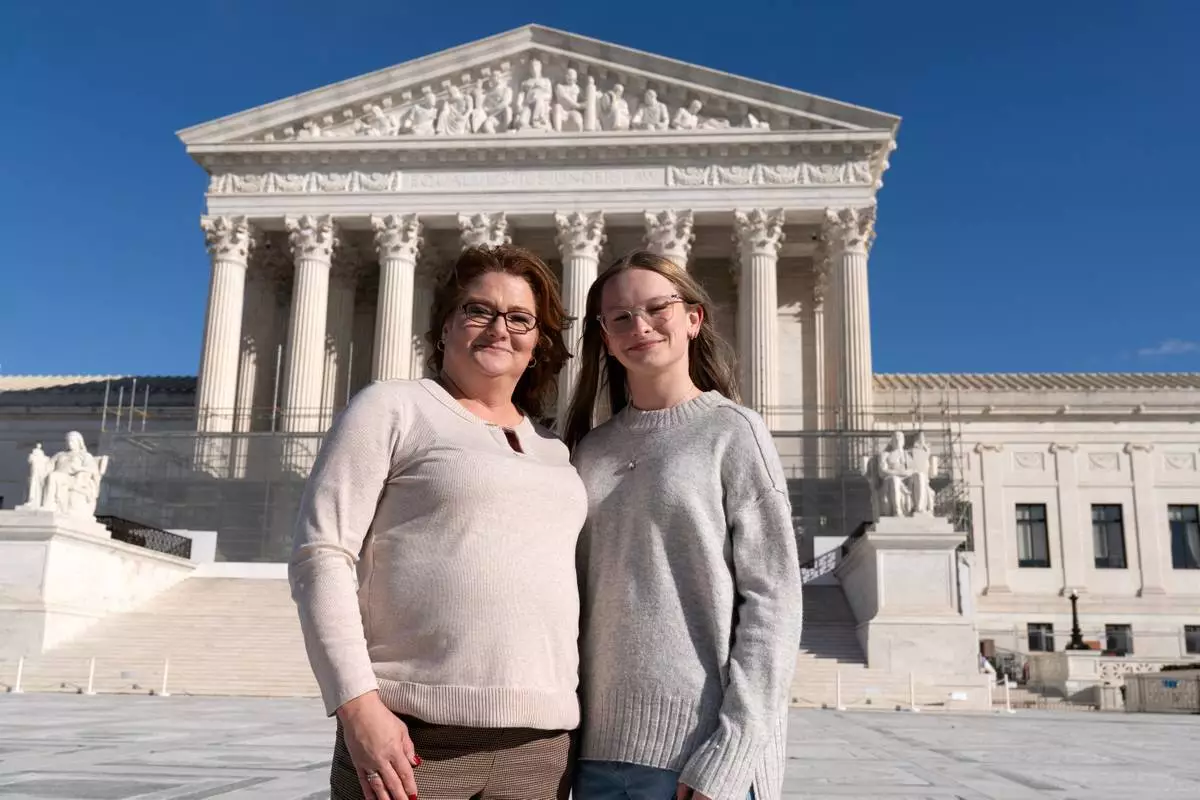
Heather Jackson, left, and Becky Pepper-Jackson pose for a photograph outside of the U.S. Supreme Court in Washington, Sunday, Jan. 11, 2026. (AP Photo/Jose Luis Magana)
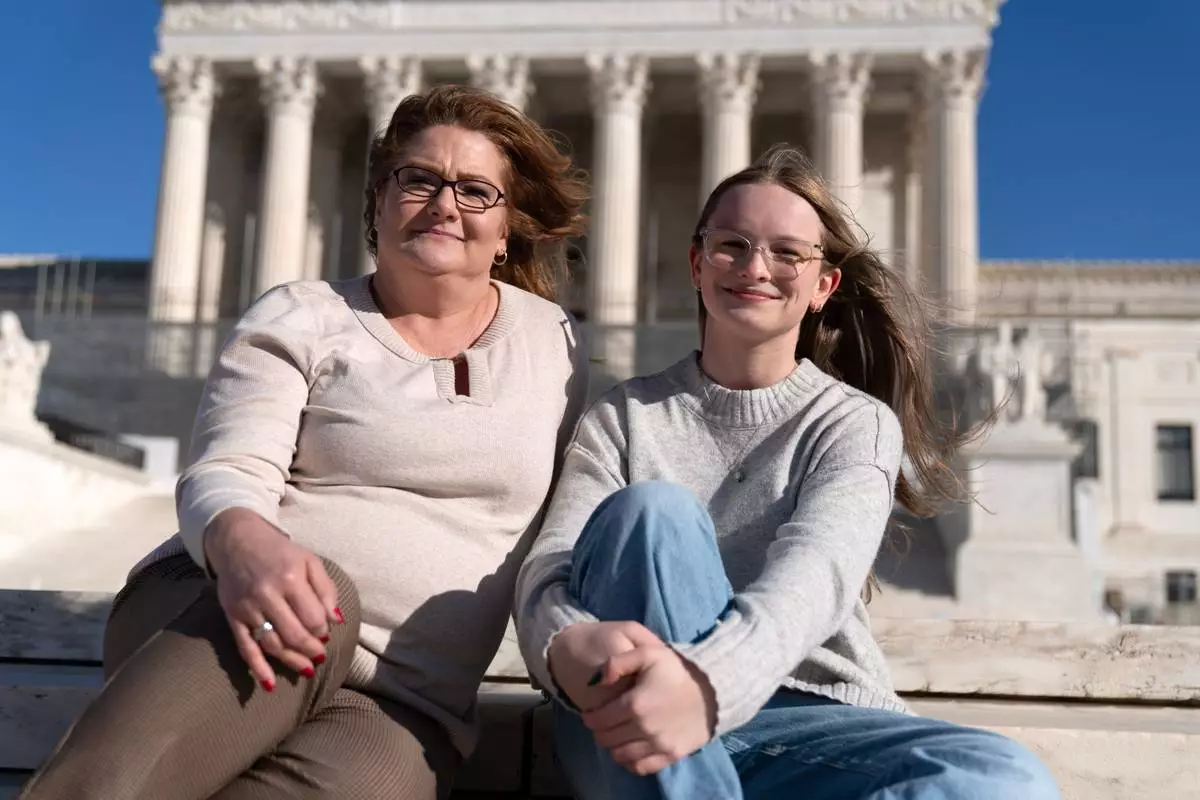
Heather Jackson, left, and Becky Pepper-Jackson pose for a photograph outside of the U.S. Supreme Court in Washington, Sunday, Jan. 11, 2026. (AP Photo/Jose Luis Magana)

Becky Pepper-Jackson poses for a photograph outside of the U.S. Supreme Court in Washington, Sunday, Jan. 11, 2026. (AP Photo/Jose Luis Magana)
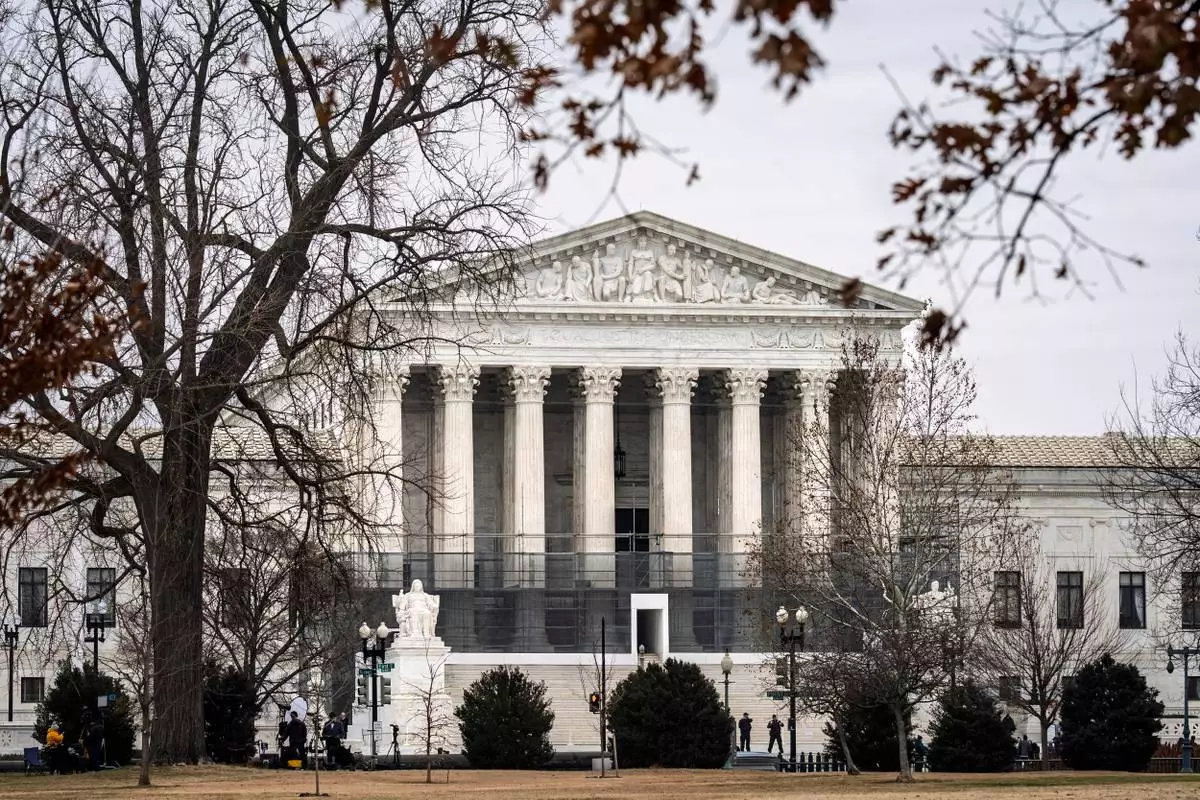
The Supreme Court stands is Washington, Friday, Jan. 9, 2026. (AP Photo/J. Scott Applewhite)
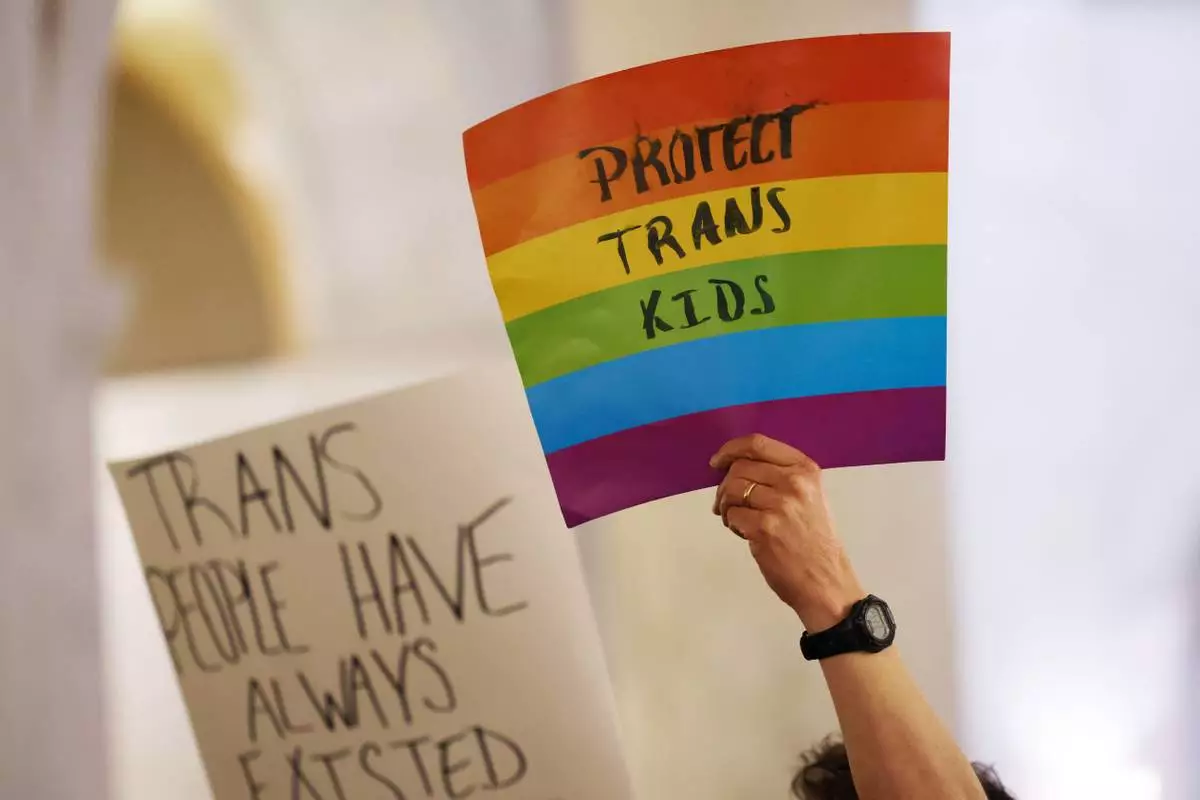
FILE - Protestors hold signs during a rally at the state capitol in Charleston, W.Va., on March 9, 2023. (AP Photo/Chris Jackson, file)