Chengdu, a southwestern Chinese city renowned for its laid-back lifestyle and vibrant culinary scene, is emerging as a key player in China's coffee culture.
The city is now home to a thriving independent coffee market, with unique brews and passionate entrepreneurs driving creativity and growing appreciation for local flavors.
China's coffee market is projected to surpass 220 billion yuan (about 30 billion U.S. dollars) this year. While in Chengdu, coffee-related enterprises surged to about 9,123 in 2023, with the number of independent cafés ranking second nationally, trailing only Shanghai.
The growth has highlighted significant opportunities for cafe owners like Wang Zifeng, the owner of a coffee shop called "Rebellion Beans."
Wang's shop is in Chengdu's Yunlin Neighborhood in the heart of Chengdu's old city. The area has historically been a hub for local artists, musicians, poets, and architects. It is now at the forefront of a quiet revolution that blends artistic traditions with modern culture, including such independent cafes -- once a niche market but now also flourishing in this area.
Wang, who studied engineering in Ireland and worked there as an architect, is part of a circle of friends of entrepreneurs drawn to Chengdu's booming coffee culture.
Despite initial resistance from his parents, who did not support his entrepreneurial ambitions, Wang pursued his passion.
"My dad hadn't even sent me a message for almost half a year. He doesn't understand why I started acting up after turning 30. And my mom said, 'Why is your adolescence only starting now'?," he said.
His journey began in Ireland, where he attended a coffee workshop and was introduced to Chinese coffee, specifically from the southwestern province of Yunnan, China's main coffee-producing region. This experience inspired him to move back to China and open a shop in Chengdu that focuses exclusively on Yunnan coffee beans.
Wang described the unique flavor profile of Yunnan coffee as many fruits, also one of his reasons to choose those coffee beans.
"If I were to describe it now, I'd say it has notes of red wine, passion fruit, tropical fruits, with a strong aftertaste. But back then, all I could think was, huh? Why does it taste so different?" said Wang.
According to Xu Depeng, a producer working on coffee geography projects at the Chinese National Geography, Chengdu's comfortable, laid-back atmosphere and its culinary culture is one of its biggest attactions.
"Chengdu, known as the 'Land of Abundance' in everyone's impression, is famous for its comfortable, laid-back vibe and its culinary culture. So whether it's locals or people visiting from other places, food and drink are always key considerations for them. This has created tremendous opportunities for Chengdu's coffee market," said Xu.
Innovative ways to make coffee are constantly giving the industry a facelift. For instance, some cafés sell coffee beans by the gram and use conveyor belts to grind and brew them, mimicking a factory assembly line. Others experiment with unique flavors, such as garlic-flavored coffee, to attract customers.
Wang's shop, Rebellion Beans, has also garnered a loyal customer base that supports his mission to promote Yunnan coffee.
"The majority of China's coffee market is dominated by foreign coffee brands. But domestically, we have Yunnan, a major coffee bean-producing province, which has largely been overlooked. So seeing a shop like this is actually quite touching," said Yin Zeming, a local customer.

Independent cafés in Chengdu underscore brewing economic vitality in China
China's flagship smart factories demonstrate not only extremely high levels of intelligence, but also a strong role in driving the wider industry forward, highlighting a new path for next-generation intelligent manufacturing that deeply integrates artificial intelligence (AI) with advanced manufacturing.
China has added 34 factories to its cultivation list of flagship smart factories, the highest tier under the country's four-tier smart factory cultivation system, bringing the total number of flagship smart factories to 49, the Ministry of Industry and Information Technology (MIIT) and five other government departments announced on Thursday.
The selected factories span a range of industries and feature advanced technologies and innovative manufacturing models.
The manufacture of national strategic equipment is an important testing ground for flagship smart factories.
In Deyang City, southwest China's Sichuan Province, Dongfang Turbine Co., Ltd. has equipped its smart factory with a modular collaborative manufacturing system to address the industry-wide challenge of coordinating the discrete manufacturing of large-scale power generation equipment.
"In leveraging our modular manufacturing model, we have enhanced the efficiency of energy equipment manufacturing and the consistency of product quality, ensuring the stable and reliable operation of national strategic equipment," said Hou Mingjun, deputy general manager of Dongfang Turbine Co., Ltd.
Beyond major equipment, tiny precision components also demonstrate China's advanced manufacturing strength.
In Weifang, east China's Shandong Province, a smart factory producing precision electroacoustic components has independently developed core production equipment across the entire chain to meet micron-level processing requirements for miniature acoustic devices, achieving agile and flexible production of multiple categories of precision electroacoustic products.
While leading in manufacturing, these smart factories also lead the industries in artificial intelligence.
A Chongqing-based automobile factory in southwest China uses an industrial brain as its intelligent hub, engaging hundreds of upstream and downstream suppliers, and integrating multiple artificial intelligence technologies such as AI visual inspection and digital twins across the entire vehicle manufacturing process.
A Nanjing-based factory in Jiangsu Province has a self-developed intelligent agent platform. Its dozens of industrial AI agents have enabled autonomous decision-making in production scheduling, equipment maintenance and other areas, achieving autonomous workflow management in the production of communications equipment.
"Intelligent agents can perceive production line status in real time, drive production autonomously through information flow, and receive real-time feedback on material flow status. They can automatically issue production instructions, schedule resources, and perform quality inspections, enabling seamless production line changeovers for more than 300 product models," said Zhou Jianfeng, general manager of ZTE Corporation (Nanjing) Co., Ltd.
Experts said that the new batch of flagship smart factories no longer simply use AI for auxiliary office work, but have deeply embedded it into core business operations such as process optimization, equipment control, research and development, and innovation.
"Among the second batch of flagship smart factories, AI applications make up more than 70 percent of total usage; over 1,000 industrial AI agents have been developed; and the average daily token calls exceed 300 million. AI is evolving from isolated applications toward a systemic architectural transformation. Most of the flagship smart factories have entered the era of data governance 2.0, leading the innovation in future manufacturing models," said Ao Li, deputy director of the China Academy of Information and Communications Technology.
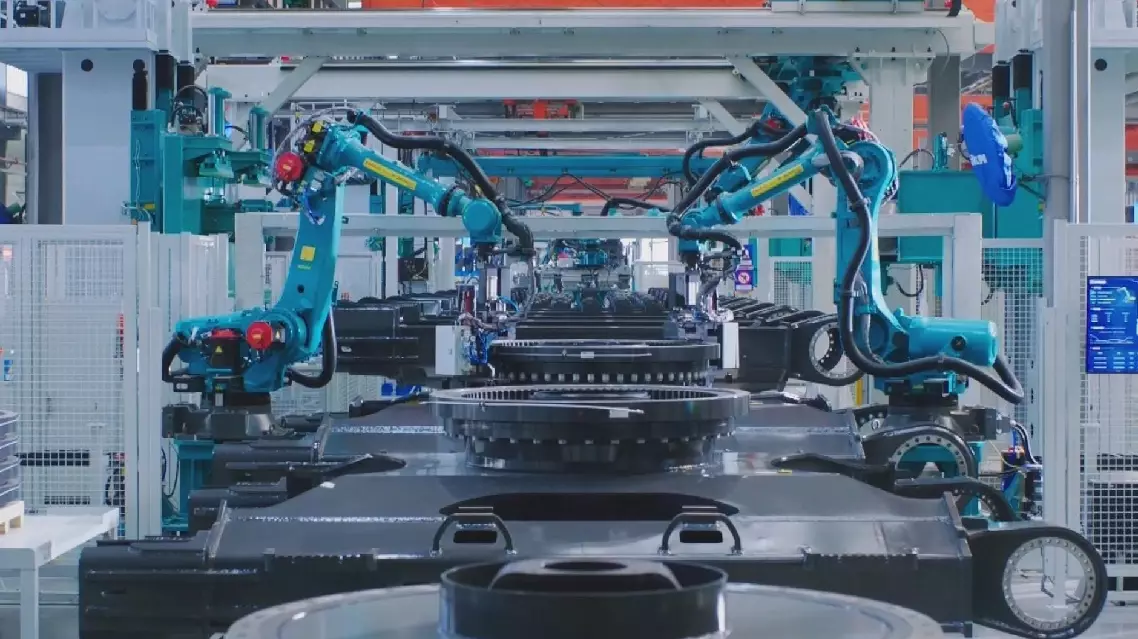
China's flagship smart factories highlight deep integration of AI, advanced manufacturing