Chinese researchers on the 41st Chinese Antarctic expedition mission have detected a drastic iceberg tsunami near the Zhongshan Station, with waves exceeding one meter in height.
According to researchers at the Chinese Antarctic Center of Surveying and Mapping of Wuhan University in central China's Hubei Province, the abnormal sea waves of the iceberg tsunami were caused by glacial calving and iceberg overturning.
"We can see here that there are some slight high-frequency vibrations on the water surface. Based on video files of the station, we speculate this abnormal phenomenon was caused by the flipping or capsizing of an iceberg, which led to abnormal oscillations in the sea water," said Ke Hao, deputy director of the Polar Remote Sensing Laboratory of the center.
This year, the tidal monitoring systems at the Zhongshan Station have recorded increasingly frequent seawater oscillations -- eight days in January and near-daily occurrences in February, indicating fast ice melt near the station.
"Melting icebergs would shift their center of gravity, causing rolls or capsizes that generate meter-scale waves, often one-meter or two-meter high," Ke said.
Long-term data at the station reveal that glacial disintegration in Antarctica is accelerating. Particularly, iceberg calving has become more and more frequent at the Dalk Glacier in Prydz Bay, a Chinese research area, according to Ke.
"The gap between the first and the second calvings was seven years, while the third calving occurred only two years after the second one. We can see here that the collapse of the end of the Dalk Glacier is accelerating," Ke said.
Iceberg tsunamis pose risks to Antarctic expedition. In March 14, 2019, a serious tsunami damaged the station's Panda Terminal, sweeping containers into the sea and destroying maritime observation equipment.
As February is a peak season for iceberg tsunamis, researchers at the station have strengthened monitoring to ensure timely issuance of early warnings if an iceberg tsunami hits the station, and thus mitigate losses.
China's 41st Antarctic expedition team set sail on Nov 1, 2024, starting a mission expected to last nearly seven months.
China has established five research bases in Antarctica over the past nearly 40 years -- the Great Wall Station, the Zhongshan Station, the Kunlun Station, the Taishan Station and the Qinling Station.

Iceberg tsunami strikes near China's Zhongshan Station in Antarctica
China's two major power grid operators -- the State Grid Corporation of China (State Grid) and China Southern Power Grid (CSG) -- reported a surge in investment in the first quarter of 2026, underscoring efforts to strengthen infrastructure construction and support high-quality socioeconomic development in China.
The State Grid said it completed fixed-asset investment worth 129 billion yuan (about 18.77 billion U.S. dollars) in the first three months of this year, up 37 percent the corresponding period of the previous year. The spending has driven more than 250 billion yuan (36 billion U.S. dollars) of investment across the wider industrial chain.
Key projects such as the Panxi ultra-high-voltage (UHV) alternating current (AC) line and the Anhui-Hubei back-to-back direct current (DC) project have seen ground broken for their construction, while several west-to-east power transmission projects have been upgraded.
Investment in connecting renewable energy generation to the grid was reported to have exceeded 10 billion yuan (1.45 billion U.S. dollars) from January to March, a year-on-year rise of more than 50 percent.
The CSG also reported robust growth in investment in the three-month period, with fixed-asset investment reaching 38.45 billion yuan (5.58 billion U.S. dollars), up about 50 percent from a year earlier.
Among its achievements, the company completed and commissioned 80 key projects, including the 220 kV cross-sea power grid interconnection project, which was officially put into operation on March 20. The project ended years of grid isolation on the Weizhou Island in south China by linking it to the main power system of the Guangxi Zhuang Autonomous Region.
The construction of 17 other major energy projects, including one linking the power grid of the Xizang Autonomous Region in southwest China with that of Guangdong Province in south China, is advancing rapidly. These projects are expected to bolster regional industries, the maritime economy, digital collaboration and the transition to green energy.
"By accelerating major project construction, investment during the 15th Five-Year Plan period (2026-2030) is expected to approach 1 trillion yuan (145 billion U.S. dollars), driving a further 2 trillion yuan (290 billion U.S. dollars) of investment across upstream and downstream industries," said Dong Yanle, deputy general manager of the Engineering Construction Department under the China Southern Power Grid.
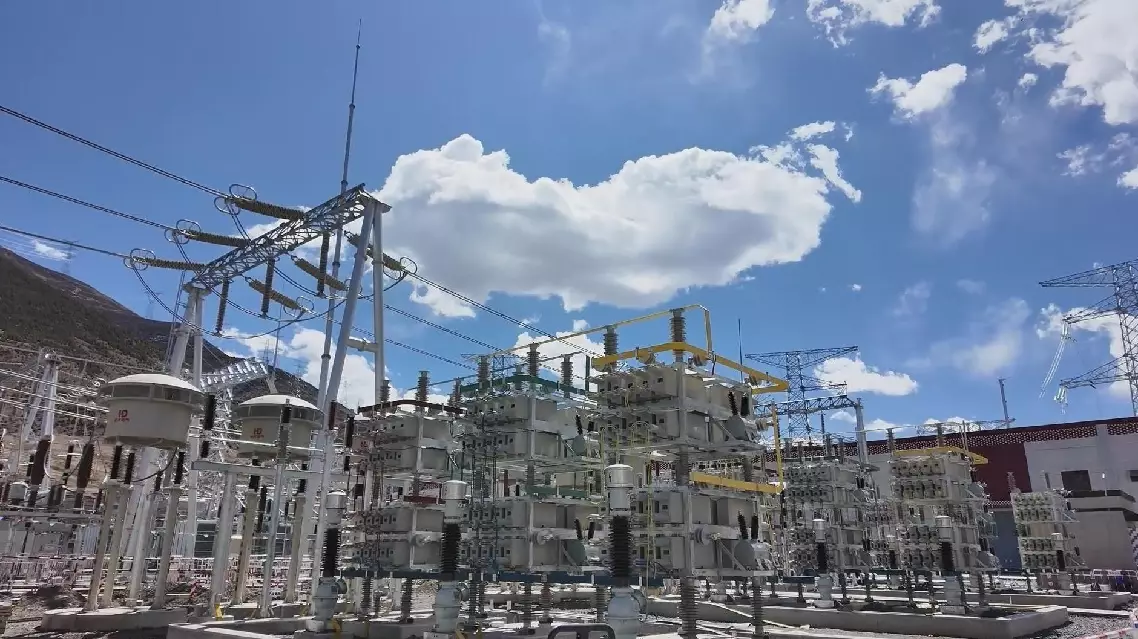
China ramps up power grid investment in January-March to boost growth