Former Chinese Vice Foreign Minister Fu Ying on Saturday said the Philippines' actions in the South China Sea threaten to undermine the hard-earned stability achieved by regional countries who have embraced negotiation.
Fu made the remarks as she attended a discussion on maritime tensions at the ongoing Munich Security Conference (MSC), which kicked off on Friday in Germany.
Click to Gallery
Restrain, negotiation key to maintaining peace in South China Sea: former Chinese Vice FM
Restrain, negotiation key to maintaining peace in South China Sea: former Chinese Vice FM
Restrain, negotiation key to maintaining peace in South China Sea: former Chinese Vice FM
Restrain, negotiation key to maintaining peace in South China Sea: former Chinese Vice FM
Restrain, negotiation key to maintaining peace in South China Sea: former Chinese Vice FM
"If the Philippines can take new rocks, how can you stop others? How can you stop China from taking more? We are capable, there's no problem. But we are exercising constraint," she said.
Countries in the region have provided wisdom as they have cooperated over the past decades to prevent war, she added.
She also noted that the South China Sea is one of the busiest sea lanes and said China has been acting professionally to ensure prosperity and development in the region.
Ng Eng Hen, Singapore's Defense Minister, provided a historical backdrop for U.S. involvement in South China Sea affairs.
"China's actions in the South China Sea, if we are frank about it, are a response to U.S. containment strategy. It was a strategy that originated from the U.S. campaign to contain the Japanese expansion in World War II," he said.
Panelists said that the involvement of countries outside the region, like the U.S., hinders the sincere efforts of regional countries to maintain peace.
"China has the South China Sea issue not only with the Philippines but also with Vietnam, with Malaysia, with Indonesia. They all handled it very well and peacefully. The reason only the Philippines has some problems with China is because now there are nine U.S. military bases in the Philippines, and that may provoke the Philippines to [be] bold to change the status quo," said Wang Huiyao, president of Center for China and Globalization.
On China-U.S. ties, Fu said that the two sides should avoid confrontation and co-exist peacefully.
"The U.S. has launched this strategic competition with China, but you don't hear China talking about accepting, defining our relationship with the U.S. as competition," she said.
Chris Coons, a U.S. Democratic Senator, called on all parties involved to actively prevent conflict.
"In the South China Sea, making sure that professional conduct is not the majority, but is uniformly what is observed and avoiding unintended collisions, accidents, and then escalation is a key responsibility of major powers and of partners in the region," he said.
The three-day MSC gathers around 60 heads of state and government, 150 ministers, and leaders of major international organizations. Key topics on the agenda include global governance, climate security, and regional conflicts and crises. The future of the transatlantic relationship, particularly in light of the return of U.S. President Trump, will also be discussed.

Restrain, negotiation key to maintaining peace in South China Sea: former Chinese Vice FM

Restrain, negotiation key to maintaining peace in South China Sea: former Chinese Vice FM

Restrain, negotiation key to maintaining peace in South China Sea: former Chinese Vice FM

Restrain, negotiation key to maintaining peace in South China Sea: former Chinese Vice FM

Restrain, negotiation key to maintaining peace in South China Sea: former Chinese Vice FM
China is forging ahead on a modernization path that integrates harmony between humanity and nature, with its ecological conservation and green development efforts intensified and generating fruitful results this year.
Pursuing high-quality development underpinned by a good environment, the Chinese society is making concerted efforts to cut carbon emissions, reduce pollution, pursue green development, and boost economic growth.
As a result, air pollution levels have plummeted. In Beijing, the annual average levels of particulate matter under 2.5 milligrams have dropped from 89.5 micrograms per cubic meter to just 27 micrograms over the past 13 years.
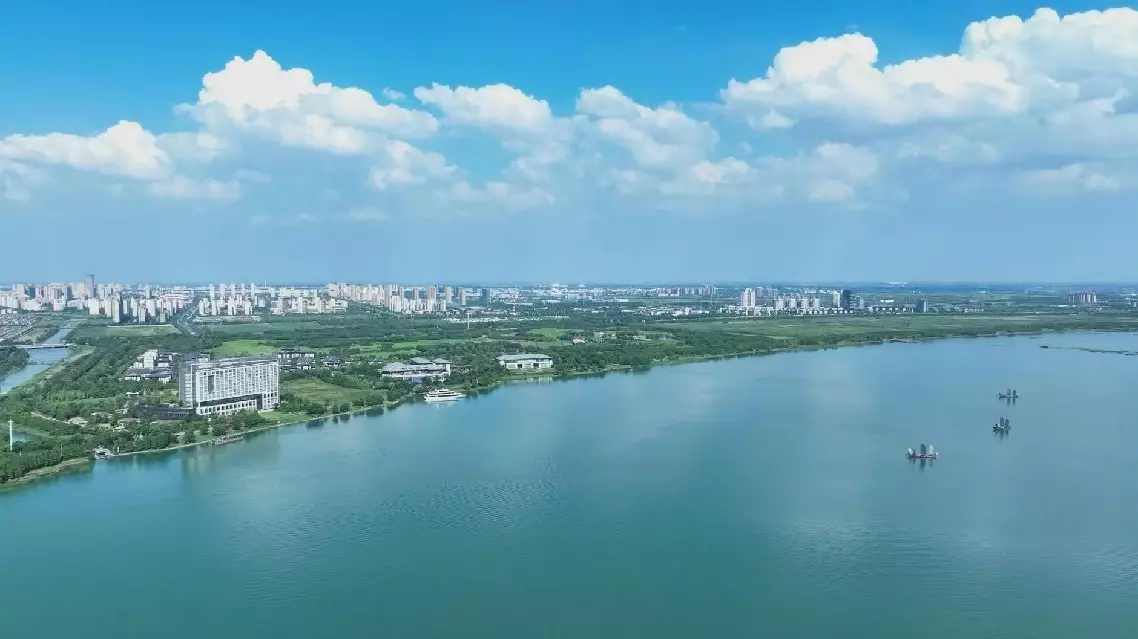
Meanwhile, the Taihu Lake in east China's Jiangsu Province, once plagued by blue-green algae blooms, now boasts crystal-clear water.
In the past decade, the lake's phosphorus concentration has fallen by nearly 30 percent, and its water quality has been improved from Grade IV to Grade III, which means it is now classed as "fairly good."
"I grew up by Taihu Lake. In recent years, the lake has become so beautiful thanks to the restoration efforts. I often take walks along its shores, and I'm truly delighted," said Fan Suming, a local resident.
To upgrade its legal system for ecological protection, China this year adopted its first Ecological and Environmental Code.
Earlier this month, seven central ecological and environmental protection inspection teams have all completed their deployment for the sixth batch of the third round of inspections.
The inspection teams will conduct one-month inspections in Liaoning, Jilin, Heilongjiang, Guangdong, Guangxi, Xizang and Xinjiang, as well as the Xinjiang Production and Construction Corps, aiming to promote coordinated regional development and high-quality growth, accelerate the country's green transformation, substantially improve environmental quality, and achieve major progress in building a Beautiful China.
Also in May, China unveiled assessment measures for the building of a Beautiful China to ensure the fulfillment of responsibilities at all levels.
The country has also started implementing its stricter ambient air quality standards since March and is taking measures in key counties to tackle pollution and stagnant water in small water bodies.
Gao Qiusheng, a photographer in Taiyuan City, north China's Shanxi Province, recently presented a reporter with photographs he has taken of the thriving wildlife that local water bodies have nurtured.
"This is a picture of a scaly-sided merganser that I took near the Fenhe Park and the northern middle ring road bridge. This is a white-tailed eagle. I can feel that my camera is capturing rare species more frequently," said Gao.
China is also optimizing the development and protection of territorial space, focusing on key ecosystem service zones. The Three-North Shelter Forest Program, the ecological conservation on the Qinghai-Xizang Plateau, mangrove conservation and restoration, and other national-level projects are all in steady progress.
By the end of March, China's total installed renewable energy capacity reached approximately 2.4 billion kilowatts, accounting for nearly 40 percent of the country's total power capacity.
In addition, green development funds are being channeled into energy saving, carbon emissions reduction, recycling, and environmental infrastructure.
Today, green commuting, green consumption, and low-carbon lifestyles have gained great popularity across China, and living a greener life has emerged as a shared pursuit in society.
"The 15th Five-Year Plan period is a critical stage in building on past successes to break new ground for building a Beautiful China and achieving fundamental improvement in the environment. We will continue to regard green and low-carbon development as the fundamental solution, consolidate and expand the outcomes of our ecological and environmental efforts to lay a decisive foundation for basically accomplishing the goal of building a Beautiful China by 2035," said Zhang Huaping, deputy director general of the Department of General Affairs of the Ministry of Ecology and Environment.
China forges ahead with ecological conservation, green development