Skip to Content Facebook Feature Image

Trump's tariffs expose Ukraine's steel industry to another war

News

Trump's tariffs expose Ukraine's steel industry to another war
News

News

Trump's tariffs expose Ukraine's steel industry to another war

2025-02-17 21:32 Last Updated At:21:41

ZAPORIZHZHIA, Ukraine (AP) — The steel mill in a partially occupied region of Ukraine is a dystopian maze of flames, chutes and tentacled pipes, vast enough to be a small city. Thunderous blazes of sparks flash above the open furnaces where workers smelt iron ore into streams of molten metal day and night.

The Zaporizhstal Iron and Steelworks, one of Ukraine’s largest steel plants, lies in the country’s industrial east, where Russia's 3-year invasion of its neighbor threatens to throttle production at any moment. Daily battles unfold along a front line 40 kilometers (25 miles) away as the plant churns out materials for military equipment and for foreign manufacturers to use in cars, appliances, and construction.

More Images
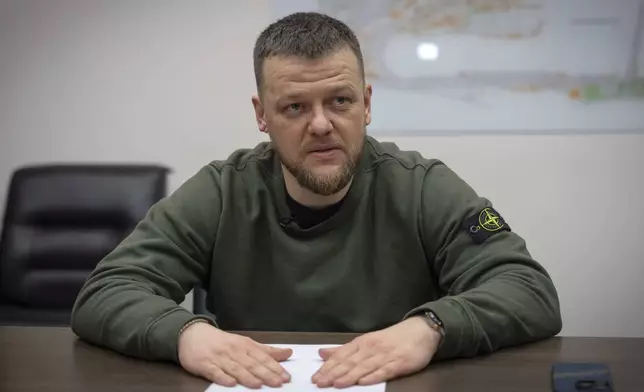
Oleksandr Myronenko, Metinvest Group Chief Operating Officer, talks to the Associated Press during the interview in his office in Zaporizhzhia, Ukraine, Thursday, Feb. 13, 2025. (AP Photo/Efrem Lukatsky)
Oleksandr Myronenko, Metinvest Group Chief Operating Officer, talks to the Associated Press during the interview in his office in Zaporizhzhia, Ukraine, Thursday, Feb. 13, 2025. (AP Photo/Efrem Lukatsky)

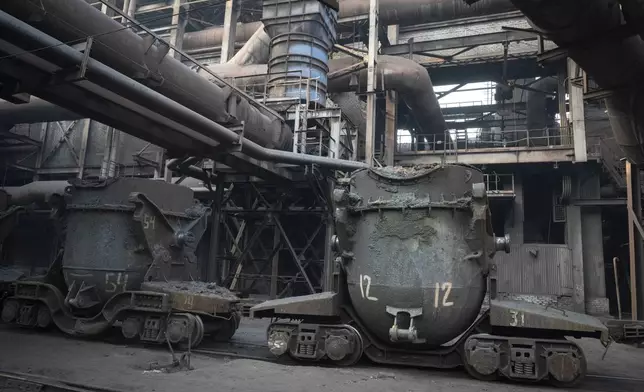
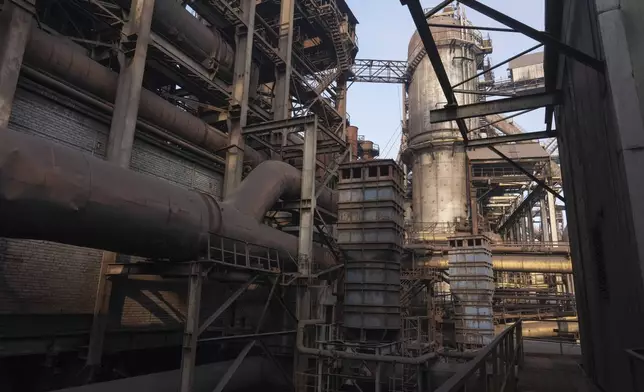
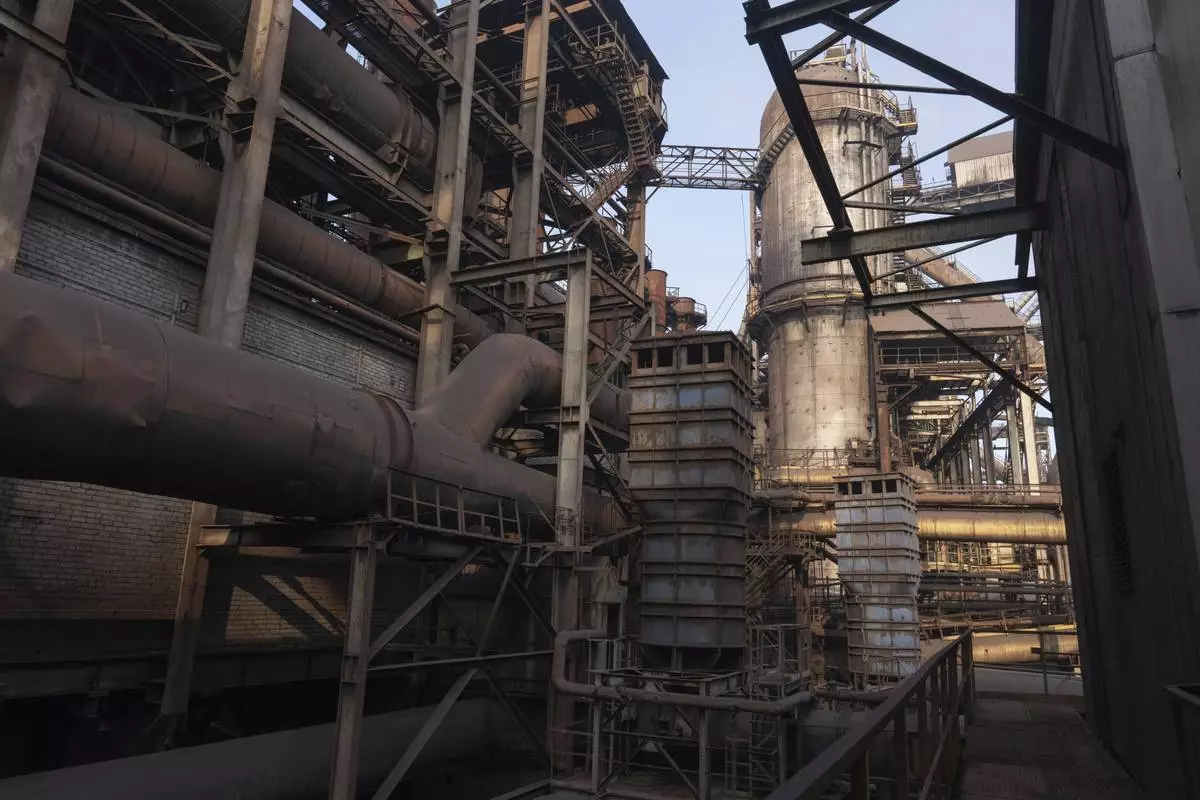
A blast furnace is seen at the Zaporizhstal Iron and Steelworks, one of the country's largest steel plants, in Zaporizhzhia, Ukraine, Thursday, Feb. 13, 2025. (AP Photo/Efrem Lukatsky)
A blast furnace is seen at the Zaporizhstal Iron and Steelworks, one of the country's largest steel plants, in Zaporizhzhia, Ukraine, Thursday, Feb. 13, 2025. (AP Photo/Efrem Lukatsky)
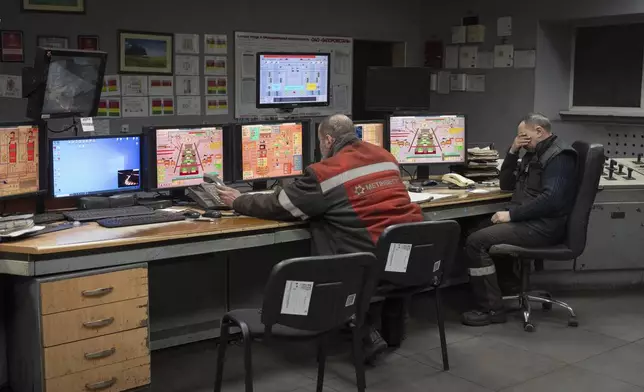
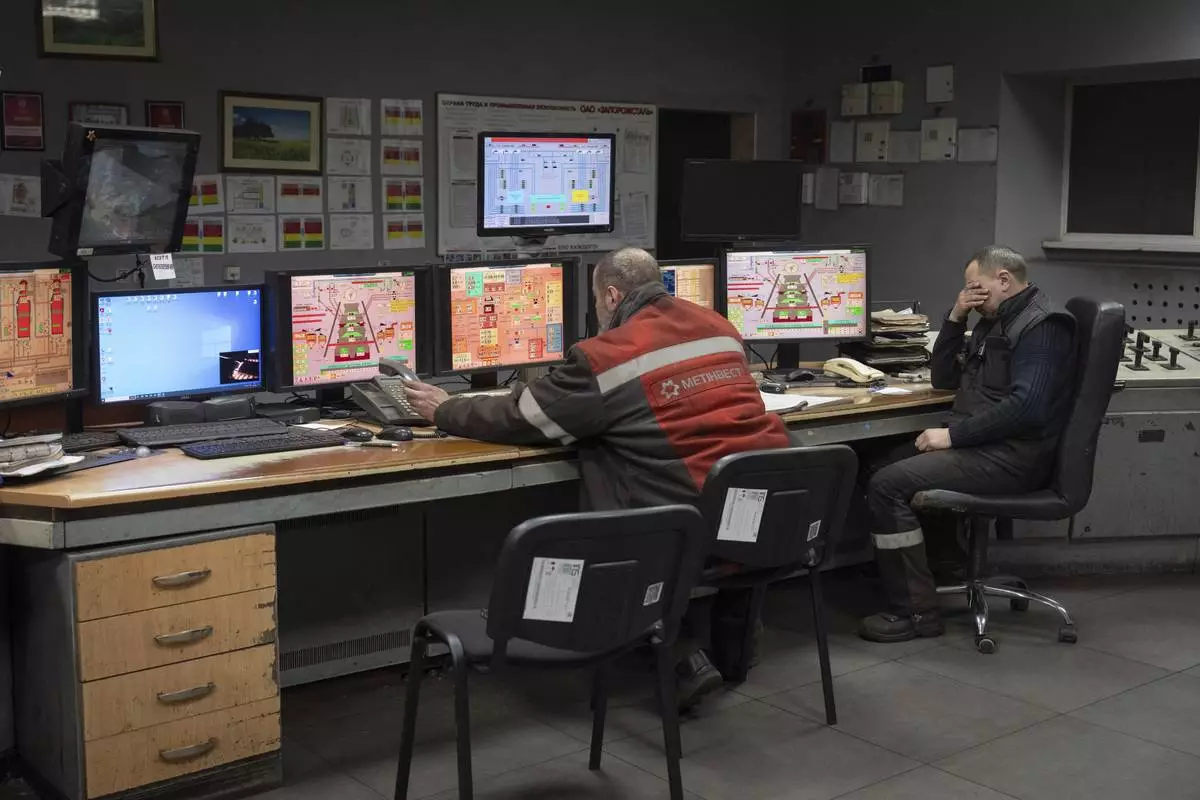
Engineers control the steel melting process at the Zaporizhstal Iron and Steelworks, one of the country's largest steel plants, in Zaporizhzhia, Ukraine, Thursday, Feb. 13, 2025. (AP Photo/Efrem Lukatsky)
Engineers control the steel melting process at the Zaporizhstal Iron and Steelworks, one of the country's largest steel plants, in Zaporizhzhia, Ukraine, Thursday, Feb. 13, 2025. (AP Photo/Efrem Lukatsky)

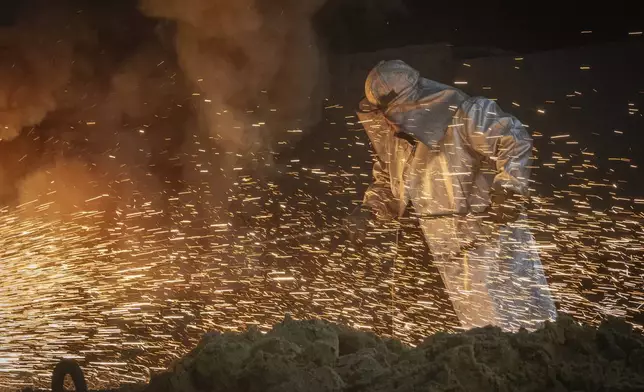
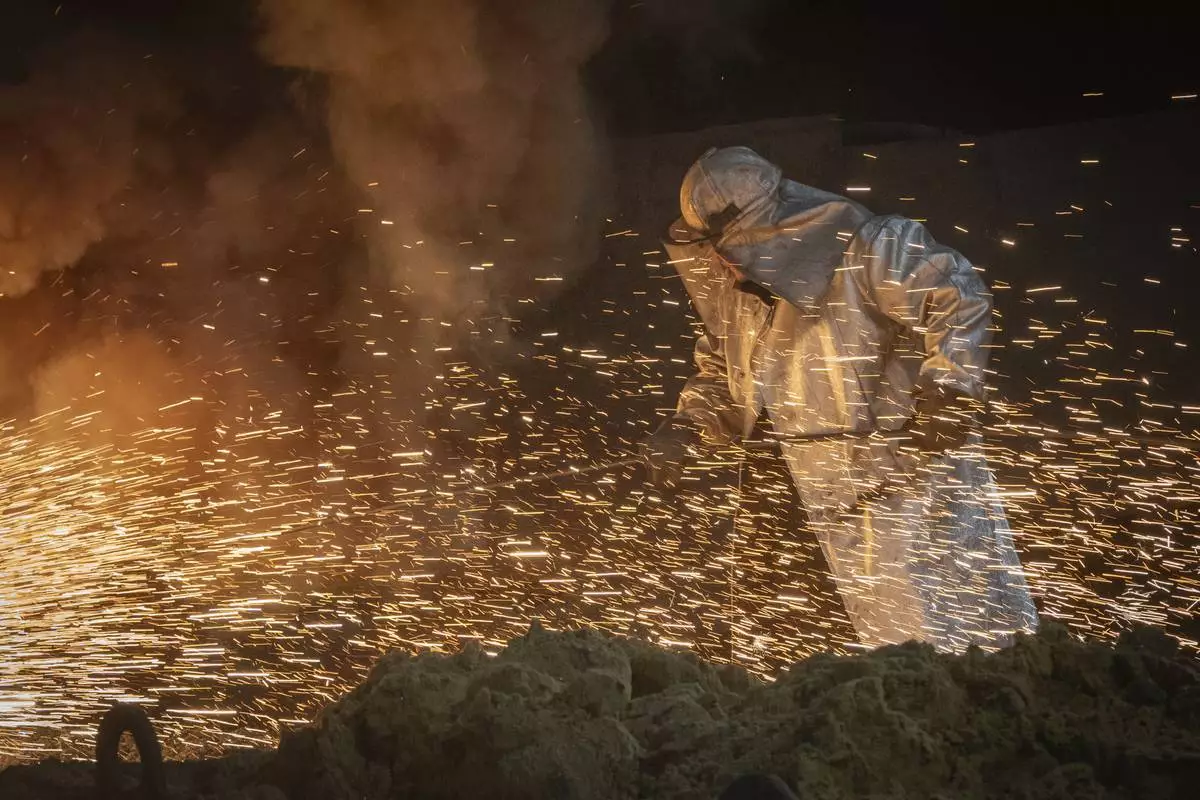
A worker in protective clothes melts steel at the Zaporizhstal Iron and Steelworks, one of the country's largest steel plants, in Zaporizhzhia, Ukraine, Thursday, Feb. 13, 2025. (AP Photo/Efrem Lukatsky)

A worker in protective clothes melts steel at the Zaporizhstal Iron and Steelworks, one of the country's largest steel plants, in Zaporizhzhia, Ukraine, Thursday, Feb. 13, 2025. (AP Photo/Efrem Lukatsky)

A worker in protective clothes melts steel at the Zaporizhstal Iron and Steelworks, one of the country's largest steel plants, in Zaporizhzhia, Ukraine, Thursday, Feb. 13, 2025. (AP Photo/Efrem Lukatsky)

A worker in protective clothes melts steel at the Zaporizhstal Iron and Steelworks, one of the country's largest steel plants, in Zaporizhzhia, Ukraine, Thursday, Feb. 13, 2025. (AP Photo/Efrem Lukatsky)

Taras Shevchenko, general manager of the Zaporizhstal Iron and Steelworks, one of the country's largest steel plants, shows the map of the steel mill in his office in Zaporizhzhia, Ukraine, Thursday, Feb. 13, 2025. (AP Photo/Efrem Lukatsky)
Taras Shevchenko, general manager of the Zaporizhstal Iron and Steelworks, one of the country's largest steel plants, shows the map of the steel mill in his office in Zaporizhzhia, Ukraine, Thursday, Feb. 13, 2025. (AP Photo/Efrem Lukatsky)

A blast furnace is seen at the Zaporizhstal Iron and Steelworks, one of the country's largest steel plants, in Zaporizhzhia, Ukraine, Thursday, Feb. 13, 2025. (AP Photo/Efrem Lukatsky)
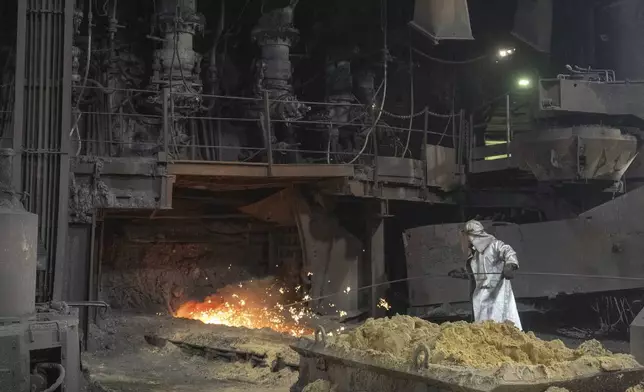
A blast furnace is seen at the Zaporizhstal Iron and Steelworks, one of the country's largest steel plants, in Zaporizhzhia, Ukraine, Thursday, Feb. 13, 2025. (AP Photo/Efrem Lukatsky)
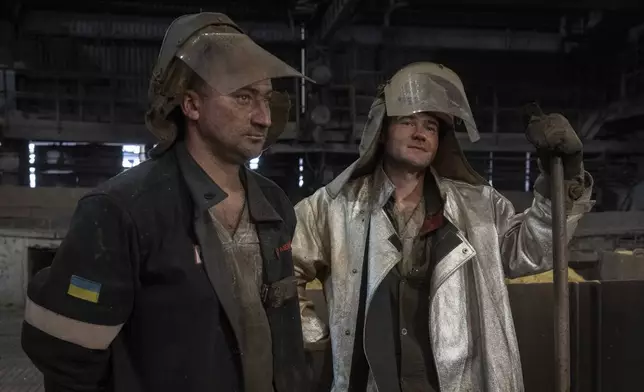
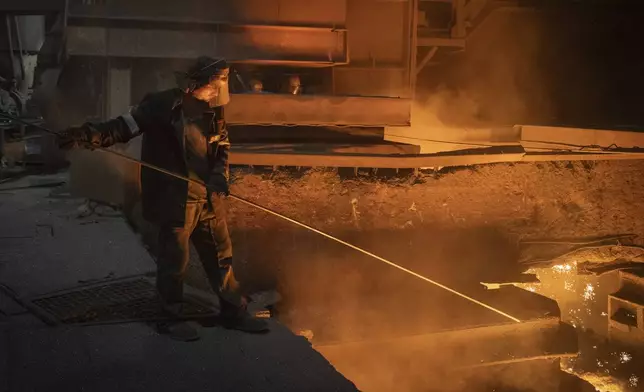
A worker in protective clothes melts steel at the Zaporizhstal Iron and Steelworks, one of the country's largest steel plants, in Zaporizhzhia, Ukraine, Thursday, Feb. 13, 2025. (AP Photo/Efrem Lukatsky)

A worker in protective clothes melts steel at the Zaporizhstal Iron and Steelworks, one of the country's largest steel plants, in Zaporizhzhia, Ukraine, Thursday, Feb. 13, 2025. (AP Photo/Efrem Lukatsky)

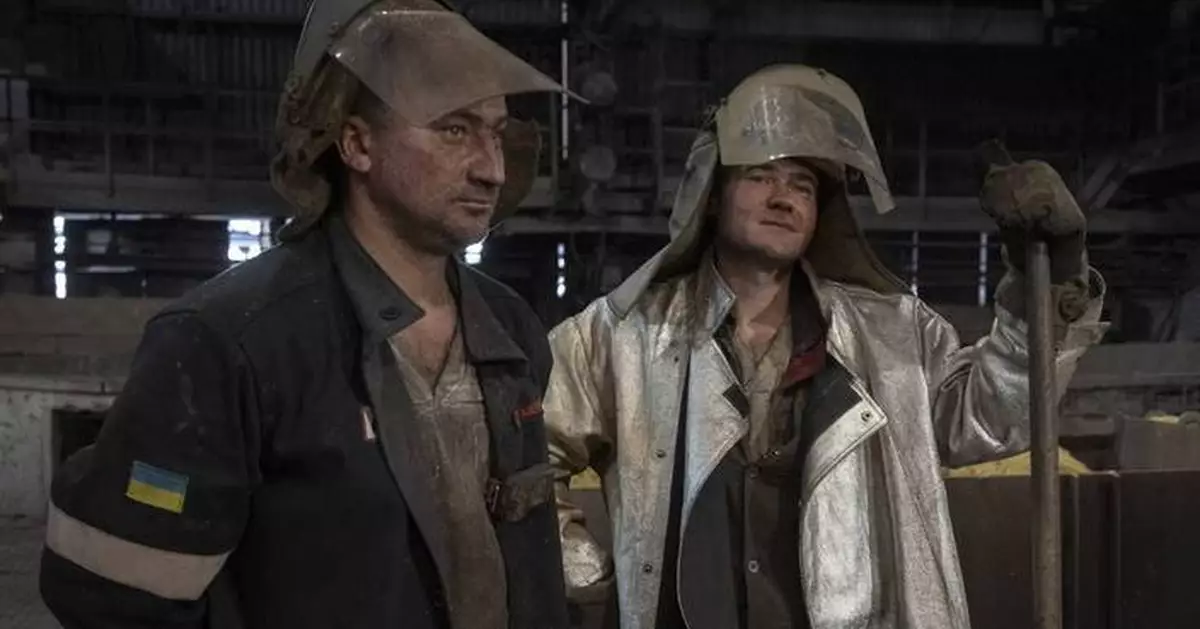
Steel melting workers chat at work at the Zaporizhstal Iron and Steelworks, one of the country's largest steel plants, in Zaporizhzhia, Ukraine, Thursday, Feb. 13, 2025. (AP Photo/Efrem Lukatsky)

Steel melting workers chat at work at the Zaporizhstal Iron and Steelworks, one of the country's largest steel plants, in Zaporizhzhia, Ukraine, Thursday, Feb. 13, 2025. (AP Photo/Efrem Lukatsky)

“Morale is not as high as it was before. We are pretty tired here,” plant supervisor Serhii Zhyvotchenko said, reflecting on the hardships. “But there is no way to go back; the only way is forward.”

Last week, though, a second war came to the doorstep of the hulking factory complex: the possible trade war that U.S. President Donald Trump has provoked since returning to office four weeks ago. Trump imposed tariffs of at least 25% on all imported steel and aluminum, a decision that could hurt an essential sector of Ukraine's battered economy.

Ukrainian government officials and business leaders were shocked by Trump’s Feb. 10 executive order, which underscored Ukraine's growing precarity in relation to its most important Western ally. The president maintains that imposing a variety of tariffs will level the playing field in international trade and make U.S. factories more competitive.

The steel industry’s share of Ukraine's gross domestic product has dropped by almost half since Russian troops entered the country, and steel exports are substantially below pre-war levels. The Ukrainian Steel Association warned that if the U.S. import duties take effect as planned on March 12, it would cost the weakened industry 2.4 billion hryvnias ($58 million) in revenue and the government 1 billion hryvnias ($24 million) in taxes a year.

The tariff order was not the only action by the president or his administration to cause alarm in Kyiv last week. Trump signaled changing winds in U.S. policy by having a direct call with Russian President Vladimir Putin, whom former President Joe Biden and other Western leaders had tried to isolate since Putin sent troops into Ukraine.

Trump also said that he would “probably” meet in person with the Russian leader in the near future, heightening concerns that Kyiv would be left out of or undermined in any ceasefire talks. Comments by both the president and U.S. Defense Secretary Pete Hegseth rejecting NATO membership for Ukraine further reinforced the fear that the country no longer had Washington in its corner.

Earlier this month, Trump indicated that he wanted to gain access to Ukraine's rare earth materials as a condition for continued U.S. support in the country's defense against Russia.

Ukrainian Economy Minister Yulia Svyrydenko expressed readiness to negotiate with U.S. officials to preserve access to the American steel market.

Ukraine hopes to get an exemption until March 2026 for steel products made in Ukraine, as well as for European Union products made from steel semi-finished Ukrainian steel. The crux of Kyiv’s argument is that the total value of steel supplied to the U.S. from Ukraine directly and via processing in the EU amounts to only 0.81% of total U.S. steel imports and cannot reasonably threaten U.S. industry.

“Maintaining the tariff exemption for Ukrainian steel, including products made in the EU from Ukrainian steel, provides essential support to Ukraine as it continues to resist unprovoked military aggression from Russia,” the Ukrainian Steel Association said in a statement. "The exemption enables Ukrainian steel exporters to sustain their operations, contribute to the national budget and support the broader Ukrainian economy.”

At the Zaporizhstal plant in southeast Ukraine's Zaporizhzhia region, smelting iron ore is the first step in a process that culminates in millions of tons of cast iron and steel getting shipped abroad

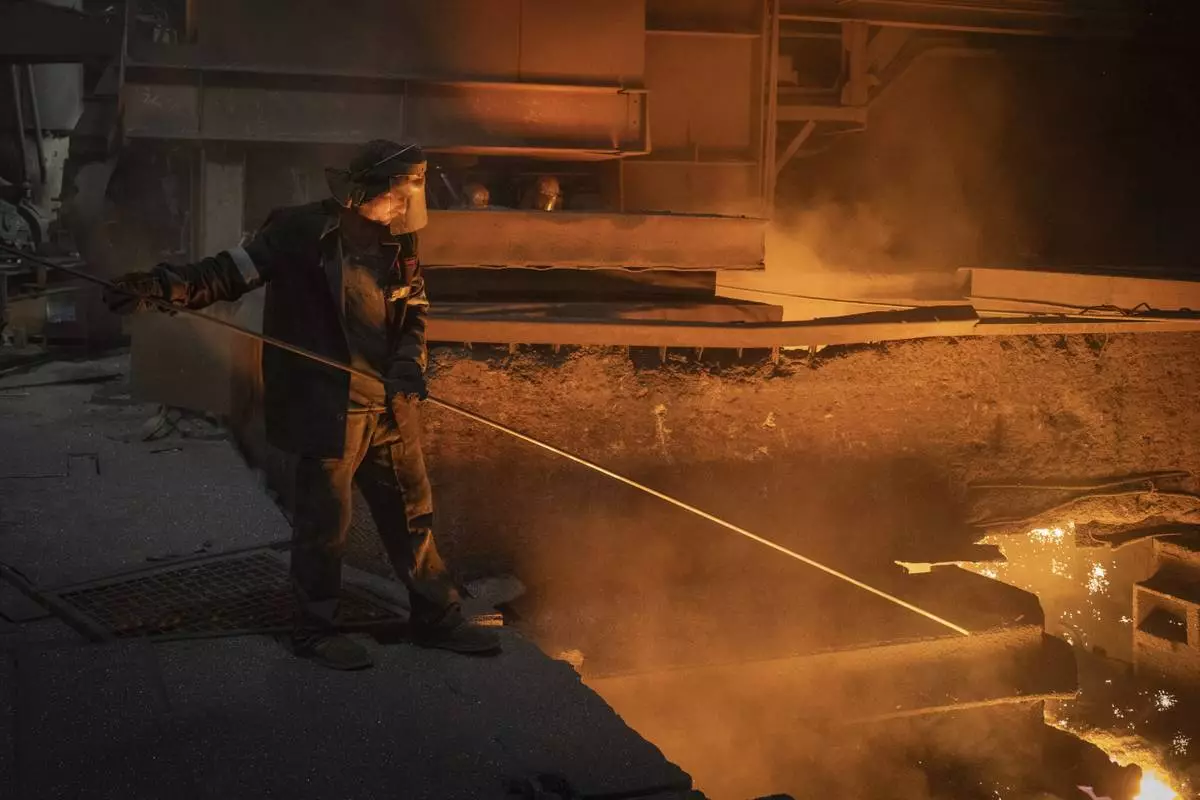
Zhyvotchenko approaches the colossal mouth of the blast furnace as if it were a dragon’s lair. A gust of oxygen raises the heat to nearly 2,000 degrees Celsius (3,632 degrees Fahrenheit). Workers in full protective gear appear like medieval knights, guiding a luminous flow of liquid steel.

For him and other employees, every day since Russia's full-scale invasion has been a test to produce more with less. The Zaporizhstal complex is operating at 75% capacity and with 12% fewer personnel after many workers were drafted into the Ukrainian army or left the country, according to the plant's owner, international mining and metals company Metinvest Group.

Metinvest lost control of two other steel plants when Russian soldiers occupied the city of Mariupol after a months-long siege in 2022. Russian gains recently cost the company an important coal mine in eastern Ukraine's Donetsk region.

Metinvest suspended operations at the Pokrovsk mine and evacuated workers as Russian troops advanced last month. Coking coal is another essential ingredient in steel production. To keep the Zaporizhstal mill running, Metinvest must import 1 million metric tons (1.1 U.S. tons) of coal a year from Europe and the U.S., plant general manager Taras Shevchenko said.

The grinding war already has brought other challenges, including soaring energy costs due to relentless attacks on Ukraine’s energy grid. Blockades and bombs disrupted trade routes. Complex export logistics required Metinivest to shift its focus from serving Asia and the Middle East to seeking customers in Europe. It was a painful process, Shevchenko said.

Ukraine plans to make the EU part of its exemption pitch because the bloc now accounts for the lion’s share of Ukrainian steel exports. There's worry the U.S. steel tariffs will have unwelcome ripple effects, such as European countries putting import duties on Ukrainian products to offset new taxes on their goods, Metinvest Group Chief Operating Officer Oleksandr Myronenko said.

“This will be a very significant problem for us,” Myronenko said.

Europe is the destination for around 80% of Metinvest’s exported products, he said. The company also has a plant in EU member-state Bulgaria from where reinforcing steel typically used as rods in concrete is exported to the U.S. The rebar shipments would be subject to tariffs as well, and demand may drop as a result, Myronenko said.

“We will have very large problems in the Bulgarian factory," he said.

Plant workers are hoping for the best in this period of uncertainty, they said.

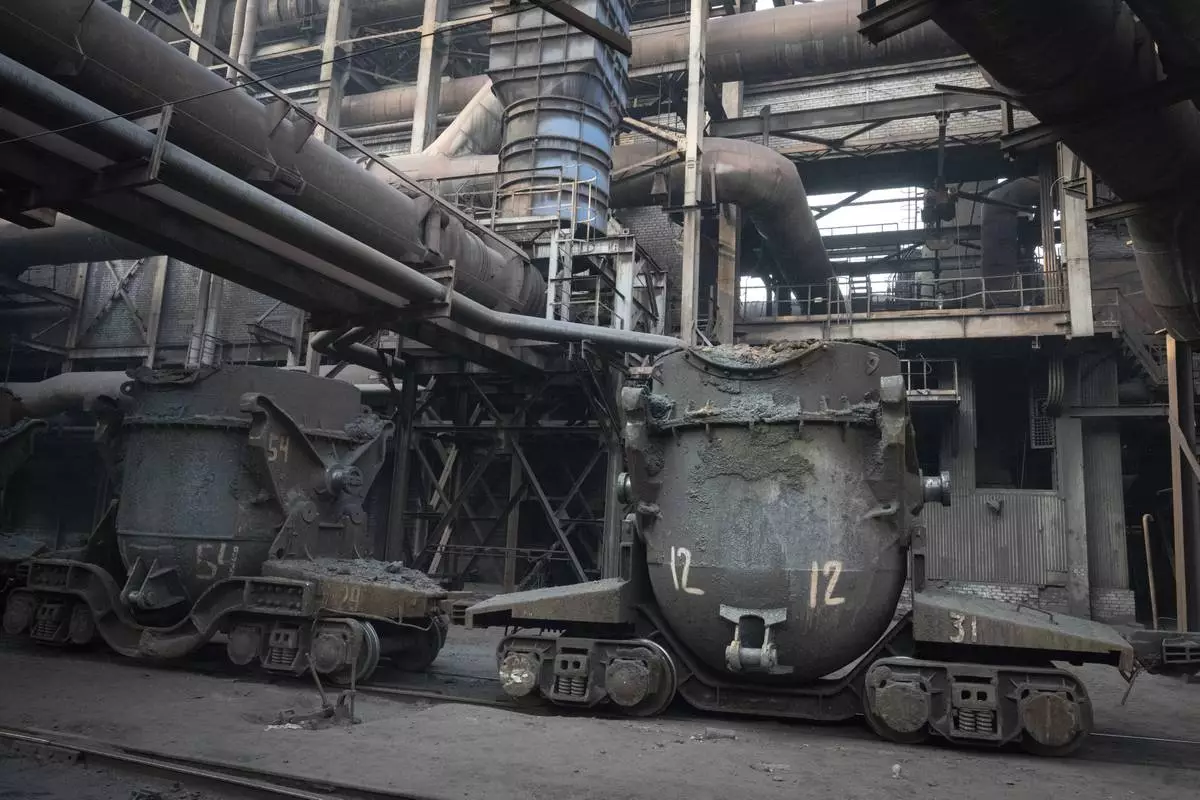
Zhyvotchenko stood outside the industrial complex, the smoke of exhaust seeping up from the ground below, as a rail car delivered gigantic ladles shaped like torpedoes. In the final stages of production, the lava-like metal will be poured into the containers for refining and casting. Then the steelworkers start the process over again.

“We can be tired, we can be tense, we can be anything, but we must endure and must work,” Myronenko said.

Associated Press journalists Dmytro Zhyhinas in Zaporizhzhia and Voldoymyr Yurchuk in Kyiv contributed to this report.
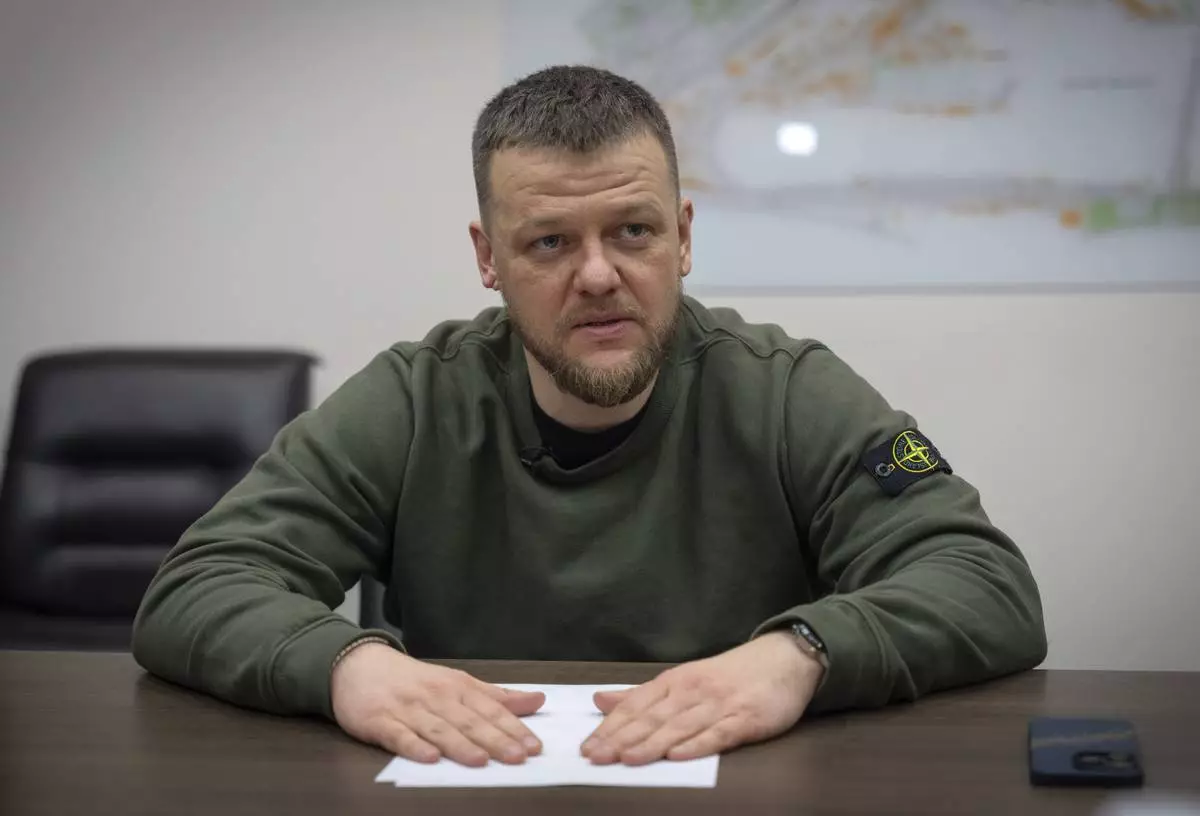
Oleksandr Myronenko, Metinvest Group Chief Operating Officer, talks to the Associated Press during the interview in his office in Zaporizhzhia, Ukraine, Thursday, Feb. 13, 2025. (AP Photo/Efrem Lukatsky)
Oleksandr Myronenko, Metinvest Group Chief Operating Officer, talks to the Associated Press during the interview in his office in Zaporizhzhia, Ukraine, Thursday, Feb. 13, 2025. (AP Photo/Efrem Lukatsky)

A blast furnace is seen at the Zaporizhstal Iron and Steelworks, one of the country's largest steel plants, in Zaporizhzhia, Ukraine, Thursday, Feb. 13, 2025. (AP Photo/Efrem Lukatsky)
A blast furnace is seen at the Zaporizhstal Iron and Steelworks, one of the country's largest steel plants, in Zaporizhzhia, Ukraine, Thursday, Feb. 13, 2025. (AP Photo/Efrem Lukatsky)
Engineers control the steel melting process at the Zaporizhstal Iron and Steelworks, one of the country's largest steel plants, in Zaporizhzhia, Ukraine, Thursday, Feb. 13, 2025. (AP Photo/Efrem Lukatsky)
Engineers control the steel melting process at the Zaporizhstal Iron and Steelworks, one of the country's largest steel plants, in Zaporizhzhia, Ukraine, Thursday, Feb. 13, 2025. (AP Photo/Efrem Lukatsky)

A worker in protective clothes melts steel at the Zaporizhstal Iron and Steelworks, one of the country's largest steel plants, in Zaporizhzhia, Ukraine, Thursday, Feb. 13, 2025. (AP Photo/Efrem Lukatsky)

A worker in protective clothes melts steel at the Zaporizhstal Iron and Steelworks, one of the country's largest steel plants, in Zaporizhzhia, Ukraine, Thursday, Feb. 13, 2025. (AP Photo/Efrem Lukatsky)

A worker in protective clothes melts steel at the Zaporizhstal Iron and Steelworks, one of the country's largest steel plants, in Zaporizhzhia, Ukraine, Thursday, Feb. 13, 2025. (AP Photo/Efrem Lukatsky)

A worker in protective clothes melts steel at the Zaporizhstal Iron and Steelworks, one of the country's largest steel plants, in Zaporizhzhia, Ukraine, Thursday, Feb. 13, 2025. (AP Photo/Efrem Lukatsky)

Taras Shevchenko, general manager of the Zaporizhstal Iron and Steelworks, one of the country's largest steel plants, shows the map of the steel mill in his office in Zaporizhzhia, Ukraine, Thursday, Feb. 13, 2025. (AP Photo/Efrem Lukatsky)
Taras Shevchenko, general manager of the Zaporizhstal Iron and Steelworks, one of the country's largest steel plants, shows the map of the steel mill in his office in Zaporizhzhia, Ukraine, Thursday, Feb. 13, 2025. (AP Photo/Efrem Lukatsky)

A blast furnace is seen at the Zaporizhstal Iron and Steelworks, one of the country's largest steel plants, in Zaporizhzhia, Ukraine, Thursday, Feb. 13, 2025. (AP Photo/Efrem Lukatsky)
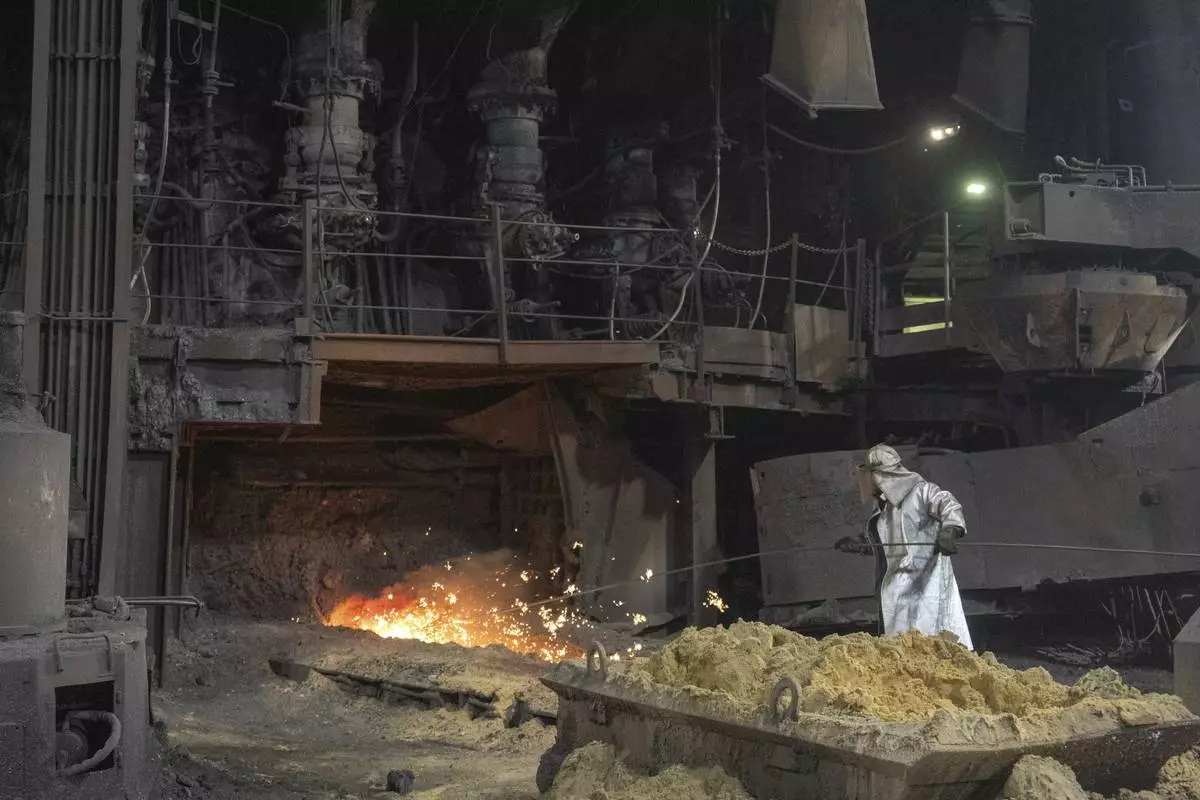
A blast furnace is seen at the Zaporizhstal Iron and Steelworks, one of the country's largest steel plants, in Zaporizhzhia, Ukraine, Thursday, Feb. 13, 2025. (AP Photo/Efrem Lukatsky)
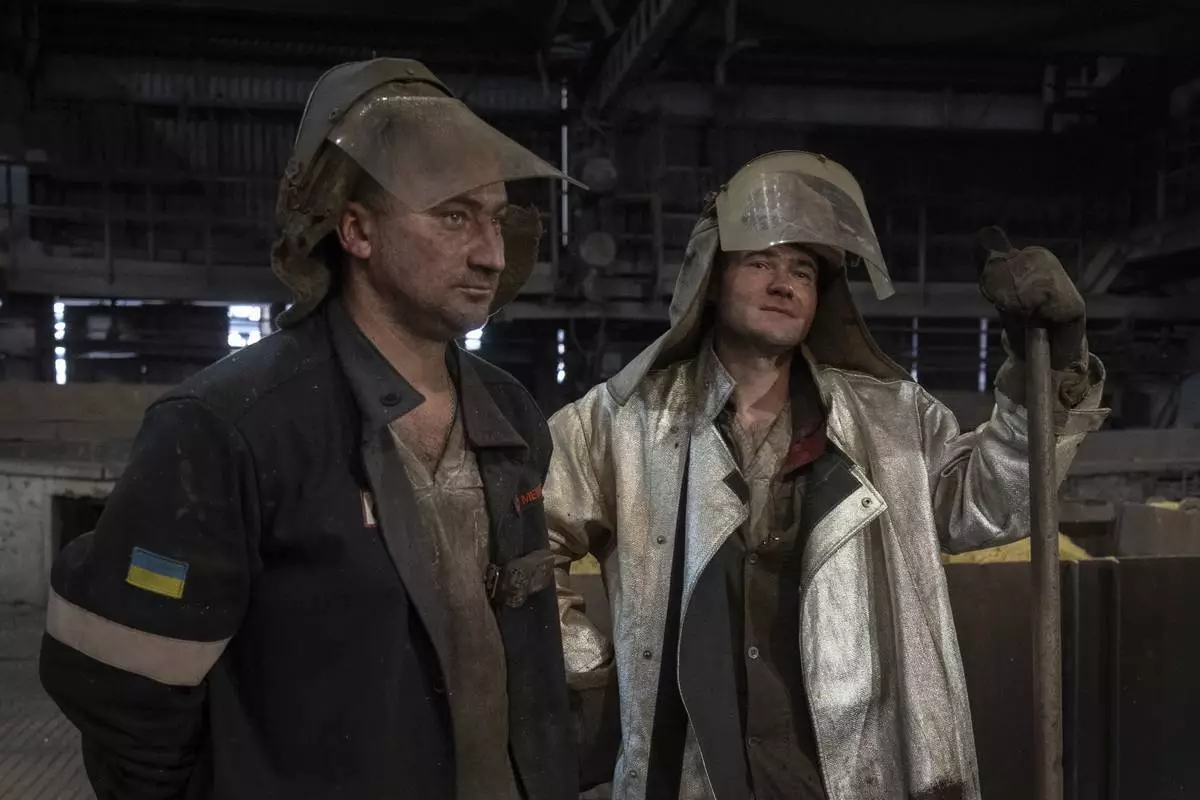
A worker in protective clothes melts steel at the Zaporizhstal Iron and Steelworks, one of the country's largest steel plants, in Zaporizhzhia, Ukraine, Thursday, Feb. 13, 2025. (AP Photo/Efrem Lukatsky)
A worker in protective clothes melts steel at the Zaporizhstal Iron and Steelworks, one of the country's largest steel plants, in Zaporizhzhia, Ukraine, Thursday, Feb. 13, 2025. (AP Photo/Efrem Lukatsky)

Steel melting workers chat at work at the Zaporizhstal Iron and Steelworks, one of the country's largest steel plants, in Zaporizhzhia, Ukraine, Thursday, Feb. 13, 2025. (AP Photo/Efrem Lukatsky)
Steel melting workers chat at work at the Zaporizhstal Iron and Steelworks, one of the country's largest steel plants, in Zaporizhzhia, Ukraine, Thursday, Feb. 13, 2025. (AP Photo/Efrem Lukatsky)
WASHINGTON (AP) — Becky Pepper-Jackson finished third in the discus throw in West Virginia last year though she was in just her first year of high school. Now a 15-year-old sophomore, Pepper-Jackson is aware that her upcoming season could be her last.

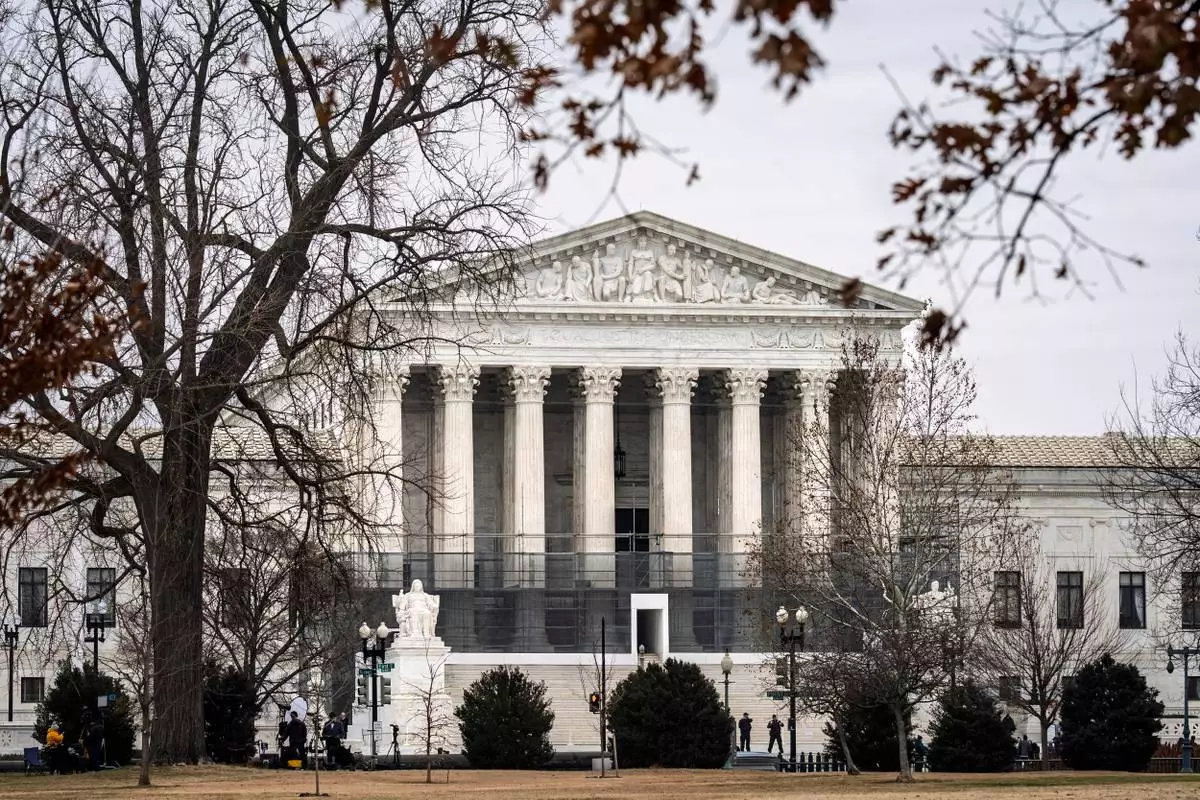
West Virginia has banned transgender girls like Pepper-Jackson from competing in girls and women's sports, and is among the more than two dozen states with similar laws. Though the West Virginia law has been blocked by lower courts, the outcome could be different at the conservative-dominated Supreme Court, which has allowed multiple restrictions on transgender people to be enforced in the past year.

The justices are hearing arguments Tuesday in two cases over whether the sports bans violate the Constitution or the landmark federal law known as Title IX that prohibits sex discrimination in education. The second case comes from Idaho, where college student Lindsay Hecox challenged that state's law.

Decisions are expected by early summer.

President Donald Trump's Republican administration has targeted transgender Americans from the first day of his second term, including ousting transgender people from the military and declaring that gender is immutable and determined at birth.

Pepper-Jackson has become the face of the nationwide battle over the participation of transgender girls in athletics that has played out at both the state and federal levels as Republicans have leveraged the issue as a fight for athletic fairness for women and girls.

“I think it’s something that needs to be done,” Pepper-Jackson said in an interview with The Associated Press that was conducted over Zoom. “It’s something I’m here to do because ... this is important to me. I know it’s important to other people. So, like, I’m here for it.”

She sat alongside her mother, Heather Jackson, on a sofa in their home just outside Bridgeport, a rural West Virginia community about 40 miles southwest of Morgantown, to talk about a legal fight that began when she was a middle schooler who finished near the back of the pack in cross-country races.

Pepper-Jackson has grown into a competitive discus and shot put thrower. In addition to the bronze medal in the discus, she finished eighth among shot putters.

She attributes her success to hard work, practicing at school and in her backyard, and lifting weights. Pepper-Jackson has been taking puberty-blocking medication and has publicly identified as a girl since she was in the third grade, though the Supreme Court's decision in June upholding state bans on gender-affirming medical treatment for minors has forced her to go out of state for care.

Her very improvement as an athlete has been cited as a reason she should not be allowed to compete against girls.

“There are immutable physical and biological characteristic differences between men and women that make men bigger, stronger, and faster than women. And if we allow biological males to play sports against biological females, those differences will erode the ability and the places for women in these sports which we have fought so hard for over the last 50 years,” West Virginia's attorney general, JB McCuskey, said in an AP interview. McCuskey said he is not aware of any other transgender athlete in the state who has competed or is trying to compete in girls or women’s sports.

Despite the small numbers of transgender athletes, the issue has taken on outsize importance. The NCAA and the U.S. Olympic and Paralympic Committees banned transgender women from women's sports after Trump signed an executive order aimed at barring their participation.

The public generally is supportive of the limits. An Associated Press-NORC Center for Public Affairs Research poll conducted in October 2025 found that about 6 in 10 U.S. adults “strongly” or “somewhat” favored requiring transgender children and teenagers to only compete on sports teams that match the sex they were assigned at birth, not the gender they identify with, while about 2 in 10 were “strongly” or “somewhat” opposed and about one-quarter did not have an opinion.

About 2.1 million adults, or 0.8%, and 724,000 people age 13 to 17, or 3.3%, identify as transgender in the U.S., according to the Williams Institute at the UCLA School of Law.

Those allied with the administration on the issue paint it in broader terms than just sports, pointing to state laws, Trump administration policies and court rulings against transgender people.

"I think there are cultural, political, legal headwinds all supporting this notion that it’s just a lie that a man can be a woman," said John Bursch, a lawyer with the conservative Christian law firm Alliance Defending Freedom that has led the legal campaign against transgender people. “And if we want a society that respects women and girls, then we need to come to terms with that truth. And the sooner that we do that, the better it will be for women everywhere, whether that be in high school sports teams, high school locker rooms and showers, abused women’s shelters, women’s prisons.”

But Heather Jackson offered different terms to describe the effort to keep her daughter off West Virginia's playing fields.

“Hatred. It’s nothing but hatred,” she said. "This community is the community du jour. We have a long history of isolating marginalized parts of the community.”

Pepper-Jackson has seen some of the uglier side of the debate on display, including when a competitor wore a T-shirt at the championship meet that said, “Men Don't Belong in Women's Sports.”

“I wish these people would educate themselves. Just so they would know that I’m just there to have a good time. That’s it. But it just, it hurts sometimes, like, it gets to me sometimes, but I try to brush it off,” she said.

One schoolmate, identified as A.C. in court papers, said Pepper-Jackson has herself used graphic language in sexually bullying her teammates.

Asked whether she said any of what is alleged, Pepper-Jackson said, “I did not. And the school ruled that there was no evidence to prove that it was true.”

The legal fight will turn on whether the Constitution's equal protection clause or the Title IX anti-discrimination law protects transgender people.

The court ruled in 2020 that workplace discrimination against transgender people is sex discrimination, but refused to extend the logic of that decision to the case over health care for transgender minors.

The court has been deluged by dueling legal briefs from Republican- and Democratic-led states, members of Congress, athletes, doctors, scientists and scholars.

The outcome also could influence separate legal efforts seeking to bar transgender athletes in states that have continued to allow them to compete.

If Pepper-Jackson is forced to stop competing, she said she will still be able to lift weights and continue playing trumpet in the school concert and jazz bands.

“It will hurt a lot, and I know it will, but that’s what I’ll have to do,” she said.

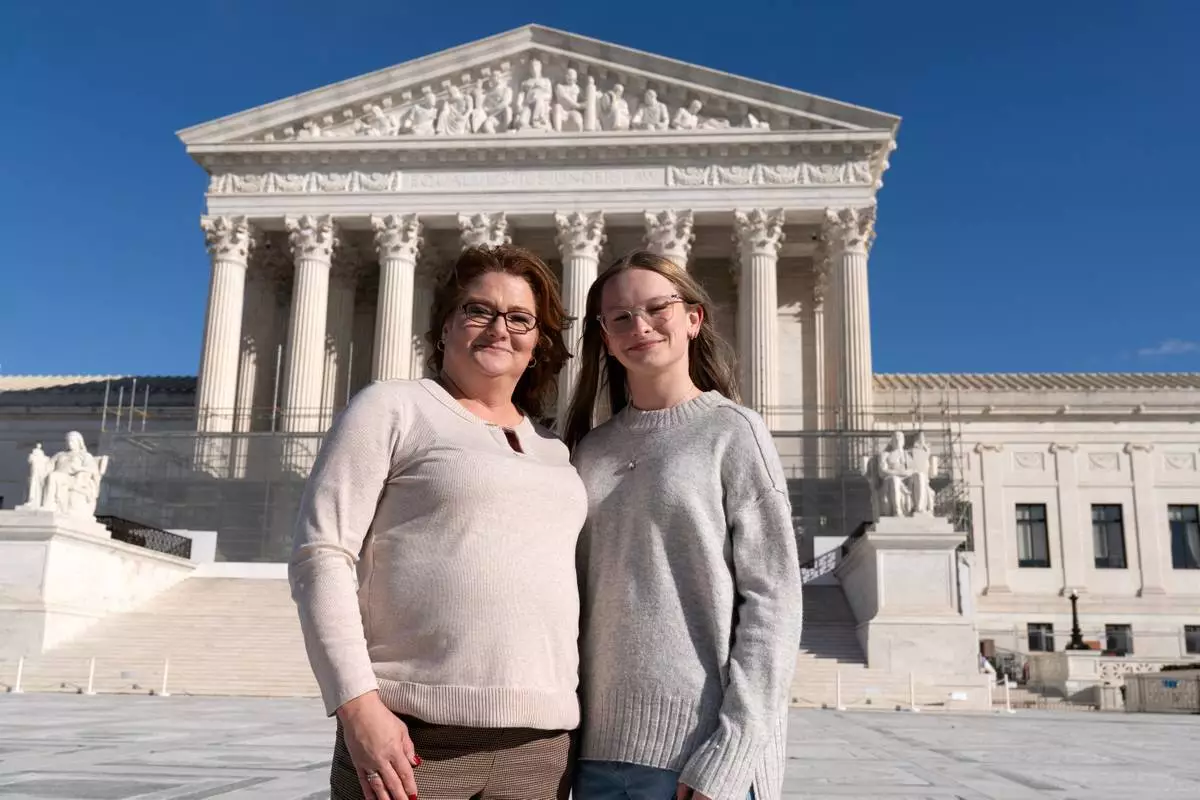
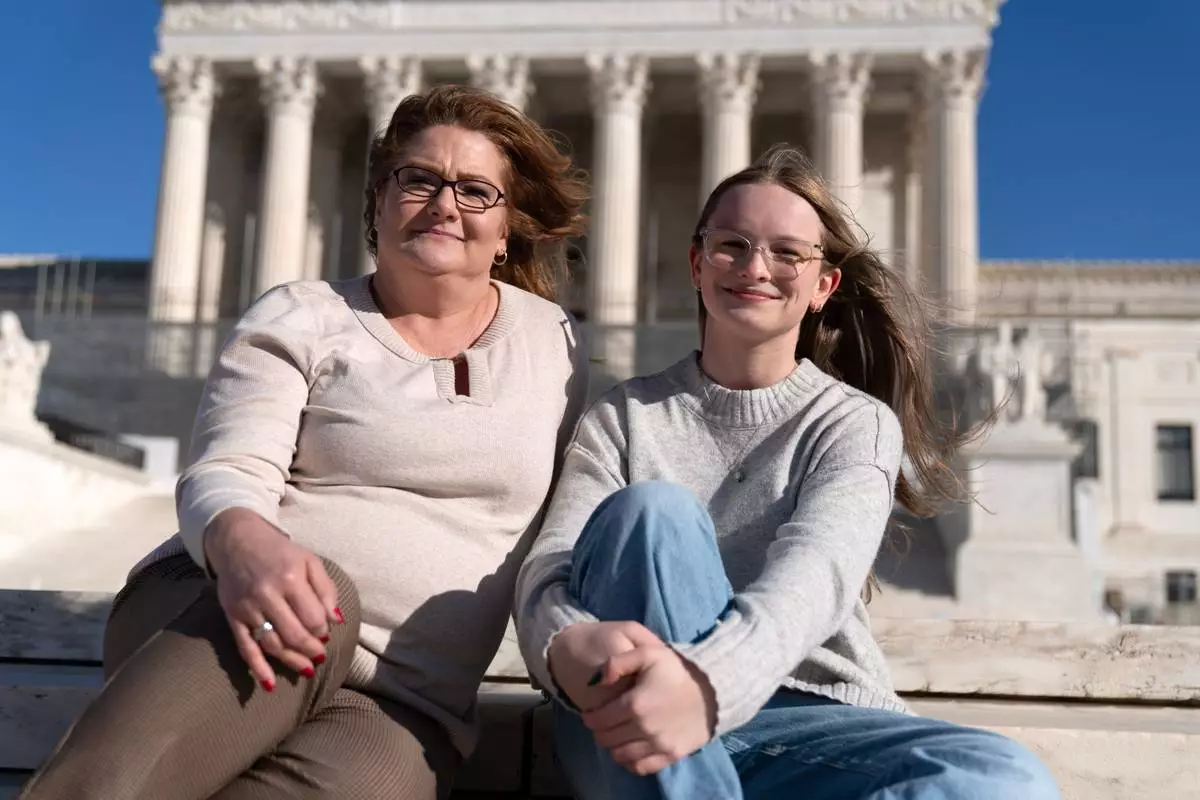
Heather Jackson, left, and Becky Pepper-Jackson pose for a photograph outside of the U.S. Supreme Court in Washington, Sunday, Jan. 11, 2026. (AP Photo/Jose Luis Magana)

Heather Jackson, left, and Becky Pepper-Jackson pose for a photograph outside of the U.S. Supreme Court in Washington, Sunday, Jan. 11, 2026. (AP Photo/Jose Luis Magana)

Heather Jackson, left, and Becky Pepper-Jackson pose for a photograph outside of the U.S. Supreme Court in Washington, Sunday, Jan. 11, 2026. (AP Photo/Jose Luis Magana)

Heather Jackson, left, and Becky Pepper-Jackson pose for a photograph outside of the U.S. Supreme Court in Washington, Sunday, Jan. 11, 2026. (AP Photo/Jose Luis Magana)

Becky Pepper-Jackson poses for a photograph outside of the U.S. Supreme Court in Washington, Sunday, Jan. 11, 2026. (AP Photo/Jose Luis Magana)

Becky Pepper-Jackson poses for a photograph outside of the U.S. Supreme Court in Washington, Sunday, Jan. 11, 2026. (AP Photo/Jose Luis Magana)

The Supreme Court stands is Washington, Friday, Jan. 9, 2026. (AP Photo/J. Scott Applewhite)

The Supreme Court stands is Washington, Friday, Jan. 9, 2026. (AP Photo/J. Scott Applewhite)

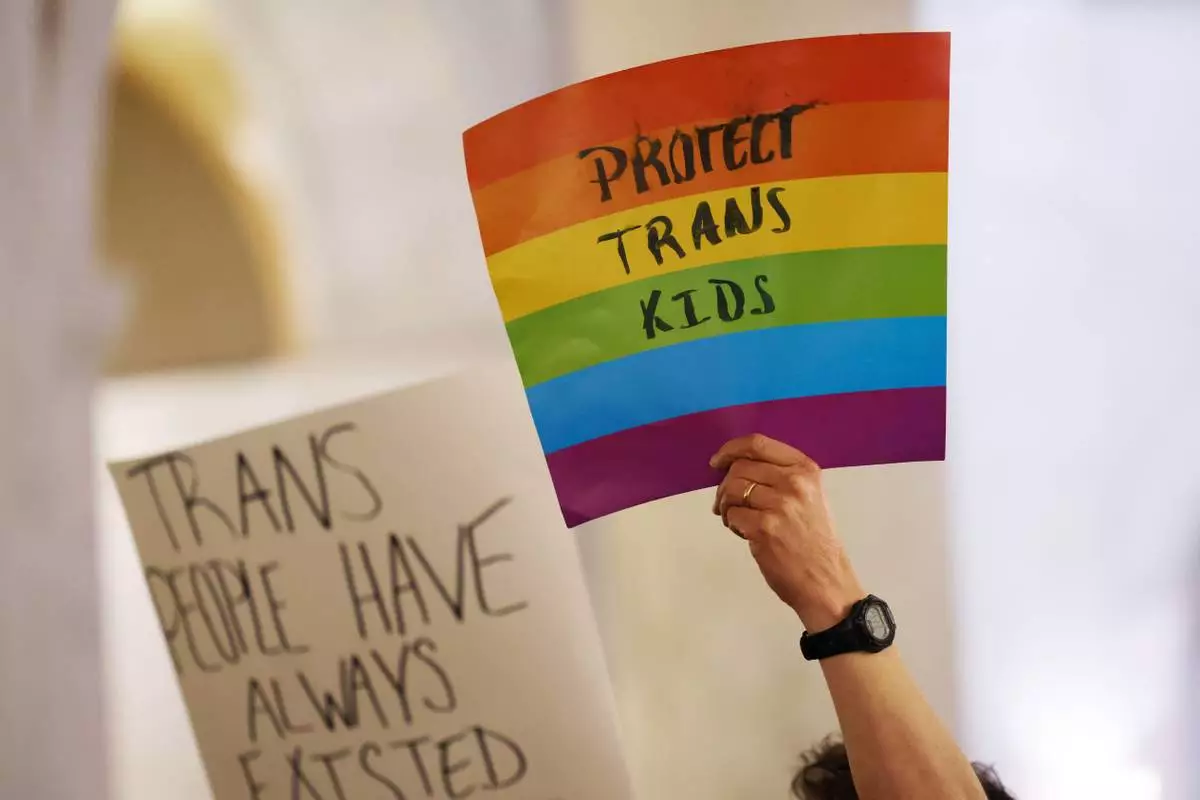
FILE - Protestors hold signs during a rally at the state capitol in Charleston, W.Va., on March 9, 2023. (AP Photo/Chris Jackson, file)

FILE - Protestors hold signs during a rally at the state capitol in Charleston, W.Va., on March 9, 2023. (AP Photo/Chris Jackson, file)

Recommended Articles