The Changcheng Station, or the Great Wall Station, China's first research base in Antarctica, celebrated its 40th anniversary with a series of activities and a seminar on Thursday.
A flag-raising ceremony at the station began all the celebratory events. Following the ceremony, members of scientific research teams from other countries joined their Chinese counterparts to write messages of blessing on postcards, which were then stamped with a special commemorative postmark for the memorable date.
On the same day, a seminar was held, with over 70 expedition members from seven countries, including Chile, Russia, Uruguay, and South Korea, participating. In-depth discussions focused on key issues such as global climate change vs. human activities, the open sharing of the Changcheng Station, and international cooperation.
After the seminar, Chinese and foreign researchers made dumplings together, experiencing Chinese culture together in Antarctica.
The Changcheng station, China's first year-round research base on the continent, has accumulated significant scientific research results since it was set up in 1985.
In polar microorganism research, it was the first to reveal the unique structure and function of marine microbial communities in both the North and South Poles, and it also explored the adaptation mechanisms of these microorganisms to the polar environment.
In terms of biodiversity protection, the reconstruction of penguin paleoecology has shed light on the historical migration of penguin breeding grounds and the impact of climate change on polar biological populations.
Over the 40 years, the station has gradually established a long-term observation system covering critical areas such as the atmosphere, soil, water, flora and fauna. To date, it has built a vast monitoring database, providing valuable data support for global climate change research.
Since China's 41st Antarctic Expedition began their work at the station, numerous scientific research achievements have been made.
"We've successfully set up a submarine seismic monitoring station in Maxwell Bay, advancing the preliminary investigation of earthquake and tsunami warning systems. At the same time, we've completed the monitoring and upgrading of key facilities and equipment here, significantly enhancing the intelligence level of the station," said Shao Hebin, head of the Changcheng Station of China's 41st Antarctic Expedition. After several rounds of expansion, the Changcheng Station now covers an area of 2.52 square kilometers. It has a total of 25 structures in various types, including scientific research facilities, living quarters, and a meteorological facility. It can accommodate 60 people in summer and 20 people in winter.
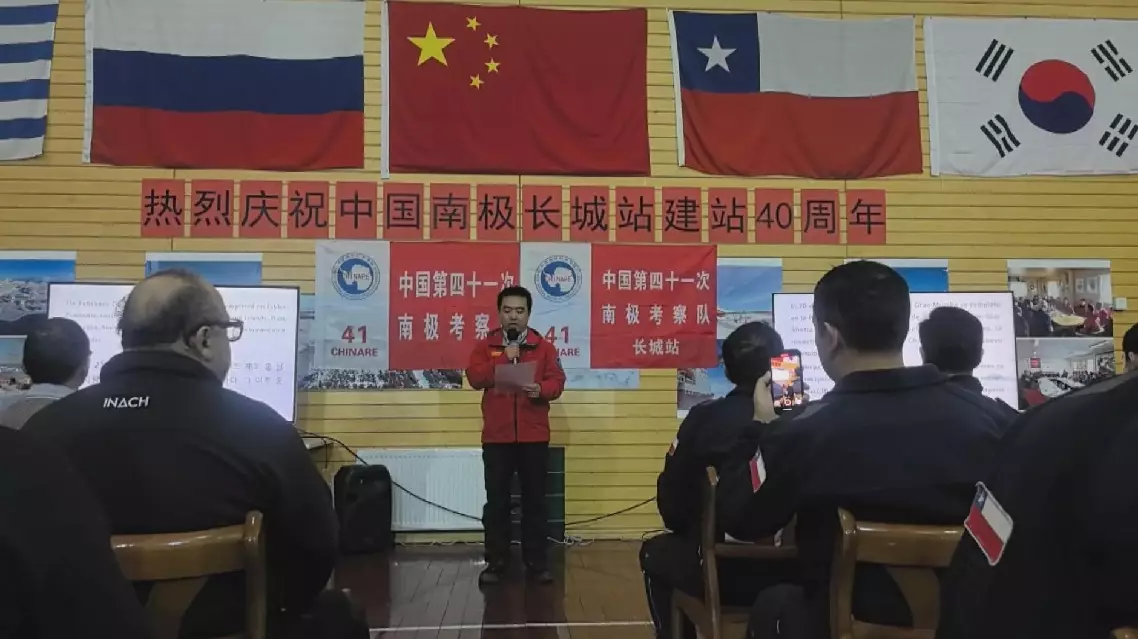
China's first research base in Antarctica celebrates 40 anniversary