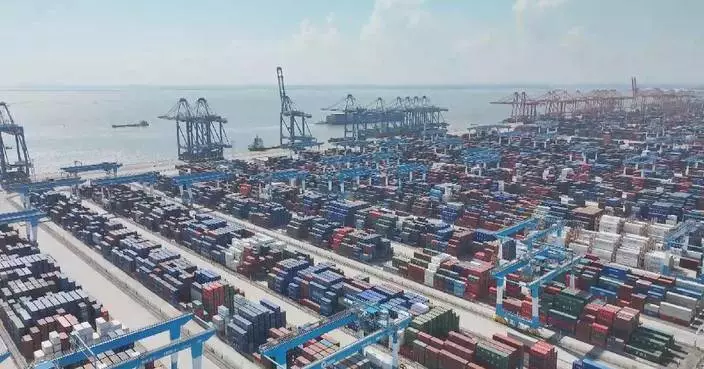
The lingering Middle East tensions provoked by the United States-Israel military strikes on Iran since February 28 has sent shockwaves to the Italian wine industry that is highly dependent on exports.
The crisis impacts not only wine orders, but also the industry's production and consumption ends via rising shipping, energy and raw material prices.
Click to Gallery
Middle East tension hits Italy's wine industry
Middle East tension hits Italy's wine industry
Middle East tension hits Italy's wine industry
Middle East tension hits Italy's wine industry
With the obstruction of sea transportation and the rise in costs, the profit margins of enterprises are narrowed, and the industry is full of concerns about the future.
In the Veneto region of northern Italy, sparkling wine enterprises are highly dependent on overseas markets, as their products have to be shipped by sea to markets in Asia, the Middle East and the Americas.
Due to the severe disruption of shipping in the Strait of Hormuz, some ships have taken detours, leading to pressure on logistics.
In the view of a local industry association, compared with short-term order changes, greater uncertainty stems from the continuous fluctuations in energy prices.
Industry insiders say that rising costs often have a lagging effect. Even if the conflict ends in the short term, the related impact may still last for several months.
"If this conflict drags long, not only will it be hard for me to predict what will happen, but I think it will be hard for everyone to predict. We must start to envision various scenarios and take into account cases in which both energy and raw materials are insufficient. So we have to look for ways to save energy, but it's impossible to realize these measures in three months," said Franco Adami, president of the Consortium for the Protection of Conegliano Valdobbiadene Prosecco DOCG, a protected wine area in the Veneto region.

Middle East tension hits Italy's wine industry

Middle East tension hits Italy's wine industry

Middle East tension hits Italy's wine industry

Middle East tension hits Italy's wine industry
China's 16th Arctic Ocean expedition achieved the country's first video call spanning the North and South Poles on September 25, coinciding with the Mid-Autumn Festival, using a domestically developed satellite system with a delay of no more than one second.
The expedition deployed four vessels -- Xuelong, Xuelong 2, Jidi, and Tansuo 3 -- to study extreme environmental changes in the Arctic amid accelerating global warming. On September 29, China's research icebreakers Xuelong and Xuelong 2 returned to Shanghai after completing their missions, while Jidi and Tansuo 3 continue their expedition tasks and are expected to return in mid-October following a three-month journey.
The expedition team held a satellite video conversation with China's Antarctic Qinling Station, extending festive greetings to their polar scientific research counterparts and testing a large-scale constellation designed to provide global broadband internet and support integrated space-Earth 6G networks.
"This is the first time that China has used a domestically developed communications satellite system to make a video call across the largest latitude span," said Liu Feng, a senior engineer at the National Marine Data and Information Service.
The around-13,000-satellite GW constellation, led by China Satellite Network Group (SatNet), is China's first mega low Earth orbit satellite internet project. During the polar test, the maximum uplink and downlink speed reached around 30 megabits per second, equivalent to taking about 10 minutes to download a 1GB file. The equipment can also be used for emergency rescue and maritime communications.
"During the test period, it also supported real-time communications among Xuelong, Jidi, Tansuo 3, the National Marine Data and Information Service and the Polar Research Center. After Jidi and Tansuo 3 entered ice zone operation areas, their communication could not be guaranteed. So file transfers and navigation logs had to be transmitted through the SatNet equipment," said Zhang Bin, an engineer at the National Marine Data and Information Service. The successful test of the domestically produced satellite communication equipment marks China's independent control over polar region communications. The equipment ensures that data remains within the country, effectively safeguarding data security.

China holds first video call between North, South Poles via homegrown satellite system