A massive demonstration took place in the Iraqi capital Baghdad on Saturday, condemning the joint attacks on Iran by the United States and Israel, the resulting crises that have affected countries in the Middle East region and even the world.
From every direction, Iraqi crowds headed to the Liberation Square in Baghdad for the massive demonstration. The rally called for supporting peace efforts and condemned what the participants described as "the unjustified U.S.-Israeli aggression against Iran," a view shared by all participants in this show of solidarity.
"The peaceful million-person march or demonstration is a condemnation of the Zionist-American aggression against the Popular Mobilization Forces and the aggression against our beloved country, as well as a show of support for our brothers in the Islamic Republic of Iran," said Sheikh Qassim al-Shihani, a Shia cleric.
"America came with its fleets across the oceans. There is no doubt that it is a brutal aggression. Do Iran or Islamic countries threaten America? But there is a much greater and deeper goal than that -- targeting Muslim countries in order to seize and control the Middle East along with its wealth. That is America's way," said demonstrator Karim Madi Al-Joudah.
A reckless adventure and a war that could spiral out of control -- this is how the demonstrators describe the ongoing conflict in the Middle East. Some even draw parallels between the war on Iran and the 2003 war on Iraq, which was also waged under the pretext of possessing weapons of massive destruction.
"Iraq was targeted by an international coalition. That coalition fought Iraq to impose a blockade and to oppose it under the pretext of possessing nuclear weapons. The same pretext is being used today against Iran -- claiming that it possesses nuclear weapons. We stand with the victim against the oppressor, and today we are standing up to reject this exploitation. The world is in crisis. We do not need war. We need peace and cooperation," said Dhirgham Samir, a demonstrator.
"Of course, there are no justifications for this aggression, and its effects have become apparent on the economic and social fronts. In fact, it has even affected the entire global economy," said Abdullah Al-Mayahi, another demonstrator.
This demonstration is just one of a series of gatherings witnessed in several Iraqi cities since Feb. 28, the day when the U.S. and Israel launched their first joint military strikes against Iran. Public anger has grown in Iraq as the country has been affected by the war's security and economic consequences, with U.S. fighter jets continuing to carry out almost daily strikes on targets deep inside the Iraqi territory.

Baghdad demonstrators condemn US-Israeli attacks on Iran
China's Qingming Festival holiday has turned flower viewing into a showcase of cultural heritage, drawing tourists and boosting local economies.
From references to "The Book of Songs", a treasured Confucian classic and China's oldest poetry collection, to longstanding flower festivals, organizers are promoting flower viewing as cultural tourism, weaving poetry and tradition into spring outings.
Hebi City in central China's Henan Province is drawing crowds with magnolias, tulips and crabapples, alongside 87 cherry blossom varieties. The blooms have become a major Qingming Festival attraction, prompting local authorities to pair tourism with cultural heritage.
As one of the birthplaces of The Book of Songs, Hebi has launched a campaign offering free entry to scenic spots for visitors who recite verses from the ancient classic. The initiative links flower viewing with a text long regarded as a cornerstone of Chinese literature.
In Binzhou, east China's Shandong Province, a park spanning 240 hectares, roughly the size of 330 football fields, is covered in blossoms, making it one of the largest spring displays in the region. The park uses smart drip irrigation to keep flowers hydrated and extend their peak season.
Originating in the Southern Song Dynasty (1127-1279), the Huazhao (Flower Deities) Festival in Xinzhou District of Wuhan boasts more than 800 years of history. Listed as a provincial intangible cultural heritage in 2011, it remains the largest folk celebration in eastern Hubei, drawing thousands of visitors each spring. A parade featuring 12 flower deities winds through the streets, anchoring the festival as both a cultural showcase and a tourism draw.
"The plum blossom represents noble character, the peach blossom radiant beauty. We hope more people will come to discover the Huazhao Festival," said Qinghuan, a performer portraying the Osmanthus Deity.
Outside the Shanxi Museum in Taiyuan City, apricot trees are in full bloom. Their pale pink petals flutter in the breeze, lining the museum's corridors and echoing the deep history within. Visitors pause to photograph the unique blend of ancient architecture and fleeting spring beauty.
During the Qingming Festival holiday, the Beijing Garden of World's Flowers turned into a "spring palette." A nearly 2,000-square-meter sea of flowers burst into color. Against this floral backdrop, traditional experiences such as archery, tea whisking and movable-type printing drew crowds seeking a holiday filled with blossoms and cultural charm.
The garden features over 40 varieties of alpine and deciduous rhododendrons in shades of purple, pink and white, layered like clouds of silk. Along the flower-lined paths, colorful benches and ribbons create picture-perfect spots. Visitors wander, stop to admire, or raise their phones to capture a moment of spring romance.
"We hope these vibrant, contrasting floral colors bring a little healing and joy to people's lives, a space to relax and find peace amid the spring bloom," said Shi Wenfang, director of the Beijing Garden of World's Flowers. Beyond flower viewing, the garden is hosting its annual Huazhao Festival during the holiday. Now in its fifth year, the event has attracted nearly 300,000 visitors in total. The festivities run through April 6.
Falling on April 5 this year, the Qingming Festival, or Tomb-Sweeping Day, is a traditional Chinese festival for honoring the deceased and paying tributes to ancestors. The three-day holiday from Saturday to Monday also provides a short break for Chinese citizens to enjoy outdoor activities and sightseeing in pleasant springtime temperatures.
Compiled between the Western Zhou Dynasty and the Spring and Autumn Period (1100 B.C. - 476 B.C.), "The Book of Songs" contains at least 305 poems and is recognized as a Confucian classic.
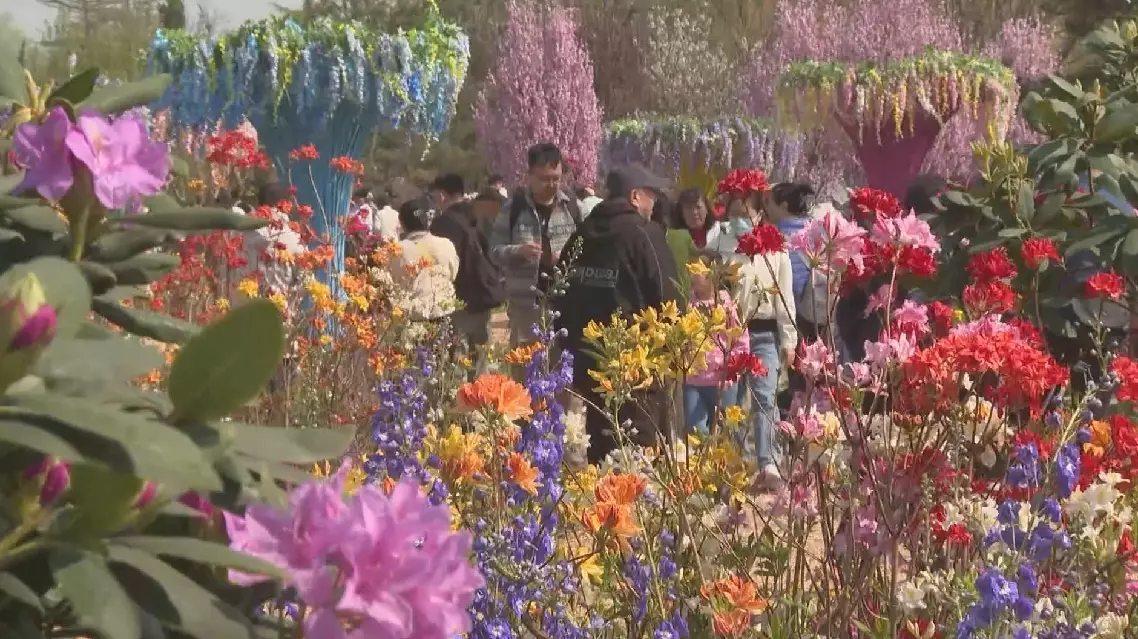
Flower viewing draws holiday crowds across China during Qingming Festival