As the Qingming Festival ushered in a season of blooming flowers and warming weather, scenic spots across China saw a significant spike in visitors, with many embracing the outdoors for spring outings and cultural experiences.
Falling on April 5 this year, the Qingming Festival, or Tomb-Sweeping Day, is a traditional Chinese festival for honoring the deceased and paying tributes to ancestors. The three-day holiday from Saturday to Monday also provides a short break for Chinese citizens to enjoy outdoor activities and sightseeing in pleasant springtime temperatures.
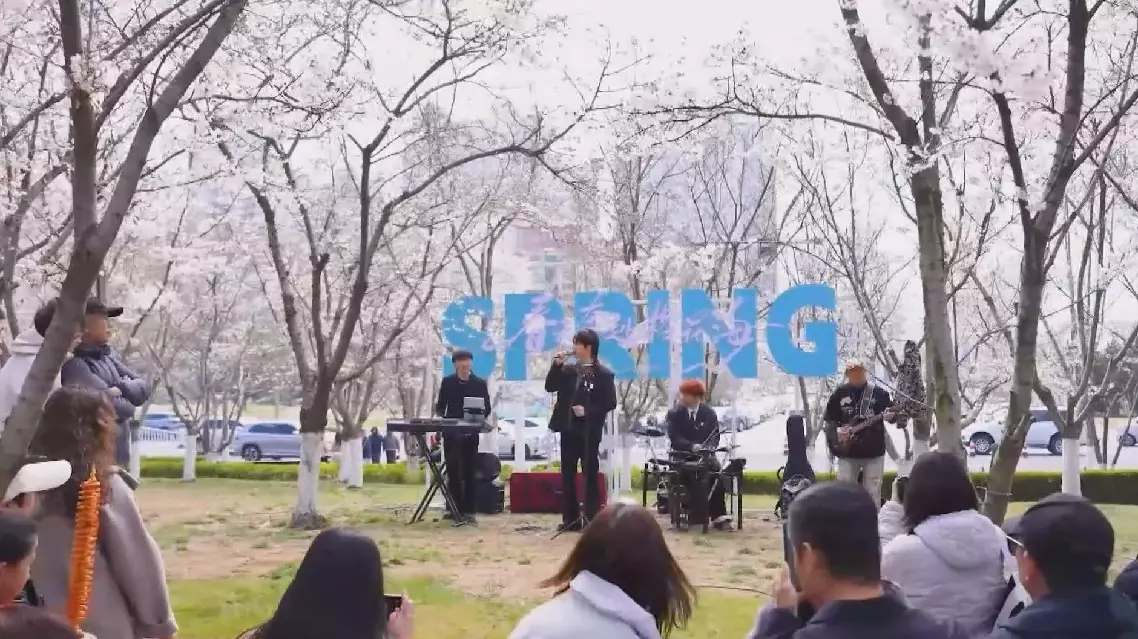
In Yantai City, east China's Shandong Province, more than 3,000 cherry blossom trees stretch for several kilometers in a park, drawing crowds eager to soak in the spring scenery.
The park has also set up a bustling market featuring over 100 stalls, along with a cherry blossom bookstore, tea-brewing corners, live concerts and Hanfu performances. The blossom viewing event is expected to run through late April.
At the Tianchi scenic area in the Tianshan Mountains of Xinjiang Uygur Autonomous Region, the ice is beginning to thaw. The snow-capped Bogda Peak contrasts with verdant spruce forests, creating a striking blend of winter and spring landscapes.
"I was told by my friends that Xinjiang is beautiful, but I didn't truly understand its beauty until I came to Tianchi," said a visitor He Jingzhen.
This year, the Tianchi scenic area has introduced a range of tourism benefits, including new discounts for study tour groups, as well as themed educational routes focusing on geological exploration, ecological nature and intangible cultural heritage.
In Zhangjiajie City, central China's Hunan Province, the Tianmen Mountain National Forest Park welcomed over 20,000 visitors on the first day of the holiday alone. Wild cherry blossoms, azaleas and magnolias dot the mountain slopes, offering panoramic views of spring.
"Tianmen Mountain is truly beautiful. It's a great opportunity to relax and enjoy the spring scenery," said Xia Xiaoyu, a tourist.
The overlap of the Qingming Festival holiday and Hong Kong's public holidays has led to a surge in cross-border travel. On Friday, Shenzhen border inspection stations recorded 641,000 inbound travelers in a single day, an all-time high. Thanks to the "one-hour living circle" of the Greater Bay Area, many Hong Kong visitors choose to make day trips.
"I came to Shenzhen for a day or two to relax, try some food, and maybe buy some gifts to bring back to Hong Kong," said a Hong Kong resident surnamed Leung.
On Saturday, the West Kowloon Station of the Guangzhou-Shenzhen-Hong Kong Express Rail Link recorded 149,700 passenger crossings, a historic high, with Hong Kong and Macao travelers accounting for 2.4 times the usual daily volume.
During the holiday, up to 122 cross-border train pairs operate daily from West Kowloon, with tickets to destinations such as Beijing, Shanghai, Chengdu and short-haul routes remaining in high demand.
The Zhuhai port of the Hong Kong-Zhuhai-Macao Bridge also remained highly active. From midnight Friday to 21:00 Saturday, more than 229,000 passengers and over 38,000 vehicles crossed the border, with the majority headed inbound. Self-driving "northbound" tours have become a new favorite among Hong Kong and Macao residents for leisure and shopping.
Spring outings drive tourist surge across China during Qingming Festival holiday
China's Qingming Festival holiday has turned flower viewing into a showcase of cultural heritage, drawing tourists and boosting local economies.
From references to "The Book of Songs", a treasured Confucian classic and China's oldest poetry collection, to longstanding flower festivals, organizers are promoting flower viewing as cultural tourism, weaving poetry and tradition into spring outings.
Hebi City in central China's Henan Province is drawing crowds with magnolias, tulips and crabapples, alongside 87 cherry blossom varieties. The blooms have become a major Qingming Festival attraction, prompting local authorities to pair tourism with cultural heritage.
As one of the birthplaces of The Book of Songs, Hebi has launched a campaign offering free entry to scenic spots for visitors who recite verses from the ancient classic. The initiative links flower viewing with a text long regarded as a cornerstone of Chinese literature.
In Binzhou, east China's Shandong Province, a park spanning 240 hectares, roughly the size of 330 football fields, is covered in blossoms, making it one of the largest spring displays in the region. The park uses smart drip irrigation to keep flowers hydrated and extend their peak season.
Originating in the Southern Song Dynasty (1127-1279), the Huazhao (Flower Deities) Festival in Xinzhou District of Wuhan boasts more than 800 years of history. Listed as a provincial intangible cultural heritage in 2011, it remains the largest folk celebration in eastern Hubei, drawing thousands of visitors each spring. A parade featuring 12 flower deities winds through the streets, anchoring the festival as both a cultural showcase and a tourism draw.
"The plum blossom represents noble character, the peach blossom radiant beauty. We hope more people will come to discover the Huazhao Festival," said Qinghuan, a performer portraying the Osmanthus Deity.
Outside the Shanxi Museum in Taiyuan City, apricot trees are in full bloom. Their pale pink petals flutter in the breeze, lining the museum's corridors and echoing the deep history within. Visitors pause to photograph the unique blend of ancient architecture and fleeting spring beauty.
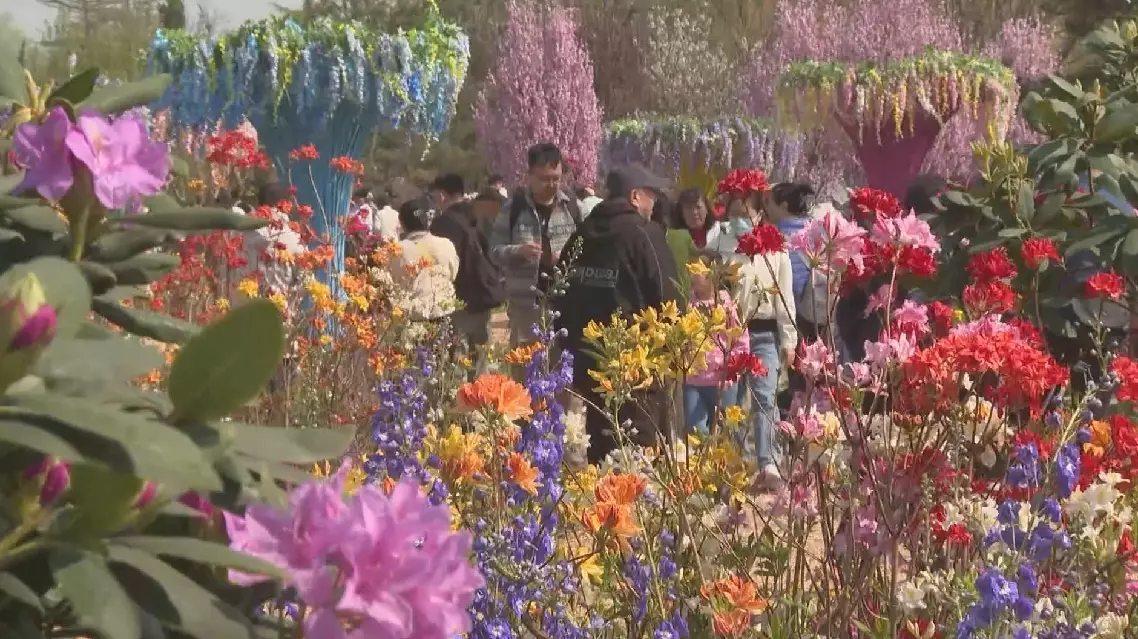
During the Qingming Festival holiday, the Beijing Garden of World's Flowers turned into a "spring palette." A nearly 2,000-square-meter sea of flowers burst into color. Against this floral backdrop, traditional experiences such as archery, tea whisking and movable-type printing drew crowds seeking a holiday filled with blossoms and cultural charm.
The garden features over 40 varieties of alpine and deciduous rhododendrons in shades of purple, pink and white, layered like clouds of silk. Along the flower-lined paths, colorful benches and ribbons create picture-perfect spots. Visitors wander, stop to admire, or raise their phones to capture a moment of spring romance.
"We hope these vibrant, contrasting floral colors bring a little healing and joy to people's lives, a space to relax and find peace amid the spring bloom," said Shi Wenfang, director of the Beijing Garden of World's Flowers. Beyond flower viewing, the garden is hosting its annual Huazhao Festival during the holiday. Now in its fifth year, the event has attracted nearly 300,000 visitors in total. The festivities run through April 6.
Falling on April 5 this year, the Qingming Festival, or Tomb-Sweeping Day, is a traditional Chinese festival for honoring the deceased and paying tributes to ancestors. The three-day holiday from Saturday to Monday also provides a short break for Chinese citizens to enjoy outdoor activities and sightseeing in pleasant springtime temperatures.
Compiled between the Western Zhou Dynasty and the Spring and Autumn Period (1100 B.C. - 476 B.C.), "The Book of Songs" contains at least 305 poems and is recognized as a Confucian classic.
Flower viewing draws holiday crowds across China during Qingming Festival