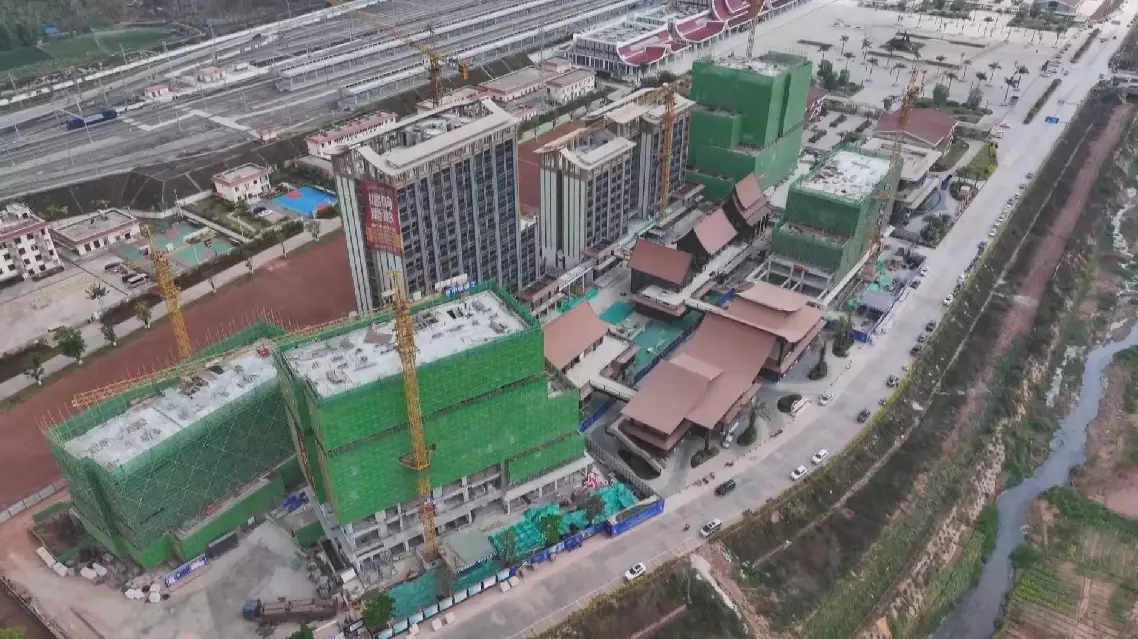
Mohan, a remote town located on the China-Laos border in southwest China's Yunnan Province, is undergoing rapid transformation into an international port city, driven by the fast development brought about by the China-Laos Railway, which began operation over three years ago.
Mohan, with a population of around 20,000, serves as a key hub on the China-Laos Railway, a landmark project of high-quality Belt and Road cooperation.
Connecting Kunming in China with Vientiane in Laos, the 1,035-kilometer railway has experienced significant growth in both cross-border passengers and goods.
Luo Feng, general manager of Yunnan Mohan Development and Investment Group Co., Ltd., is both a key participant in and a witness to Mohan's growth.
"Our investment promotion efforts are progressing well. Looking ahead, our industrial park will focus on on-site processing and export-oriented industries," said Luo.
According to Luo, the construction of a 3.4-kilometer tunnel linking Mohan with the neighboring town of Boten in Laos will begin this year to facilitate flow of people and goods between the two sides.
"The tunnel is expected to open to traffic by the end of 2027. Upon completion, it will significantly improve the flow of people and goods between China and Laos, and enhance connectivity within the industrial park," said Luo.
To further facilitate the growing bilateral trade between China and Laos, the land port at Mohan is being expanded from two lanes to 12 lanes.
Meanwhile, people-to-people exchanges between China and Laos are also thriving. Just 40 kilometers from Mohan, an occupational high school accommodates over 500 students from Laos, with the number of applicants steadily increasing. "The China-Laos Railway is not only convenient and fast but also carries our dreams. The trains take us not only to China but also toward a brighter future," said Phetnavongxay Winner, a Lao student.
Since Feb 10, tour groups from ASEAN countries have been eligible for visa-free entry to Xishuangbanna in Yunnan, with Mohan serving as a key entry point.
Experts predict that, with the ongoing advancement of the Belt and Road Initiative, Mohan will become an increasingly important hub in Yunnan's role as a gateway to South and Southeast Asia.
Chinese border town rises amid development brought by China-Laos Railway
China's Large High Altitude Air Shower Observatory (LHAASO), a high-altitude cosmic ray observatory in Sichuan Province, is pushing the boundaries of astrophysics by bringing humanity closer to answering the century-long question of the origins of ultra-high-energy cosmic rays.
Completed in 2021, LHAASO sprawls across an area the size of 190 football fields. It is the world’s highest-altitude, largest-scale, and most sensitive observatory for detecting cosmic ray particles as they enter Earth’s atmosphere.
The project traces back two decades, when physicist Cao Zhen envisioned China taking a decisive role in this frontier of science.
"Each particle has the energy much higher than what we can produce on Earth. We don't know where it was produced. This is the fascinating question that has bothered people for 100 years already. First of all, (we) go to the high altitude -- the higher [you go], the less the influence from the atmosphere. And then we decided to build such a large-scale experiment: the larger, you get more cosmic rays," said Cao Zhen, chief scientist at LHAASO and a researcher at the Institute of High Energy Physics under the Chinese Academy of Sciences (CAS).
LHAASO functions as a giant set of "eyes" -- detectors that track cosmic ray particles invisible to the human eye. At its core lies a warehouse the size of 2.5 National Aquatic Centers, housing the world's most sensitive gamma-ray telescope.
Surrounding it are raised mounds -- muon detectors engineered to absorb photons and electrons while allowing only highly penetrating muons to pass through. Scattered among them, 18 blue, container-shaped telescopes complete the vast array.
Despite the thin atmosphere at an altitude of over 4,400 meters, China completed the construction of LHAASO in under five years, showcasing a remarkable feat of human endurance.
"Some of our detectors work perfectly fine in the lab, but they might malfunction when installed here because of the high-altitude environment. During the day, with the sun, the humidity is only about 20 to 30 percent, but at night it rises rapidly, reaching 100 percent. In addition, the detectors are also affected by temperature, wind, and extreme weather," said Wang Yudong, a researcher at the Institute of High Energy Physics.
The effort quickly began to yield results. In 2020, even before the observatory was fully completed, scientists using LHAASO's partial array identified 12 ultra-high-energy gamma-ray sources. Two years later, in October 2022, the facility captured an extraordinary event: a millennial gamma-ray burst, a dazzling "cosmic firework" triggered by the collapse of a massive star some two billion years ago.
LHAASO is but one of 77 mega-science infrastructures now operating across China. Over the past five years, these facilities have propelled the country to the forefront of high-impact publications and patent applications, unraveling cosmic mysteries, advancing core technologies, and driving industrial progress along the way.
China's LHAASO edges closer to solving cosmic ray mystery