The World Bank predicted Tuesday that energy prices may surge 24 percent in 2026 to their highest level since the Russia-Ukraine conflict erupted in 2022 due to the war in the Middle East, while overall commodity prices are projected to increase 16 percent.
In its latest Commodity Markets Outlook released on Tuesday, the World Bank said that attacks on energy infrastructure and shipping disruptions in the Strait of Hormuz, which handles about 35 percent of global seaborne crude oil trade, have triggered the largest oil supply shock on record, with an initial reduction in global oil supply of about 10 million barrels per day.
Fertilizer prices are projected to increase by 31 percent in 2026, driven by a 60-percent jump in urea prices, while prices for base metals, including aluminum, copper and tin, are expected to reach all-time highs.
Precious metals prices are forecast to increase 42 percent as geopolitical uncertainty fuels demand for safe-haven assets.
Commodity prices could rise even higher if hostilities escalate or supply disruptions from the Iran war last longer than projected, the report said.
Indermit Gill, the World Bank Group's chief economist and senior vice president for Development Economics, said the war is hitting the global economy in cumulative waves, warning that poorer populations will be hardest hit.
World Bank forecasts 24-pct surge in energy prices in 2026
Director-General of the Food and Agriculture Organization (FAO) Qu Dongyu on Tuesday called for a coordinated policy response to address the impact of the crisis in the Gulf region on global agri-food systems.
Speaking at the 180th Session of the FAO Council, Qu said that peace and stability are prerequisites for food security, and the right to food is a fundamental human right.
The closure of key maritime routes has been disrupting global agricultural food systems, leading to severe interruptions in the supply of energy, fertilizers and agricultural inputs, he noted.
Qu stressed that coordinated policy responses are urgently needed.
Emergency measures, including developing alternative trade routes, strengthening market monitoring, avoiding export restrictions on energy and fertilizers, and providing financial support to farmers, will be taken over the next 90 days, Qu said.
In the medium-term, diversifying import sources and supporting vulnerable countries through emergency food aid should be the focus, while long-term strategies should make sustainable agriculture and renewable energy investments a priority, he noted.
The FAO has launched several initiatives, including real-time tracking of shipping and freight rate changes, collaborating with Gulf Cooperation Council (GCC) countries to prevent panic buying, developing alternative transport routes for perishable goods, and prioritizing fertilizer allocation to low-income, landlocked developing countries.
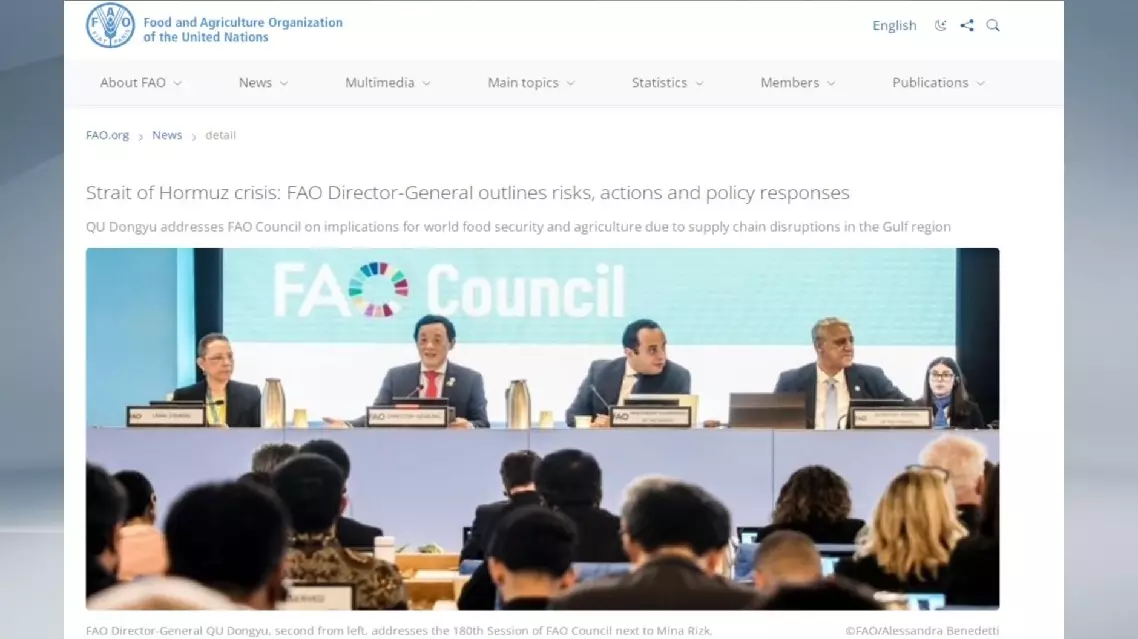
FAO calls for coordinated policy responses to crisis in Gulf region