China welcomes more foreign businesses, including Jardine Matheson, to deepen cooperation with China and achieve mutual benefits and win-win outcomes, Chinese Vice Premier He Lifeng said on Tuesday.
He, also a member of the Political Bureau of the Communist Party of China (CPC) Central Committee, made the remarks during his meeting with Ben Keswick, executive chairman of Jardine Matheson, a diversified, Asia-focused investment company, in Beijing.
The vice premier said that during the 15th Five-Year Plan period (2026-2030), China will unwaveringly expand high-standard opening up and promote high-quality development, thereby creating broader market opportunities for foreign enterprises.
He noted that more foreign enterprises, including Jardine Matheson, are welcome to deepen cooperation with China, participate in the development of the Guangdong-Hong Kong-Macao Greater Bay Area, and achieve mutual benefits and win-win outcomes.
Keswick said that Jardine Matheson is confident in China's development prospects and will continue to deepen its presence in the Chinese market, steadily increase investment in China, and make contributions to the sustained and healthy development of economic and trade relations between Britain and China.

China welcomes more foreign businesses for win-win cooperation: vice premier
The Chinese Academy of Sciences (CAS) on Tuesday revealed an artificial intelligence (AI) model system supporting scientific research, empowering multiple scientific domains including mathematics, physics and biology.
This marks a transition in AI-driven scientific research from fragmented and isolated exploration toward collaborative, efficient and platform-based innovation.
Named ScienceOne 100, the model system has been built on the basis of the scientific foundation model ScienceOne, with a cluster of multidisciplinary domain-specific large models.
ScienceOne provides three core functions: literature compass, innovation evaluation and agent factory, empowering the entire research and innovation workflow.
ScienceOne was released in 2025 and trained on professional scientific corpus and data. Its latest version has achieved flagship-level performance for scientific knowledge and agentic long-horizon reasoning, and has attained state-of-the-art results in terms of multiple benchmarks related to scientific image understanding and manipulation.
The model system currently comprises eight domain-specific large models, covering mathematics, physics, materials science, astronomy, environmental science, aerospace, geosciences and biology.
Zeng Dajun, deputy director of the Institute of Automation at CAS, cited the system's application in materials design as an example.
"In the design of various materials, catalyst design is a critical step. In the past, developing a new catalyst was highly time-consuming, requiring extensive literature review and numerous experiments. Now, with the ScienceOne 100 model system, research efficiency can be boosted by dozens of times," said Zeng.
The system has already been deployed and applied across over 50 CAS institutes, covering more than 100 research scenarios.
It has demonstrated tremendous potential in typical applications such as high-speed rail flow field reconstruction, spectral identification, materials discovery, adjuvant design, astronomical observation, Qinghai-Tibet Plateau scientific expedition, marine forecasting and ecological research.
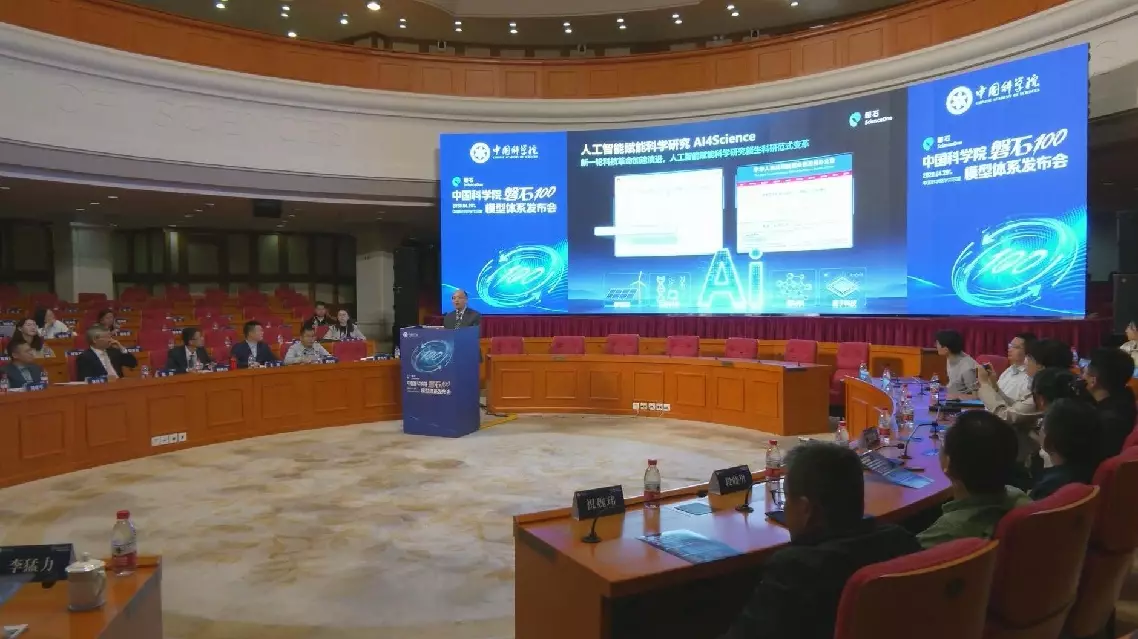
Chinese Academy of Sciences unveils AI model system for scientific research