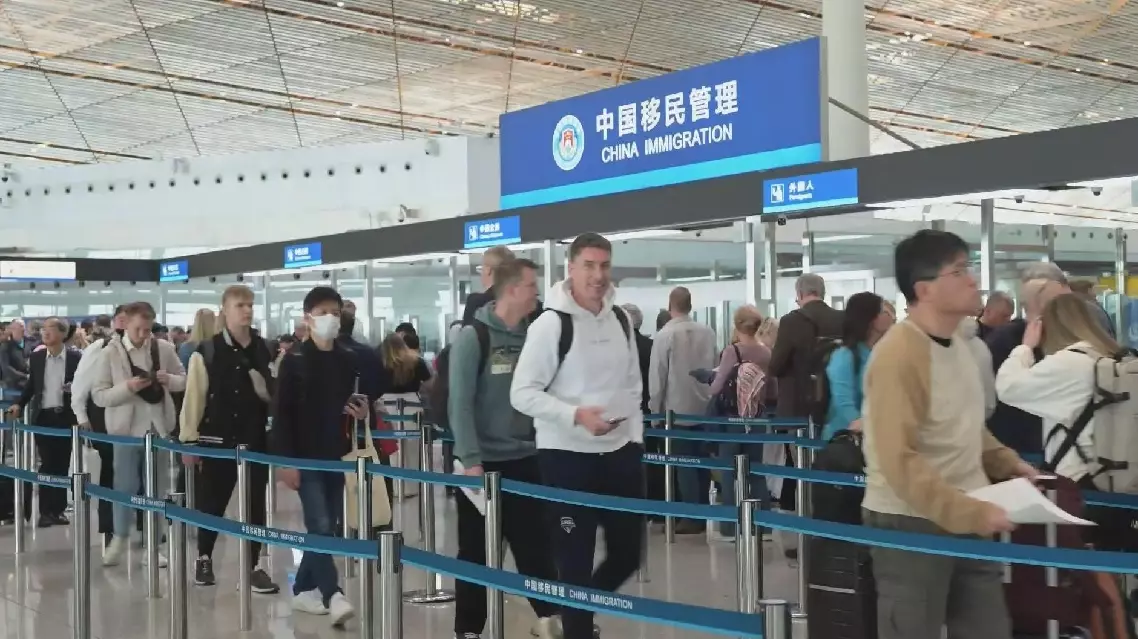
China is bracing for a surge in cross-border travel as the May Day holiday approaches, with major airports across the country seeing a steady influx of passenger traffic.
Daily passenger flows nationwide during the May Day holiday, running from May 1 till 5, are expected to average 2.25 million and the single-day peak is projected to exceed 2.4 million, according to estimates released Tuesday by the National Immigration Administration.
As the holiday approaches, major international airports in Beijing, Shanghai, Chengdu and Shenzhen have already seen notable increases in passenger volumes since April 26.
Data shows that as of 08:00 on April 26, Beijing's ports had processed over seven million entry-exit trips this year, up 13.3 percent year on year. Among them, foreign nationals accounted for more than 2.28 million trips, a 34 percent increase, reflecting a steady rise in overseas visitors to China.
"The culture is very different with Australia's, which makes it fun for me because I like experiencing something different," said a traveler from Australia.
"The culture is amazing, the food is delicious and the people are very friendly. And then we want to see the ancient history of the Great Wall and everything that Beijing has to offer," a Canadian visitor said.
During the May Day holiday, Beijing's ports are expected to handle over 334,000 entry-exit trips. Of these, Beijing Capital International Airport will see around 245,000 trips, averaging 49,000 per day, an 11 percent increase from the daily average in April. Beijing Daxing International Airport is projected to process about 89,000 trips, or 18,000 per day, a 10.6 percent rise from April. "To cope with the holiday rush, we are closely monitoring passenger flows and adjusting inspection channels accordingly. We are also implementing facilitation policies such as the 240-hour visa-free transit and online arrival card filing for foreign nationals to enhance the travel experience," said Zhao Kun, a team captain of the Beijing Immigration Inspection Station.
Beijing's appeal to overseas tourists has been further strengthened by special events during the holiday, including the Taihu Jazz Festival and the Shougang Craft Beer Festival, alongside multilingual tour guides, foreign card payment options and tax refund services.
Elsewhere, Shanghai's ports are expected to process 581,000 entry-exit trips during the holiday, averaging 116,000 per day, a 2.9 percent increase from the same period last year. Three cruise ships, Spectrum of the Seas, Orient Dream and Adora Magic City, will call at Shanghai's Wusongkou International Cruise Terminal during the holiday, carrying over 20,000 passenger trips.
Shenzhen ports, which serve as a major gateway between the mainland and Hong Kong, are forecast to handle 940,000 daily trips on average, with the peak possibly exceeding one million. Shenzhen has rolled out more than 200 holiday events spanning exhibitions, performances and sports to attract visitors from both sides.
"A peak for arrivals from Hong Kong is expected on the evening of April 30, with two-way traffic peaks from May 1 to 3. The highest single-day volume is likely on May 1, so travelers are advised to plan ahead and avoid peak times," said Zhou Yin, deputy director of the border inspection division of Shenzhen Immigration Inspection Station.
Meanwhile, aviation ports in Chengdu, a major transportation hub in southwest China, are projected to handle about 100,000 entry-exit trips during the holiday, with daily passenger flows of around 20,000, a 16 percent year-on-year increase.
The combination of diverse cultural experiences and smooth customs services is fueling a boom in inbound tourism to Sichuan Province, where attractions such as giant pandas, western Sichuan landscapes, Three Kingdoms culture, and intangible cultural heritage continue to draw growing interest.
China braces for surge in cross-boarder travel as May Day holiday approaches