Intelligent driving systems powered by advanced artificial intelligence are stealing the spotlight at the ongoing 2026 Beijing International Automotive Exhibition, also known as Auto China 2026, with industry insiders predicting this technology could come to revolutionize our roads.
With the theme of "Future of Intelligence," this year's edition of the world's largest auto show opened on Friday and is scheduled to run until May 3, with over 1,450 vehicles on display, including 181 debutants and 71 concept cars.
Chinese autonomous driving startup ZYT is among the many firms speeding ahead to this high-tech future, with its intelligent assisted driving mode allowing a driver to completely take their hands off the wheel. For those who have experienced it, perhaps the most impressive aspect is how the system can handle complex city traffic, moving steadily like an experienced driver behind the wheel.
This progress has been driven by the rapid iteration and advancement of AI models, according to ZYT's senior product manager Zhang Zeyu.
"This U-turn is enabled by our data-driven technology, an advanced solution in the industry. It handles oncoming vehicles and speed control with exceptional smoothness. Trained on massive driving data from seasoned drivers, the AI delivers mature and stable performance. Besides, our foundational model is adaptable to far more scenarios than just urban roads and highways," said Zhang as he sat at the wheel of one of the firm's autonomously-driven vehicles.
ZYT has publicly unveiled its state-of-the-art 'Native Multimodal Foundation Model' for the first time at the Beijing Auto Show, and the company says it is confident in the development of this next-generation intelligent driving system.
"You can see on our booth, we empower everything that moves, from a truck to a last-mile delivery vehicle to a passenger car to a humanoid robot. So everything that moves is powered by our brain. In order to work in different verticals, as we call it, the model has to be trained with different input data. Like your human brain, you train on different input data, so you get smarter. And this is the same logic we use for our multi-modal foundation model," said Nils Oldemeyer, Head of Europe for ZYT.
Auto China 2026 is also highlighting China's supply chain breakthroughs in areas such as ultra-fast charging and cockpit-driving integration but the AI revolution is evident at the event, where the concept of 'in-vehicle AI' is no longer a gimmick but has become a standard feature.
As well as ZYT, other driving technology brands including Horizon Robotics, Momenta, and Huawei are all showcasing their cutting-edge strengths at increasingly affordable prices, and for these Chinese brands, developing their own homegrown chips could be the key to success.
With the arrival of the J6 chip developed by Horizon Robotics, top tier computing power has reached an impressive 560 TOPS (trillion operations per second), going head to head with AI chip leader NVIDIA, while Chinese new energy vehicle giants including NIO, Li Auto, and Xpeng are also all equipping their cars with self-developed chips.
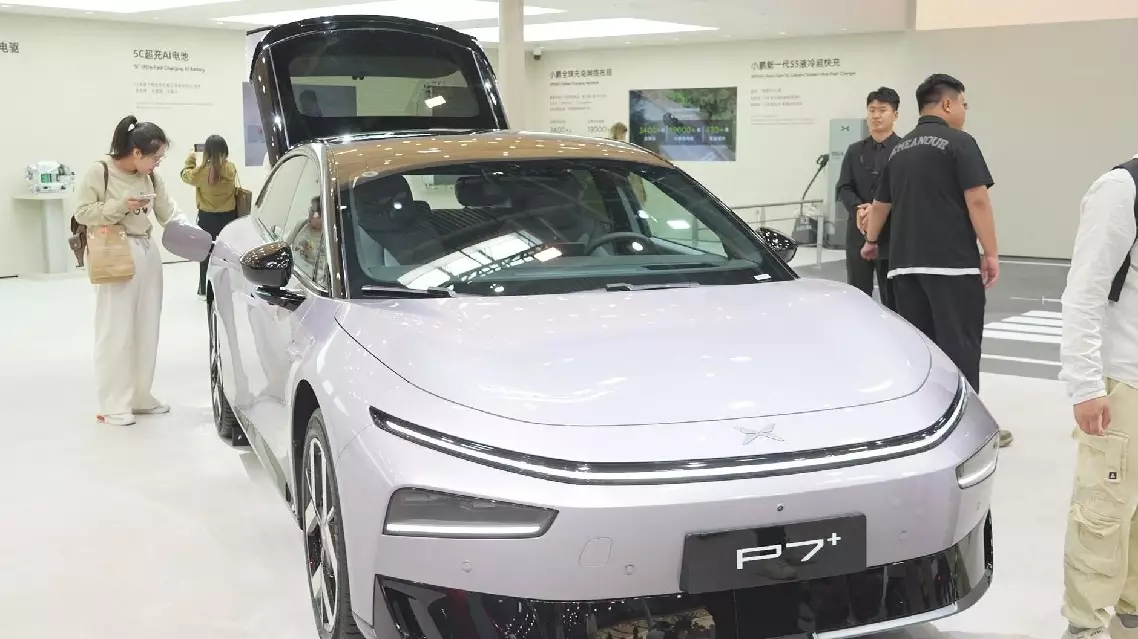
Xpeng's GX model features four self-developed Turing AI chips delivering local computing power of 3,000 TOPS.
The firm's founder He Xiaopeng stressed that the era of physical AI in automobiles has truly arrived and predicts it will bring a profound impact with it.
"We've all seen massive shifts in digital AI across China, the U.S., and the world over the past three years. Digital AI is changing our digital world, but I believe physical AI will truly change how we experience life and impact many jobs. It can make things easier—like driving, through intelligent assisted driving. Physical AI will change the role of traditional drivers and also create diverse new roles," said He, who is Chairman and CEO of XPENG Inc.
Amid this wave of automotive intelligence, numerous mainstream joint-venture and luxury brands are also partnering with local Chinese tech firms to tap into the latest Chinese technology, all with the aim of creating better driving experiences.
Intelligent driving takes the wheel at world's largest auto show in Beijing