Iran’s largest airline, Mahan Air, has resumed passenger flights to China, reconnecting Tehran with Beijing, Shanghai and Guangzhou as the country gradually reopens its airspace.
After seven hours, 18 passengers touched down on Monday evening in the Chinese capital on a commercial flight from Tehran -- some for business or study, others for family reunions.
One of the passengers described the experience as surprisingly calm, noting the unusually light load.
"Everything was good in the flight, very easy. The good option was it was not crowded at all -- 18 people on a big airplane, and we could sleep with four seats, for example," he said.
Yet despite the smooth flight, he admitted lingering anxiety.
"I always thought that for example, if we're going up maybe some fighter [jet] comes or something. I was very stressed all the trip till we exited the border," said the passenger.
Mahan Air announced last week it would resume flights between Iran and China, signaling a fragile recovery in Middle Eastern civil aviation after the war launched by the U.S. and Israel against Iran in late February. Flight-tracking data shows airspace over the region remains partially restricted, a sign that the aviation environment has yet to fully normalize.
"We have stress to come back. I don't know, maybe one week later, [there is] fighting, and we should stay here or maybe come by other countries [using road] to my country," said the passenger.
This latest phase of Mahan Air’s operations is scheduled through late May. Continuation beyond that will depend on how the geopolitical situation evolves.
Iran shut down its airspace after joint U.S. and Israeli strikes on Feb 28, halting civilian aviation nationwide. The country began reopening on April 18, starting with eastern airspace and smaller airports. The Civil Aviation Authority has said services will return to normal once technical and operational preparations by military and civilian authorities are complete.

Iran's largest airline resumes flights to China
The Chinese Academy of Sciences (CAS) on Tuesday revealed an artificial intelligence (AI) model system supporting scientific research, empowering multiple scientific domains including mathematics, physics and biology.
This marks a transition in AI-driven scientific research from fragmented and isolated exploration toward collaborative, efficient and platform-based innovation.
Named ScienceOne 100, the model system has been built on the basis of the scientific foundation model ScienceOne, with a cluster of multidisciplinary domain-specific large models.
ScienceOne provides three core functions: literature compass, innovation evaluation and agent factory, empowering the entire research and innovation workflow.
ScienceOne was released in 2025 and trained on professional scientific corpus and data. Its latest version has achieved flagship-level performance for scientific knowledge and agentic long-horizon reasoning, and has attained state-of-the-art results in terms of multiple benchmarks related to scientific image understanding and manipulation.
The model system currently comprises eight domain-specific large models, covering mathematics, physics, materials science, astronomy, environmental science, aerospace, geosciences and biology.
Zeng Dajun, deputy director of the Institute of Automation at CAS, cited the system's application in materials design as an example.
"In the design of various materials, catalyst design is a critical step. In the past, developing a new catalyst was highly time-consuming, requiring extensive literature review and numerous experiments. Now, with the ScienceOne 100 model system, research efficiency can be boosted by dozens of times," said Zeng.
The system has already been deployed and applied across over 50 CAS institutes, covering more than 100 research scenarios.
It has demonstrated tremendous potential in typical applications such as high-speed rail flow field reconstruction, spectral identification, materials discovery, adjuvant design, astronomical observation, Qinghai-Tibet Plateau scientific expedition, marine forecasting and ecological research.
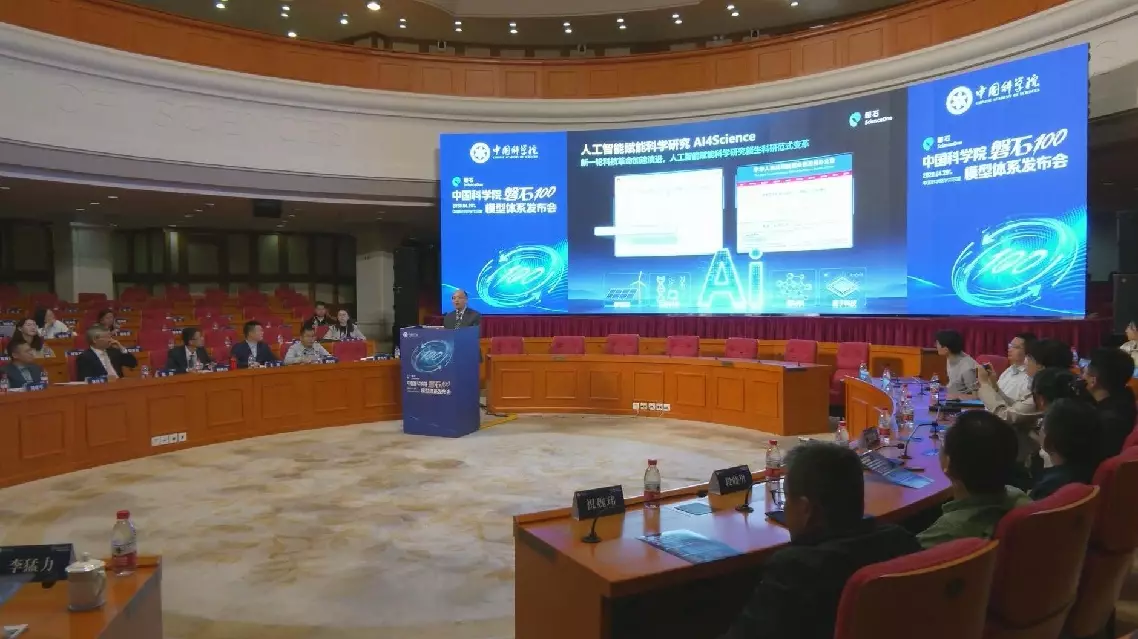
Chinese Academy of Sciences unveils AI model system for scientific research