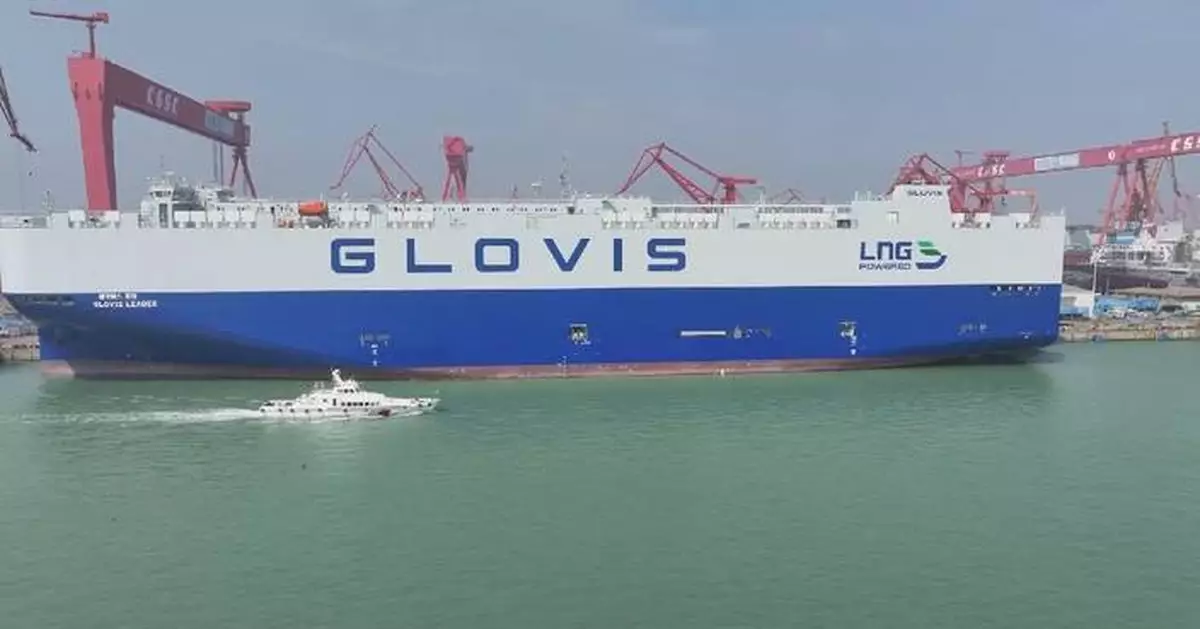
The world's first dual-fuel vehicle carrier with 10,000-vehicle capacity, built by Guangzhou Shipyard International (GSI) under China State Shipbuilding Corporation, was officially delivered on Tuesday in Nansha district of Guangzhou, capital city of south China’s Guangdong Province.
Measuring 230 meters in length and 40 meters in width, the carrier features 14 garage decks, enabling flexible loading of a wide spectrum of vehicle types, including electric vehicles, hydrogen fuel cell cars, and heavy-duty trucks. Furthermore, the ship is equipped with an advanced green fuel system, ensuring full compliance with the latest global environmental standards.
"This vessel is a green energy ship equipped with an LNG (liquefied natural gas) system. It also features a shaft generator system, which can power the entire ship independently while at sea, a key aspect of its energy efficiency. We have also completed preliminary feasibility studies on ammonia and methanol fuel retrofits, allowing the vessel to be modified to run on these alternative fuels if the shipowner requires," said Zhang Fuli, technical manager of the 10,800-vehicle carrier at GSI.
The official delivery of this pioneering vessel signifies that China has fully mastered the construction technology for this type of vehicle carriers, cementing its leading position in this specialized global shipbuilding market.
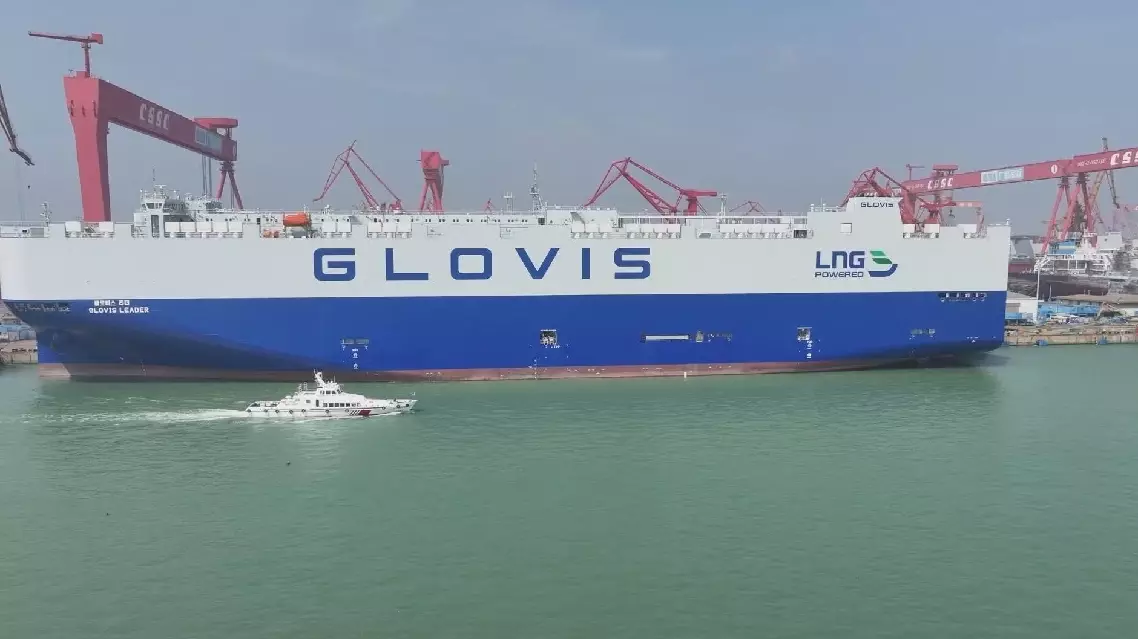
World's first 10,000-vehicle dual-fuel carrier delivered in China
The Chinese Academy of Sciences (CAS) on Tuesday revealed an artificial intelligence (AI) model system supporting scientific research, empowering multiple scientific domains including mathematics, physics and biology.
This marks a transition in AI-driven scientific research from fragmented and isolated exploration toward collaborative, efficient and platform-based innovation.
Named ScienceOne 100, the model system has been built on the basis of the scientific foundation model ScienceOne, with a cluster of multidisciplinary domain-specific large models.
ScienceOne provides three core functions: literature compass, innovation evaluation and agent factory, empowering the entire research and innovation workflow.
ScienceOne was released in 2025 and trained on professional scientific corpus and data. Its latest version has achieved flagship-level performance for scientific knowledge and agentic long-horizon reasoning, and has attained state-of-the-art results in terms of multiple benchmarks related to scientific image understanding and manipulation.
The model system currently comprises eight domain-specific large models, covering mathematics, physics, materials science, astronomy, environmental science, aerospace, geosciences and biology.
Zeng Dajun, deputy director of the Institute of Automation at CAS, cited the system's application in materials design as an example.
"In the design of various materials, catalyst design is a critical step. In the past, developing a new catalyst was highly time-consuming, requiring extensive literature review and numerous experiments. Now, with the ScienceOne 100 model system, research efficiency can be boosted by dozens of times," said Zeng.
The system has already been deployed and applied across over 50 CAS institutes, covering more than 100 research scenarios.
It has demonstrated tremendous potential in typical applications such as high-speed rail flow field reconstruction, spectral identification, materials discovery, adjuvant design, astronomical observation, Qinghai-Tibet Plateau scientific expedition, marine forecasting and ecological research.
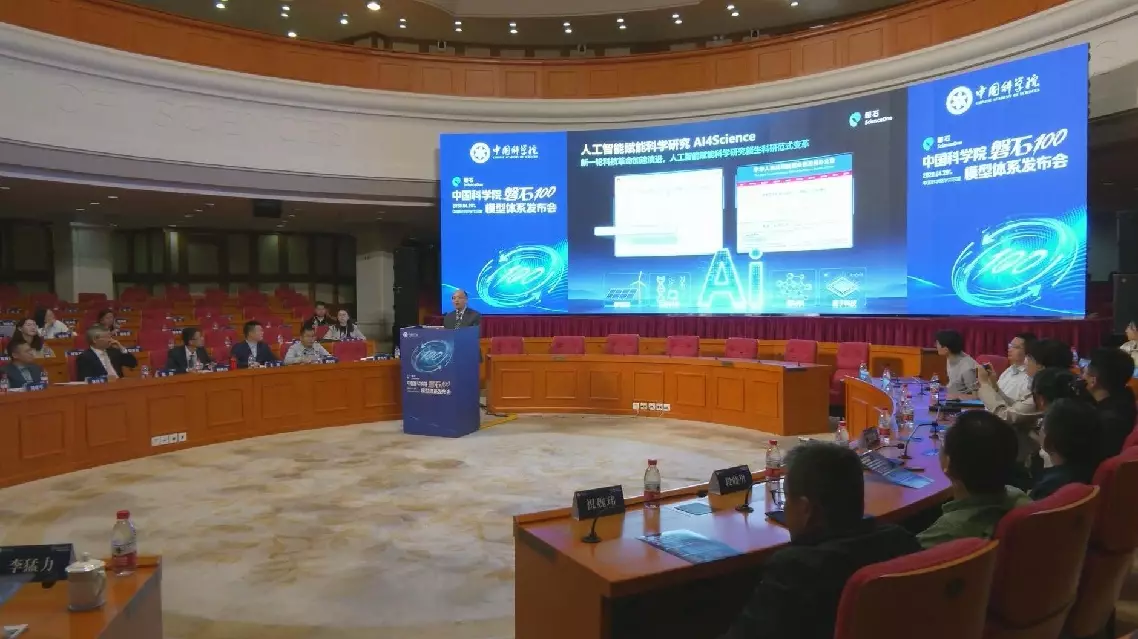
Chinese Academy of Sciences unveils AI model system for scientific research