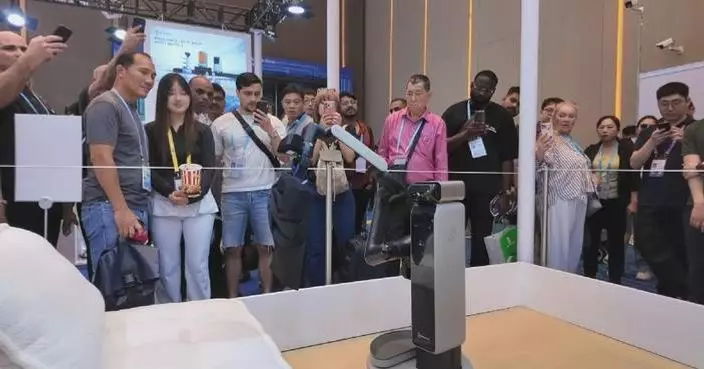
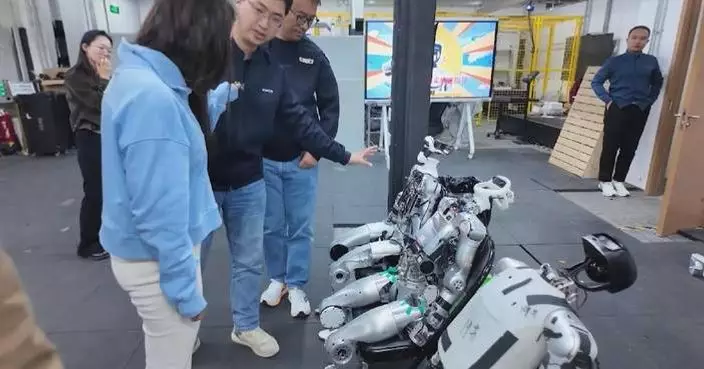
China is seeing steady growth of its humanoid robot market as tech startups accelerate their pace of research and development to improve the capacity of their advanced models, which have impressed the public with exceptional intelligence and agility.
The humanoid robot industry in China has been making rapid progresses over the recent years, with more and more intelligent products being rolled out by tech enterprises, boosting the rising anticipation that they will help provide greater convenience to human beings in everyday life.
In a dazzling display of innovation, China's 2025 Spring Festival Gala made history, with millions watching a batch of humanoids twirling handkerchiefs in a uniform manner.
The development team of the humanoid robots, based in east China's "tech city" Hangzhou, Zhejiang Province, said the robot performers are able to run, jump and even backflip under the guidance of engineers.
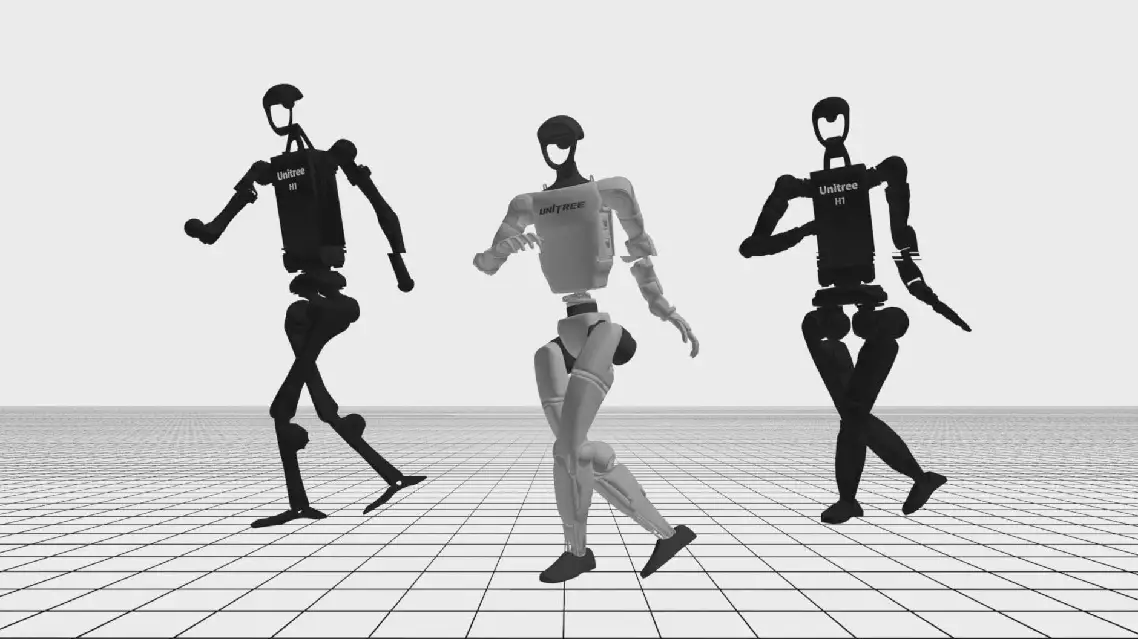
Huang Jiawei, marketing director at Unitree Robotics, said the latest model of the company's humanoid robots has greater degrees of freedom (DF) and once being added with more motors, the robots can move more flexibly.
"G1 has more degrees of freedom than H1. The elementary version of G1 has 23 DF, and the latest version has 43. For example, one more motor can be added to its arms, and three DF on its waist, so that the dance movements will be smoother," said Huang.
Humanoid robots, "catalyzed" by large models, are undergoing a systemic evolution that transcends mere partial improvements to achieve holistic improvements. Huang said currently the company is working to enhance the learning capacity of their models, reducing the required time for robots to acquire new movements.
"In the long run, we hope to embed a large model that allows robots to learn simple motion control and dancing by simply watching them once. It'd be our ultimate goal," said Huang.
China sees accelerated humanoid robot research and development
China sees accelerated humanoid robot research and development