ATLANTA--(BUSINESS WIRE)--Feb 26, 2025--
Hai Robotics, a global leader in warehouse automation, today announced the release of HaiPick Climb, a revolutionary robotic solution that simplifies goods-to-person automation, enabling warehouses and distribution centers to retrofit existing facilities more easily. It increases throughput while reducing implementation time and costs compared to traditional Automated Storage and Retrieval Systems (ASRS), making ASRS more accessible and affordable for a wider range of facilities.
This press release features multimedia. View the full release here: https://www.businesswire.com/news/home/20250225781910/en/
Built around the innovative HaiClimber robot, an intelligent, compact climbing robot, HaiPick Climb unlocks new possibilities in warehouse automation. This breakthrough system offers a smarter, simplified way for warehouses and distribution centers to boost efficiency, increase storage density, and scale operations — all with minimal infrastructure requirements.
“We know that many warehouses want to automate but are put off by the complexity and cost,” said Richie Chen, Founder and CEO of Hai Robotics. “That’s why we created HaiPick Climb — to deliver powerful automation without the need for major facility modifications. Our system is built on simplicity, requiring only standard racking and minimal floor preparation while providing top-tier performance.”
A Simpler Way to Automate
The HaiPick Climb system is designed for easy installation, operation, and ownership, with seamless expansion and system modifications — all while advancing the benefits of traditional ASRS.
Hai Robotics' goods-to-person solutions are widely recognized for their ability to automate storage and retrieval for a range of tailored needs. HaiPick Climb now offers a more standardized solution that makes automation more accessible to more facilities.
Easy to Implement and Scale
HaiPick Climb operates by attaching climbing channels to one side of nearly any industry-standard racking. Compact robots travel up and down these channels, retrieving totes from both sides of narrow aisles. Since the system mounts from just one side, it requires less infrastructure and is more tolerant of floor irregularities than typical ASRS, reducing facility preparation and cutting implementation costs.
The system is easily expandable with minimal disruption, enabling phased implementations and modifications without interrupting operations.
Easy to Operate and Maintain
Human travel for order picking is eliminated with the HaiPick Climb system. Totes of goods are automatically delivered to one or more ergonomic workstations that are easy to use and quick to learn. An easy-to-understand interface makes picking fast and efficient with a 99%+ accuracy rate.
The HaiClimber robots are easy to maneuver and maintain. Their mechanics are easy to access, with half the climbing mechanisms of typical climbing robots, simplifying maintenance. Aisles allow just enough space for standard compact scissor lift access, eliminating the need for specialized equipment to access the system’s interior, while the use of industry-standard racking makes maintenance a breeze.
Extreme Throughput Efficiency
HaiClimbers freely navigate under racking, allowing for the most direct and optimized path for each tote delivery and avoiding robot congestion that can occur in aisle "highways." Robots have direct access to every tote at all times, eliminating the wasted response time associated with searching or digging.
Traveling an extreme speed of 4 meters per second (13 feet per second) and climbing at 1 meter per second (3 feet per second), the HaiPick Climb system can process 4,000 totes per hour within a 1,000-square-meter (10,764-square-foot) space. Totes are delivered to workstations in as little as 2 minutes after order receipt — 34% faster than traditional ASRS — allowing for extended order cutoff times for same-day fulfillment.
Maximum Storage Density
Facilities can achieve 30,000 storage locations within a 1,000-square-meter (10,764-square-foot) space, with totes stored up to 12 meters (39+ feet) high. This is over 6 times higher than manual storage operations and provides 35% more vertical storage capacity than other leading ASRS solutions.
Narrow aisle widths, minimized to 900 millimeters (35.5 inches), further optimize space utilization. This combination of high storage density and vertical access enables facilities to reduce their storage footprint by up to 75%.
“This isn’t just automation — it’s empowerment,” Chen said. “HaiPick Climb allows businesses to achieve new levels of efficiency and scalability without the typical barriers of ASRS. It’s about making advanced automation available to everyone.”
About Hai Robotics
Founded in 2016, Hai Robotics is a leading global provider of Automated Storage and Retrieval Systems (ASRS), delivering unparalleled system flexibility and maximizing operational efficiency for facilities of all sizes and conditions.
Hai developed a modular approach to automation called HaiPick Systems. With a catalog of advanced robotic equipment and software that operates with nearly any industry-standard racking and storage materials, Hai Robotics provides tailored automation solutions that can be easily modified even after implementation.
HaiPick Systems reduce warehouse storage footprints by up to 75% through increased storage density, with vertical storage reaching up to 12 meters (39+ feet). They achieve 99%+ order pick accuracy, 4x increased efficiency, 3x daily throughput, and eliminate human travel for order picking.
With 1,500+ projects implemented across 40+ countries, supported by 8 global offices and 60+ partners worldwide, Hai Robotics is a reliable resource for providing local support.
Visit HaiRobotics.com for more information.

Hai Robotics Unveils HaiPick Climb:Revolutionizing Warehouse Automation With Simplified Efficiency (Photo: Business Wire)
MADRID (AP) — Millions of Spaniards are voting Sunday in an election dominated by concerns over housing affordability that could see the far right enter the national government for the first time since Spain’s dictatorship ended half a century ago.
The election is widely seen as a referendum on incumbent Prime Minister Pedro Sánchez. The leader of the left-wing Socialist party has governed Spain for eight years through numerous crises, but also a period of economic growth that, for many voters, has been eclipsed by cost-of-living concerns.
No issue has galvanized Spaniards in recent years quite like access to affordable housing. Soaring home and rental costs in cities and tourism hot spots have caused widespread discontent, especially among the young.
Last month, Sánchez announced an early election for Nov. 29, after right-wing parties in parliament voted down measures that his left-wing government introduced to alleviate housing pressures.
He has warned voters that a conservative government wouldn't make their lives more affordable, and has frequently said his opponents would take Spain backward. Sánchez's decision to hold the vote followed nationwide protests that sprang up around the country of 50 million after the dramatic eviction of an 87-year-old woman from her apartment in Madrid.
“I am feeling optimistic,” Sánchez told reporters soon after casting his vote on Sunday, saying he expected ”a huge turnout."
Opposition leader Alberto Núñez Feijóo of the conservative Popular Party, or PP, has excoriated Sánchez's record, promising voters more stability and better governance.
He has criticized Sánchez not just for his government's failure to improve Spaniards' housing woes during eight years in office, but also for two fatal train crashes this year on Spain's high-speed rail network, a nationwide blackout in April 2025 and a border crisis in Spain's North African exclave.
Feijóo also pilloried Sánchez — who relied on backing from far-left and separatist parties to cling to power in 2023 — for not being able to pass a budget in nearly four years, because of a lack of parliamentary support.
“It's not that Spain is failing, it's its government,” Feijóo said after the October train crash south of Madrid in which 69 people were killed.
It's widely expected that Feijóo would attempt to form a coalition with the far-right Vox party, led by its bearded and barrel-chested leader Santiago Abascal, who has campaigned almost entirely on an immigration crackdown.
Vox is betting its hard-line stance will win over voters and enable it to play kingmaker with the PP.
Spain in recent years has welcomed millions of people mainly from Latin America but also from Africa and elsewhere in Europe. One in five residents was born outside Spain, according to census data. Earlier this year, the Spanish government legalized the status of nearly 1.2 million immigrants living in the country without authorization.
Both Feijóo and Abascal have portrayed Sánchez's immigration-friendly policies as harmful to ordinary Spaniards, often connecting the issue to the housing supply-and-demand imbalance and strained public services. Both candidates have condemned the migrant legalization measure.
If Vox entered a new government as a junior member with the PP, it would mark the return of an ultranationalist, far-right party to power for the first time since the death of Spain's military dictator, Gen. Francisco Franco, in 1975.
The result will also be closely watched across Europe before an election-packed 2027, in which voters will head to the polls in France, Italy, Greece and Poland.
In France, the far-right National Rally is aiming to take power, while in Italy, Premier Giorgia Meloni's right-wing coalition is expected to seek another term.
A Spanish prime minister is elected by parliament. A candidate needs the support of an absolute majority — or at least 176 lawmakers — in the first parliamentary vote, often relying on coalition agreements or support from other parties. If an absolute majority isn't secured in the first parliamentary vote, a second vote is held in which a candidate needs more votes in favor than against.
Several opinion polls conducted before Sunday showed Sánchez’s Socialist Party behind the combined support of the PP and Vox. Sánchez will likely need backing from smaller parties to the left of the socialists. However, infighting between those parties in the lead-up to the election is expected to weaken Sánchez's chance at forming a progressive coalition like he did in 2023.
Traditional regionalist parties in Catalonia, the Basque region, Galicia and the Canary Islands, the Spanish archipelago off the coast of western Africa, could also play a role in forming a governing coalition if results are close.
Voting in Spain generally takes place in schools, community centers, town halls and other municipal facilities. Spaniards can also vote by mail, though it's less popular than doing so in person.
About 39 million people are eligible to cast ballots. Voting started at 9 a.m. and closes on the mainland at 8 p.m. and an hour later in the Canary Islands. Votes are tallied quickly and the result is usually known within hours.
Sánchez, a Madrid native and former economics professor, became a hero to the global left for his government's opposition to the Israel-Hamas war in Gaza, which he has called a genocide, and his resistance to U.S. President Donald Trump. He roundly criticized the U.S. and Israel over the Iran war, and was one of Western Europe’s first major leaders to formally recognize Palestinian statehood.
His government has turbocharged Spain's climate commitments, pledging to source all its energy from renewable sources by 2050. The country already generates more than half its electricity from noncarbon sources.
The Spanish leader also regularly defends causes like multilateralism and an international rules-based order, and has pushed for more regulation of artificial intelligence. He is the first Spanish prime minister to speak comfortably in English.
Sánchez's party, including members of his inner circle, has been dogged by legal cases involving corruption. The cases have implicated a former minister and top officials, eroding trust in him and the socialists.
Feijóo, in contrast, is a lifelong civil servant-turned-politician from rural northwestern Galicia who doesn't speak English and projects himself as a sensible, moderate and effective administrator.
Feijóo won election after election in Galicia during the 13 years in which he governed the region of 2.7 million people. He is expected to mend bridges with the United States and Israel if he wins.
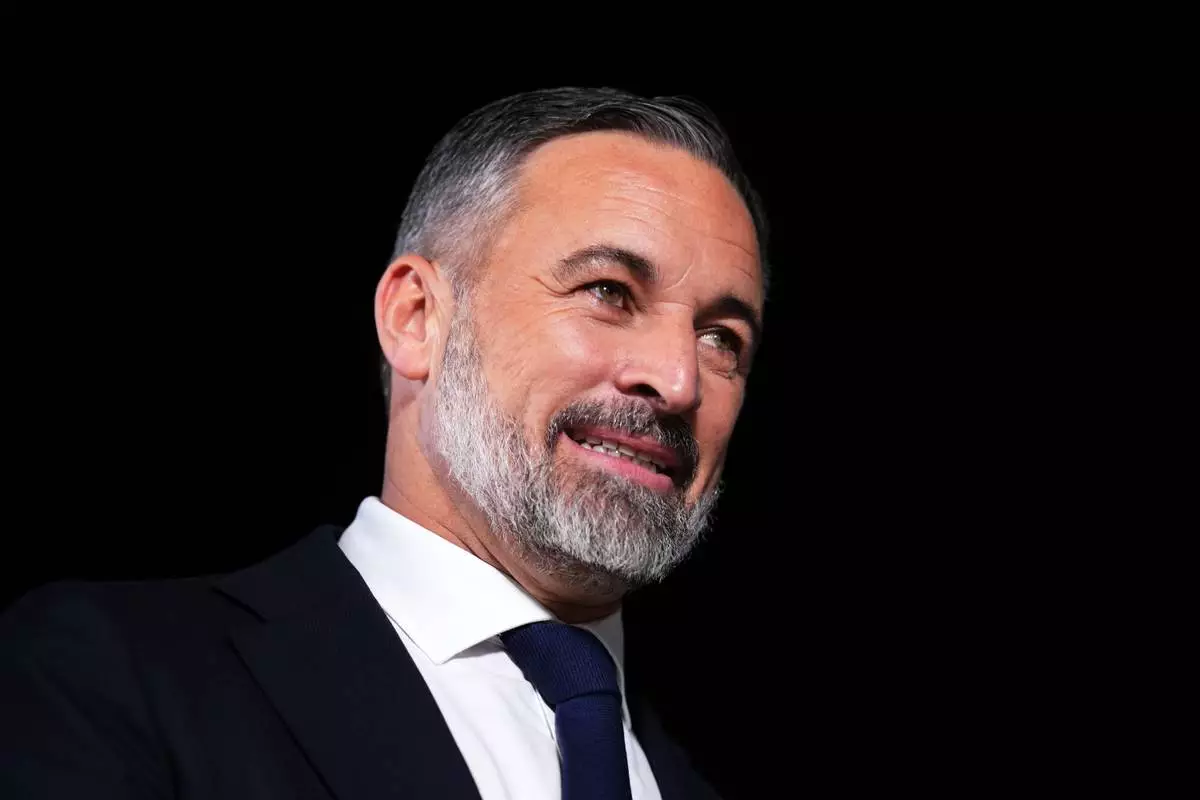
Santiago Abascal, leader of Spain's far-right Vox party, arrives for a live televised debate in Madrid, Spain, Thursday, Nov. 26, 2026. (AP Photo/Manu Fernandez)

A person picks a ballot to vote in Spain's general election at a polling station in Madrid, Spain, Sunday, Nov. 29, 2026. (AP Photo/Manu Fernandez)

Spain's incumbent Prime Minister Pedro Sanchez votes in Spain's general election at a polling station in Madrid, Spain, Sunday, Nov. 29, 2026. (AP Photo/Francisco Seco)

Voters pick up ballots before voting at a polling station in Spain's general election in Madrid, Spain, Sunday, Nov. 29, 2026. (AP Photo/Manu Fernandez)

Spain's incumbent Prime Minister Pedro Sanchez votes in Spain's general election at a polling station in Madrid, Spain, Sunday, Nov. 29, 2026. (AP Photo/Francisco Seco)

An election worker organizes ballots at a polling station in Spain's general election, in Barcelona, Spain, Sunday, Nov. 29, 2026. (AP Photo/Emilio Morenatti)

Spain's Prime Minister and Socialist Party Secretary-General Pedro Sánchez waves to supporters at the final campaign rally ahead of Sunday's general election in Madrid, Spain, Friday, Nov. 27, 2026. (AP Photo/Francisco Seco)

Popular Party candidate Alberto Nunez Feijoo waves to supporters during a campaign rally ahead of the general election in Madrid, Spain, Wednesday, Nov. 25, 2026. (AP Photo/Francisco Seco)

FILE, Santiago Abascal, leader of the far-right Vox party, arrives to an electoral rally in Madrid, Friday, Nov. 13, 2026, on the first day of the campaign ahead of general elections. (AP Photo/Francisco Seco, File)

Popular Party supporters wave Spanish flags as they listen to speeches during a campaign rally ahead of the general election in Madrid, Spain, Wednesday, Nov. 25, 2026. (AP Photo/Francisco Seco)

From left, the leader of the far-right Vox party, Santiago Abascal, Spain's Prime Minister and Socialist Party Secretary-General Pedro Sánchez and Popular Party candidate Alberto Núñez Feijóo pose for a photo at the start of a live televised debate in Madrid, Spain, Thursday, Nov. 26, 2026. (AP Photo/Manu Fernandez)