No-Headquarters/BOZEMAN, Mont.--(BUSINESS WIRE)--Feb 26, 2025--
Snowflake (NYSE: SNOW), the AI Data Cloud company, today announced an expanded partnership with Microsoft that will empower enterprises to build easy, efficient, and trusted AI-powered apps and data agents with OpenAI’s models directly in Snowflake Cortex AI, Snowflake’s fully managed AI service. Snowflake Cortex AI will integrate Microsoft Azure OpenAI Service in Azure AI Foundry, making OpenAI’s state-of-the-art models available for use on Microsoft Azure regions within Snowflake, and optimized to reason across audio, video, and text in real-time. Now, thousands of global enterprises will be able to create data agents powered by OpenAI’s models in the secure boundary of Snowflake’s AI Data Cloud — ultimately saving businesses time and money.
This press release features multimedia. View the full release here: https://www.businesswire.com/news/home/20250226499406/en/
“We’re expanding our long-standing partnership with Microsoft to deliver the best of OpenAI’s innovations directly to our customers, further advancing our promise to bring easy, efficient, and trusted AI to enterprises around the world,” said Christian Kleinerman, EVP of Product, Snowflake. “There’s enormous power in our customers being able to use OpenAI models directly in Snowflake’s secure platform, unlocking multimodal, agentic, and conversational AI use cases that drive high impact.”
By bringing OpenAI’s models to Cortex AI through an integration with Azure OpenAI Service, Snowflake further solidifies its leadership in providing users with frontier AI models within the same unified governance framework as their data. Snowflake’s cross-region and cross-cloud AI inference also enables global customers to seamlessly access OpenAI’s models from any cloud or region, without needing complex integrations or manual setup. Access to these models is secured with Snowflake's strong security guarantees through deep integrations with Microsoft Azure, providing protected connections for customers on any cloud provider. OpenAI’s models provide advanced reasoning and instruct capabilities, allowing users to quickly build scalable AI apps and data agents that deliver accurate, grounded insights using their enterprise data. Snowflake customers achieve this because OpenAI’s models run within the security boundary of Snowflake’s AI Data Cloud. Snowflake Horizon Catalog ’s strong enterprise-grade compliance, security, privacy, discovery, and collaboration capabilities natively integrated into Cortex AI allows users to focus on driving impact with OpenAI’s models.
“Enterprises are looking to leverage their proprietary data to create AI differentiation in ways that bring the richest experiences to the world, and the Snowflake partnership with Azure OpenAI Service through Azure AI Foundry will empower our joint customers to deliver intuitive and trustworthy app experiences even faster,” said Asha Sharma, CVP, Head of Product, Microsoft AI Platform. “It’s our shared data-centric approach to AI that helps break down barriers to production for businesses of all sizes.”
Introducing OpenAI to the AI Data Cloud Through Azure OpenAI Service Integration
According to a recent MIT Technology Review Insights report, Data Strategies for AI Leaders, 59% of respondents cited data governance, security, or privacy as a challenge to deploying generative AI. For today’s enterprises, trust and security are paramount to the success of AI initiatives. With OpenAI’s models available directly in Cortex AI through Azure OpenAI Service, enterprises benefit from Snowflake’s built-in data governance, access controls, and monitoring, enabling customers to protect their most sensitive information.
With OpenAI’s models in the AI Data Cloud, joint customers of Snowflake and Microsoft can now seamlessly combine structured and unstructured data to deliver a richer, more engaging user experience. OpenAI’s models will be available on select Microsoft Azure regions in the United States, with plans to expand globally.
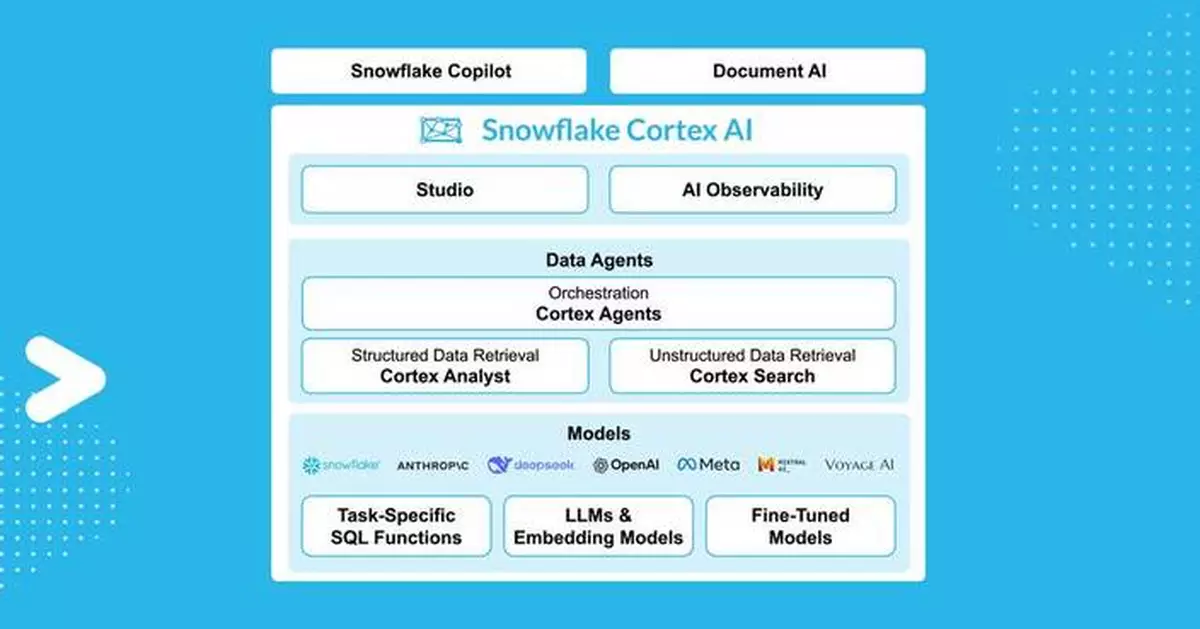
In addition to OpenAI’s models, Snowflake offers various models from leading providers including Anthropic, DeepSeek, Meta, Mistral, and more, alongside Snowflake’s Arctic open source language and embedding models. Snowflake is committed to making the top-performing models seamlessly accessible to users within Cortex AI, allowing customers the choice and flexibility to select the best model for their specific use case.
Snowflake Brings Data Agents to Microsoft 365 Copilot and Microsoft Teams
Through this expanded partnership, Snowflake is collaborating with Microsoft to make Snowflake Cortex Agents available for end users in Microsoft 365 Copilot and Microsoft Teams (anticipated general availability in June 2025). Powered by Cortex AI, Cortex Agents will allow Microsoft’s enterprise customers to interact with their structured and unstructured Snowflake data in natural language directly from within Microsoft apps — streamlining their ability to ask questions and get insights from the core Microsoft tools they use every day. With this integration, AI-driven insights become more accessible for users at every skill level, improving productivity and helping fuel better decision-making across the enterprise. Additionally, developers can also leverage these Snowflake features through convenient REST APIs to customize and build secure natural language interfaces between Microsoft 365 apps and their data in Snowflake. Leading data and engineering teams will be able to leverage Cortex AI through Microsoft Copilot to accelerate business insights.
Learn More:
Forward Looking Statements
This press release contains express and implied forward-looking statements, including statements regarding (i) Snowflake’s business strategy, (ii) Snowflake’s products, services, and technology offerings, including those that are under development or not generally available, (iii) market growth, trends, and competitive considerations, (iv) the integration, interoperability, and availability of Snowflake’s products with and on third-party platforms, and (v) the proposed strategic partnership with Microsoft. These forward-looking statements are subject to a number of risks, uncertainties and assumptions, including (i) risks related to unforeseen technical, operational, or business challenges impacting the timing, scope, or success of our strategic partnerships and (ii) the risks described under the heading “Risk Factors” and elsewhere in the Quarterly Reports on Form 10-Q and the Annual Reports on Form 10-K that Snowflake files with the Securities and Exchange Commission. In light of these risks, uncertainties, and assumptions, actual results could differ materially and adversely from those anticipated or implied in the forward-looking statements. As a result, you should not rely on any forward-looking statements as predictions of future events.
© 2025 Snowflake Inc. All rights reserved. Snowflake, the Snowflake logo, and all other Snowflake product, feature and service names mentioned herein are registered trademarks or trademarks of Snowflake Inc. in the United States and other countries. All other brand names or logos mentioned or used herein are for identification purposes only and may be the trademarks of their respective holder(s). Snowflake may not be associated with, or be sponsored or endorsed by, any such holder(s).
About Snowflake
Snowflake makes enterprise AI easy, efficient and trusted. More than 11,000 companies around the globe, including hundreds of the world’s largest, use Snowflake’s AI Data Cloud to share data, build applications, and power their business with AI. The era of enterprise AI is here. Learn more at snowflake.com (NYSE: SNOW).
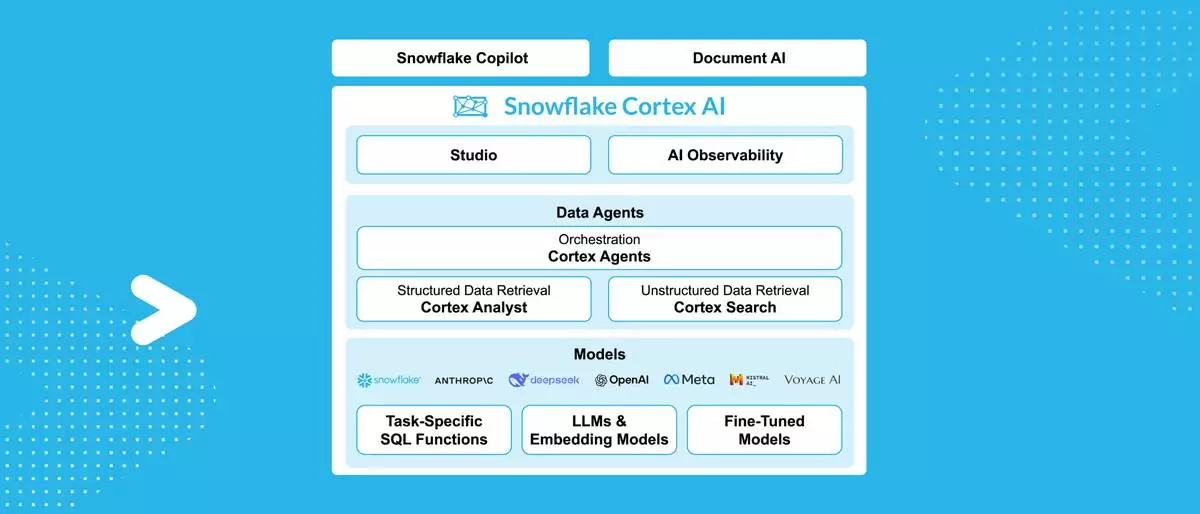
Snowflake Securely Integrates Microsoft Azure OpenAI Service to Provide Access to the Latest OpenAI Models with Expanded Microsoft Partnership (Graphic: Business Wire)