A new report reveals that China's logistics costs relative to GDP reached a record low in 2024 to 14.1 percent, driven by infrastructure improvements, technological innovation, and optimized transport structures.
The report, released by China Federation of Logistics and Purchasing (CFLP) on Thursday, shows that the logistics costs reduced last year exceeded 400 billion yuan (about 55.1 billion U.S. dollars) and the ratio of social logistics costs to GDP fell by 0.3 percentage points compared to 2023, reflecting improved efficiency.
According to the report, China's logistics infrastructure has seen continuous improvement, providing a solid foundation for expanding transportation scale, enhancing efficiency, and developing multimodal transport.
For example, the newly launched foreign trade services at Jiujiang Hongguang Port in east China's Jiangxi Province have significantly shortened the export process for local businesses. Companies no longer need to first transport their goods to a port 60 kilometers away before shipping them to overseas destinations, but can now process their export shipments directly on their doorstep.
"Hongguang Port is only three kilometers away from our company. We estimate that it is expected to save us nearly 1.5 million yuan in logistics costs annually compared to using other ports," said Wang Man, deputy director of international logistics at Jiangxi Intco Medical Products Co., Ltd.
The rapid development of new productive forces has also driven the adoption of advanced technologies and equipment in the logistics sector, further reducing costs.
In Changzhou City, east China's Jiangsu Province, a manufacturing company introduced intelligent porter robots this year, enabling 24/7 operations that significantly shorten the handling time and improve warehouse throughput. As a result, logistics and storage costs will possibly be cut by up to 80 percent while the delivery efficiency doubles.
Zhou Zhicheng, director of the CFLP's Research Office, noted that while China has made strides in reducing logistics costs, further improvements are still needed. He called for greater integration and innovation between logistics and industrial enterprises, optimizing processes, sharing facilities, and improving information sharing to achieve cost reductions across the entire supply chain.
"Reducing logistics costs is not just about lowering freight rates, but improving quality and efficiency through process optimization, organizational adjustments, and resource integration to bring down the entire supply chain's logistics costs," Zhou said.
The report also notes that China's transportation structure continues to optimize, with a shift from road to water and rail transport, as well as the growth of multimodal transport. In 2024, the share of road freight turnover decreased by 0.6 percentage points compared to 2023, while air and water transport saw increases of 0.2 and 1.5 percentage points, respectively.
Additionally, data-sharing mechanisms between major ports and railway yards have been established, improving infrastructure connectivity. By the end of 2024, over 90 percent of coastal ports and major ports along the Yangtze River had achieved rail access. Container rail-water transport volume grew by approximately 15 percent year on year, and the share of multimodal and agent transport increased by 0.3 percentage points.
"For different types of cargo, different transport methods should be adopted based on distance, timeliness, and requirements. In this way we can enhance overall social efficiency and further reduce logistics costs," Zhou noted.
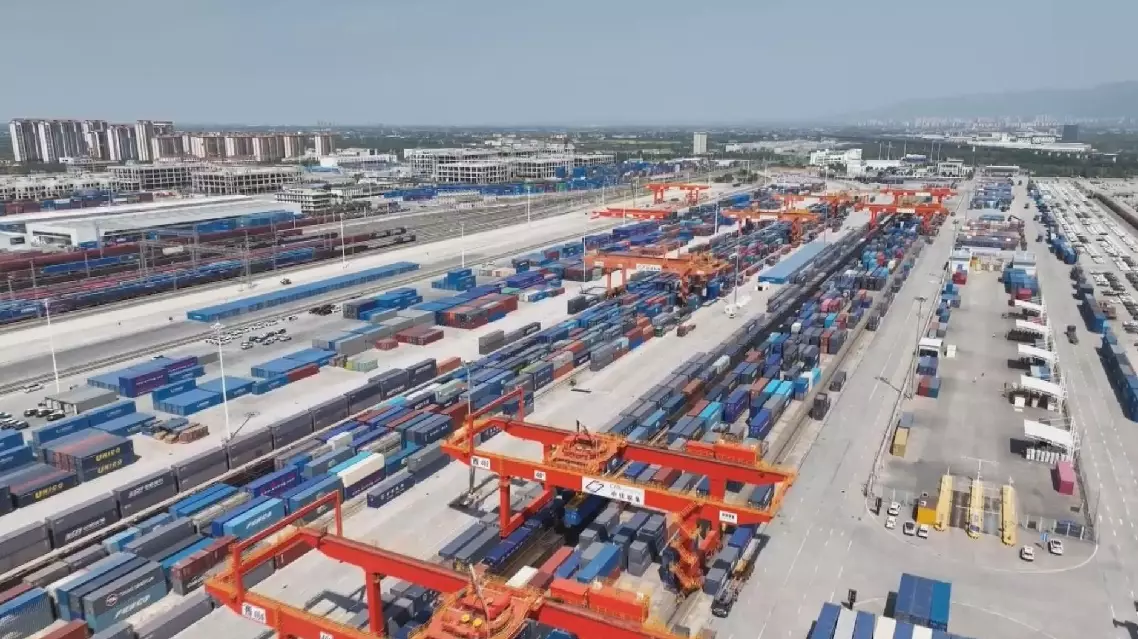
Logistics sector sees big cost savings as China optimizes transport structure