BASANKUSU, Congo (AP) — Hundreds of people have tested positive for malaria in northwest Congo as health officials try to understand what may be behind a surge of illnesses that has surpassed 1,000 cases and killed at least 60 people.
The World Health Organization said that while malaria — a mosquito-borne disease — is prevalent in Congo's Equateur province, it has not yet ruled out other causes. It is unclear if the outbreaks are related, the U.N. health agency said in an update Thursday.
“Detailed epidemiological and clinical investigations, as well as further laboratory testing, are (still) needed,” WHO's Africa office said.
It said nearly 1,100 cases have been reported since the first outbreaks were discovered in two villages more than 100 miles apart in late January.
Africa’s top public health agency said infections have been detected in at five villages and that the agency is investigating whether water or food could be the cause of the infections, along with flu and typhoid.
However, tests are “pointing toward malaria,” Dr. Ngashi Ngongo of the Africa Centers for Disease Control and Prevention said in an online briefing Thursday.
The first outbreak was detected in the village of Boloko after three children ate a bat and died within 48 hours. WHO has recorded 12 cases and eight deaths in Boloko. Nearly half of the people who died did so within hours of the onset of symptoms, health officials said this week.
The village of Bomate, which is around 200 kilometers (125 miles) from Boloko, has been hardest hit: 98% of the cases and 86% of deaths have been recorded in Bomate in the Basankusu health zone, WHO said. Of 571 patients in Basankusu who were tested for malaria, 309 — 54.1% — tested positive, it said.
Patients have shown common malaria symptoms such as fever and body aches. Other symptoms include chills, sweating, stiff neck, runny or bleeding nose, cough, vomiting and diarrhea.
Eddy Djoboke said he and his family fled Bomate because they were afraid of falling sick. After they left, one of his children complained his neck and stomach hurt, suggesting he may have been infected before they fled.
“We were asked to have tests done and we are waiting for what happens next," Djoboke said.
Marthe Biyombe, said her child became infected in Bomate and was suffering from body aches and fever. She said the hospital struggled to treat her child because of a lack of medication, but that she was able to buy drugs privately and WHO doctors eventually arrived with more supplies.
“When we arrived at the hospital, we went two weeks without medicine. There were no medicines and we bought the medicines elsewhere (before) the WHO doctors came and started giving us the medicines,” Biyombe said. She did not describe the drugs given to her child.
Experts say access to the sick has been hindered by the remote locations of the affected villages and that several people died before medical teams were able to reach them.
Asadu reported from Abuja. Associated Press journalist Rodney Muhumuza in Kampala, Uganda contributed.
For more on Africa and development: https://apnews.com/hub/africa-pulse
The Associated Press receives financial support for global health and development coverage in Africa from the Gates Foundation. The AP is solely responsible for all content. Find AP’s standards for working with philanthropies, a list of supporters and funded coverage areas at AP.org.

Men sit outside the general hospital in Basankusu, Democratic Republic of the Congo, where some victims of unidentified illnesses are being treated, Thursday, Feb. 27, 2025. (AP Photo/Guy Masele Sanganga)
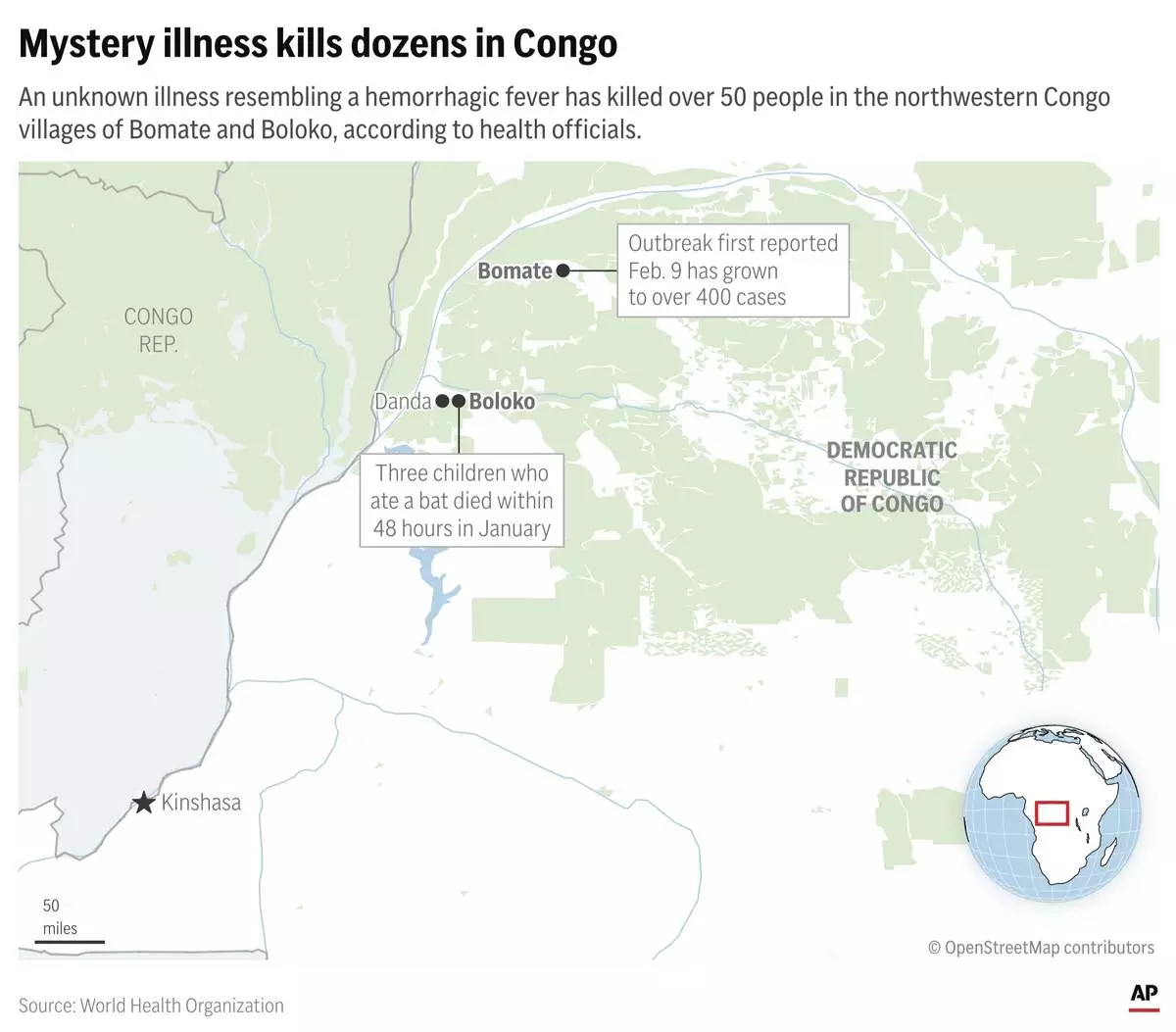
A hemorrhagic fever outbreak in the Democratic Republic of Congo has left more than 50 people dead. (AP Graphic)
DURHAM, N.C.--(BUSINESS WIRE)--Sep 14, 2026--
Jaggaer, a leader in AI-powered procurement solutions, today announced it has completed its acquisition of Ivoflow, a spend & price intelligence platform for direct materials, based in Koblenz, Germany. The transaction closed on September 11, 2026.
This press release features multimedia. View the full release here: https://www.businesswire.com/news/home/20260913930858/en/
The acquisition advances Jaggaer’s strategy to build the industry’s most intelligent procurement platform. For customers, the combination will address one of procurement’s most persistent challenges: organizations have more data than ever before, but converting that data into measurable savings and margin improvement remains a challenge.
The addition of Ivoflow enables Jaggaer to provide true spenddecision intelligence.
The outcome: rather than simply answering questions about historical spend, the combined capabilities help procurement teams make better decisions.
What each company does
Jaggaer's software helps large organizations manage the entire procurement process, from selecting suppliers, to negotiating contracts, to paying invoices. Its customers include manufacturers, universities, hospitals, and government agencies.
Ivoflow, founded in 2020, focuses on a narrower but critical problem for manufacturers: knowing whether the price you're paying for a part is in line with the market. Its software pulls together a company's purchasing records, often scattered across different systems and hard to compare, and lines them up against outside market data such as raw material costs and currency movements.
Closing a gap that costs manufacturers real money
Direct materials (the raw materials, parts, and components that go directly into what a manufacturer builds) typically represent 50% to 70% of cost of goods sold for complex manufacturers. Yet fewer than 2% of manufacturers operate with a purpose-built spend & price intelligence capability for this category. Most are still comparing supplier prices by hand in spreadsheets, with no reliable way to know whether what they're paying is fair as markets move.
Ivoflow closes that gap. Its platform connects a manufacturer's ERP and procurement data with live market inputs: commodity indices, currency movements, and cost data. It recalculates, at the individual part level, what each part should cost as conditions change. That insight enables buyers to negotiate better contracts.
Ivoflow customers like Georg Fischer, Sumitomo, Grammer, TI Automotive and ZF Lifetec use the platform for full spend visibility, faster negotiations, and more defensible pricing decisions.
Why the two companies are stronger together
Jaggaer and Ivoflow solve two halves of the same problem. Jaggaer helps organizations run the buying process end to end, selecting suppliers, negotiating, sourcing, and paying invoices. Ivoflow helps them know whether the price on the table is a fair one. Together:
Where AI comes in
Manufacturers routinely receive requests from suppliers to raise prices, citing higher costs for steel, plastic, or other raw materials. Checking whether each request is actually justified takes a lot of manual work, so many get approved without a real check, and unjustified increases quietly eat into a company's profit.
Ivoflow's software uses AI to automate that check. It reads a supplier's price-increase request, breaks down what's actually driving the cost (raw materials, currency, labor), compares that against real market data, and tells the buyer how much of the requested increase is justified and how much is not. As an example, a supplier's requested 6% price increase held up to only 1.3%, once checked against actual cost drivers. The same approach also scans a company's full spend on its own, flagging categories where prices have already drifted out of step with the market before a supplier even asks for an increase.
Investing in growth
Jaggaer intends to invest in the Ivoflow team, product, and roadmap, including expanding its AI-driven capabilities, such as scenario modelling, savings-probability generation, and proactive procurement guidance. Ivoflow's co-founders, Daniel Demuth and Nicolas Neubauer, will continue to lead the Ivoflow team, which joined Jaggaer as part of the transaction.
“Ivoflow will enable buyers to manage more of their direct materials within a single platform, bringing powerful market and cost intelligence into supplier negotiations. This means more transparent, fact-based conversations with suppliers, stronger partnerships, and better commercial outcomes. We see real opportunity to invest in the team, expand the platform, and accelerate what we can deliver together,” said Andrew Roszko, Chief Executive Officer of Jaggaer.
“We built Ivoflow to help manufacturing companies become leaders in cost excellence and drive profitability. Joining Jaggaer gives us the reach and platform to bring that capability to many more customers and accelerate what we set out to build. We are very much looking forward to what lies ahead and to becoming part of the Jaggaer team,” said Nicolas Neubauer, Co-Founder of Ivoflow.
“Jaggaer gives us the opportunity to help shape the future of how manufacturing enterprises manage their spend and identify savings. By combining Ivoflow’s capabilities with Jaggaer’s team, reach and platform, we can accelerate our roadmap, expand our AI capabilities, and build toward becoming the leading provider of spend and price intelligence for manufacturers globally,” said Daniel Demuth, Co-Founder of Ivoflow.
About Jaggaer
Jaggaer has been building procurement software since 1995. Its platform helps organizations manage the full lifecycle of buying, from selecting suppliers through paying invoices, and serves customers including several Fortune 500 companies, universities, hospitals, and government agencies.
About Ivoflow
Founded in 2020 and based in Koblenz, Germany, by co-founders Daniel Demuth and Nicolas Neubauer, Ivoflow is a direct materials spend and price intelligence platform built by a team with deep procurement industry experience. The two met roughly a decade ago while working together at a major automotive supplier ZF Friedrichshafen. Ivoflow serves 17 enterprise manufacturing customers, with €77.6M in savings tracked under management. The platform has been recognized in the ProcureTech 100 (2023, 2024, and 2025/26, Analytics, Data & Intelligence category), named to SpendMatters' “Future 5,” validated on SpendMatters' SolutionMap for Spend Analytics, awarded The Hackett Group's 2026 Customer Value recognition in that category, and awarded the BSFZ seal for innovation competence in 2025.

Daniel Demuth and Nicolas Neubauer