Artificial intelligence (AI) is becoming increasingly prevalent in primary and secondary school classrooms across China, providing a modern approach to education while fostering scientific thinking and innovative skills among students.
In 2024, China's Ministry of Education issued a major policy promoting AI education in primary and secondary school classrooms. The goal is to achieve full coverage of AI educational courses by 2030.
The requirements are very clear. Primary school students will focus on experiencing AI, while high school students will develop skills that can be applied to AI projects.
The importance of AI education comes as no surprise, and cultivating interest is the first step. From robots to programing courses on AI, experts say a future-oriented education revolution is now unfolding.
At a school in Chengdu, the capital city of southwest China's Sichuan Province, when Generation Z encounters an AI humanoid robot, the future of education is redefined. These primary and high school students are full of curiosity about AI and humanoid robots.
"We can now see the future very clearly. For example, 10 or 20 years from now, just like these primary and high school students, they will definitely face the world of artificial intelligence after they start working. The future determines they must learn artificial intelligence from now on," said Feng Zhenyu, CEO of Sichuan Embodied Intelligent Robot Technology.
How to use AI programming to build small robots has become a compulsory course in some primary schools.
"We are earnestly promoting the strategic action of digital education and carrying out a series of application scenarios such as moral education, teaching, sports, aesthetic and scientific education enabled by AI," said Tang Min, deputy director of the Chengdu Education Bureau.
Wang Zhiyong, Communist Party secretary at the Experimental Middle School of University of Electronic Science and Technology of China, said he believes China is focused on promoting scientific education, introducing advanced concepts and educational methods from universities into basic education, and better cultivating innovative talents.
"We have opened an elective course called Mathematical Modeling and AI. The course is mainly taught by university teachers. The foundation of artificial intelligence is mathematics. We will introduce the basic projects of the university into the course. We encourage our students to participate in the national mathematical modeling contest for college students, the American mathematical modeling contest for college students, the informatics contest, the robotics contest and so on," Wang said.
Experts say strengthening mathematical knowledge in basic education and future industrial applications, while combining mathematics with AI, will help students face the challenges of the AI era.
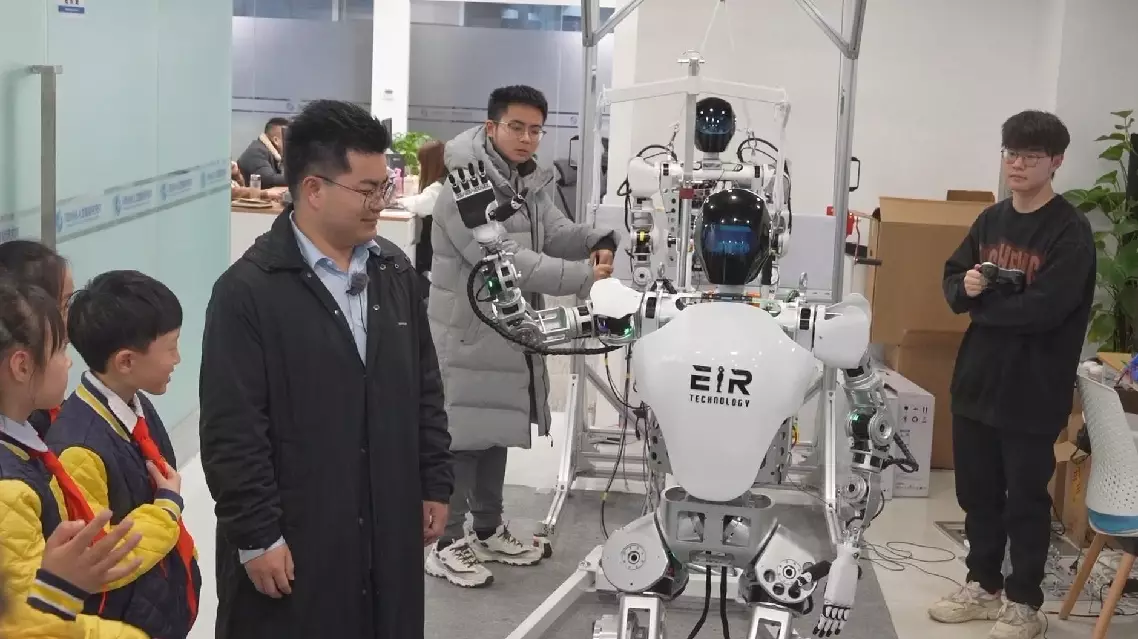
China transforms education through introduction of AI courses
China transforms education through introduction of AI courses