The Intergovernmental Panel on Climate Change (IPCC) on Sunday unveiled the outcomes of its 62nd plenary session which was held in Hangzhou of east China's Zhejiang Province under the theme "Climate Science: Insights and Future Directions."
The five-day session concluded on Friday after gathering representatives from over 130 IPCC member countries, relevant observer organizations and international organizations. It addressed critical aspects of climate change, including the physical science basis, impacts, adaptation, vulnerability, and discussed possible mitigation strategies.
The meeting also sought to reach agreement on the outlines of the three working group contributions to the "Seventh Assessment Report" and the "Methodology Report on Carbon Dioxide Removal Technologies, Carbon Capture Utilization and Storage."
Founded back in 1988, the IPCC, a UN body that brings together the collective efforts and contributions of scientists worldwide, is currently in the middle of its seventh assessment cycle, a period which formally began in July 2023. During its past six cycles, it has published a total of 43 assessment reports on climate change.
IPCC chair Jim Skea stressed that much of the focus in this current cycle is now on how best to adapt to the ongoing challenges brought by climate change.
"Our reports are comprehensive. We cover almost everything. It's very much dominated by the question of adaptation to the effects of climate change that we are already experiencing. So I think the work on adaptation, including work that we are doing at the invitation of the UN Framework Convention on Climate Change (UNFCCC), on indicators and metrics for adaptation activity, is going to be one of the highlights of the (climate change assessment) cycle," Skea said in an interview with China Central Television (CCTV) on Saturday.
During the session in Hangzhou, China's practical experience in developing early warning mechanisms and enhancing related capacities was highlighted as a model for global efforts.
Chao Qingchen, director of the National Climate Center under the China Meteorological Administration, said China has been working hard on developing strong early warning systems to protect its population against hazardous weather and climate events, and hopes to share its experience and practices with other countries in this regard.
"We know that climate change has brought many extreme weather and climate events. In 2022, the UN Secretary-General [Antonio Guterres] proposed the 'Early Warnings for All' initiative. In response, the China Meteorological Administration has constantly advanced scientific methods for early warnings, improved monitoring, and addressed the 'last mile' challenge, playing a vital role in global efforts," she said.
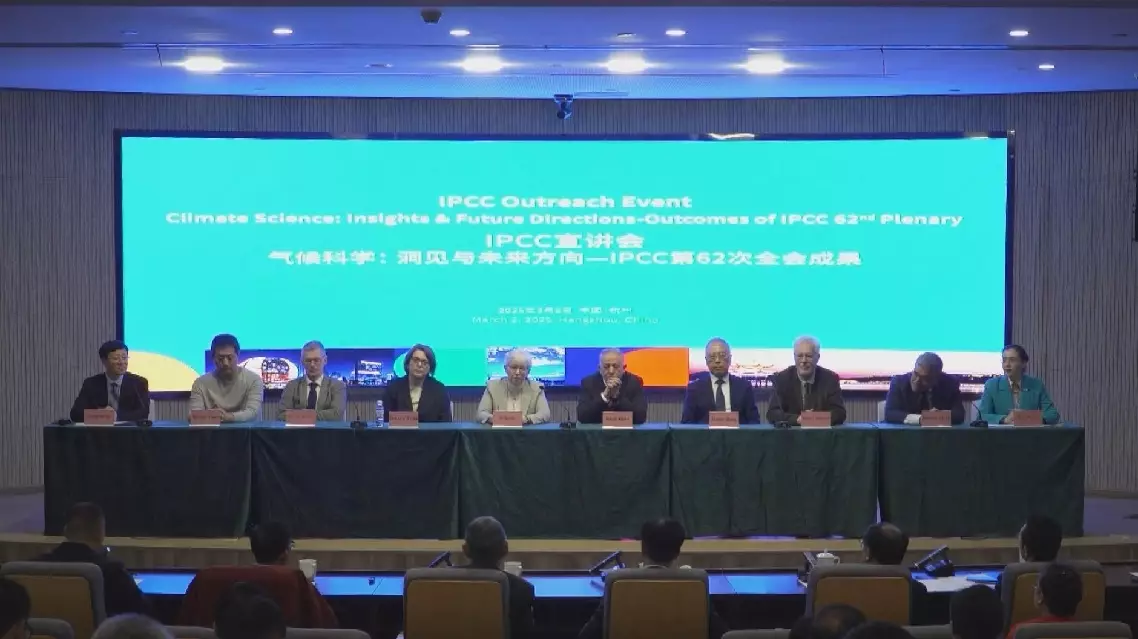
IPCC's 62nd Plenary Session highlights adaption to climate change, early warning systems