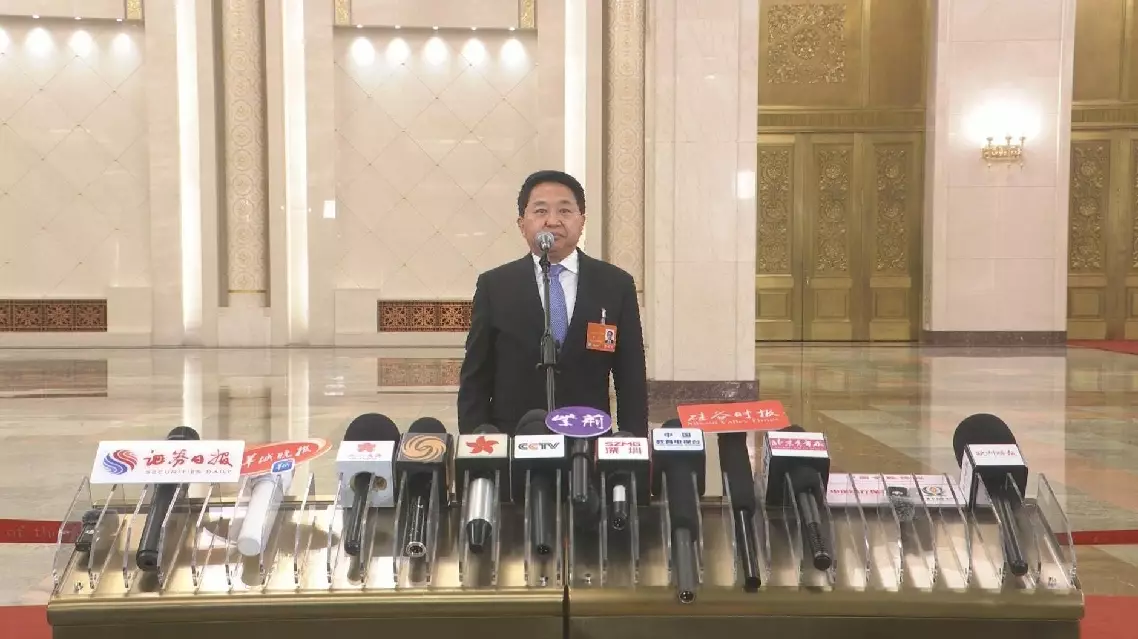
China will implement stringent oversight of digital platforms, as part of a broader effort to ensure fair competition and protect the legitimate rights of both consumers and businesses, said Luo Wen, head of the State Administration for Market Regulation.
Speaking to the press after the opening meeting of the third session of the 14th National People's Congress (NPC) at the Great Hall of the People in Beijing on Wednesday, Luo said that the Chinese ministerial-level agency aims to implemented targeted measures to resolve the difficulties in ensuring a healthier market environment.
"This year, efforts will be made to optimize the regulatory approaches and methods, and vigorously promote the healthy development of the platform economy," he stressed.
"Regarding platform regulations, we will uphold the principles of transparency and equality to foster a mutually beneficial environment for all stakeholders. To address the significant issue of platforms abusing the 'refund-only' policy - causing merchants to lose both goods and payments - we will mandate that platforms clearly define the scope and specific circumstances for rule application, thereby safeguarding the legitimate rights and interests of merchants. Concerning platform fees, we will require that platforms simplify and publicly disclose their fee-based services, optimize pricing mechanisms, ensure merchants' right to information, and help merchants lower operational costs while enhancing efficiency," Luo said.
In response to the rat race competition due to the platforms' practice of automatic price matching and offering rock bottom price, the administration will urge the platforms to regulate their promotional practices and safeguard merchants' rights to independent operation, he added.
"In terms of live-streaming e-commerce, we will enforce platform accountability for content review, intensify targeted inspections of product quality, strengthen regulatory enforcement, and rigorously combat false advertising and misleading promotions. With respect to platform algorithms, market regulatory authorities will collaborate closely with relevant departments to enhance comprehensive governance, promote greater algorithmic transparency, and refine algorithmic rules," he continued.
China to optimize regulations on digital platforms

China will strengthen fiscal and financial coordination to amplify policy effectiveness, experts said as the draft central and local budgets for 2026 were unveiled on Friday at the ongoing fourth session of the 14th National People's Congress.
According to the draft central and local budgets for 2026, 1.3 trillion yuan (190 billion U.S. dollars) of ultra-long special treasury bonds will be issued to provide continued support for the implementation of major national strategies and security capacity-building in key areas and for large-scale equipment upgrades and consumer goods trade-in programs.
Ultra-long special treasury bonds totaling 800 billion yuan will be allocated to support the implementation of major national strategies and security capacity-building in key areas, and 250 billion yuan in ultra-long special treasury bonds will be earmarked for consumer goods trade-in programs.
The country will refine these programs in terms of their scope and subsidy standards, and continue to support the scrapping and replacement of automobiles, home appliance trade-in schemes, and purchases of new digital and smart products.
China will also set up a 100-billion-yuan fiscal-financial coordination fund to boost domestic demand. The fund will support consumption and private investment through loan interest subsidies, financing guarantee, and risk compensation.
"Fiscal and monetary policies are the two major macroeconomic tools for macro-control, and their coordination is crucial. For instance, fiscal funds primarily serve as a guiding role, while financial institutions provide the capital. When fiscal guidance and financial resources are combined, the synergistic effect creates a result greater than the sum of its parts," said Yang Zhiyong, director of the Chinese Academy of Fiscal Sciences.
"By leveraging interest subsidies, we can mobilize substantial credit from financial institutions, thereby naturally stimulating consumption. The Ministry of Finance, in collaboration with the People's Bank of China, has introduced highly innovative measures, such as providing guarantees for the issuance of corporate bonds by small and medium-sized enterprises (SMEs), and compensating investors for losses. I believe the leveraging effect, making minimal efforts for maximum results, will become even more potent," said Yao Dongmin, director of the Center for China Fiscal Development under the Central University of Finance and Economics.
China's top legislature opened its annual session on Thursday morning at the Great Hall of the People in Beijing, with Chinese President Xi Jinping and other Party and state leaders attending the opening meeting alongside more than 2,700 NPC deputies. This year's NPC session is scheduled to run till March 12.
China to strengthen fiscal, financial coordination to amplify policy effectiveness: experts